Bergman Annika, Abel Frida, Behboudi Afrouz, Yhr Maria, Mattsson Jan, Svensson Jan H, Karlsson Per, Nordling Margareta
Department of Medical and Clinical genetics, Sahlgrenska Academy, Gothenburg, Sweden.
BMC Med Genet. 2008 Dec 13;9:108. doi: 10.1186/1471-2350-9-108.
The scaffold attachment factor B1 and B2 genes, SAFB1/SAFB2 (both located on chromosome 19p13.3) have recently been suggested as tumour suppressor genes involved in breast cancer development. The assumption was based on functional properties of the two genes and loss of heterozygosity of intragenic markers in breast tumours further strengthened the postulated hypothesis. In addition, linkage studies in Swedish breast cancer families also indicate the presence of a susceptibility gene for breast cancer at the 19p locus. Somatic mutations in SAFB1/SAFB2 have been detected in breast tumours, but to our knowledge no studies on germline mutations have been reported. In this study we investigated the possible involvement of SAFB1/SAFB2 on familiar breast cancer by inherited mutations in either of the two genes.
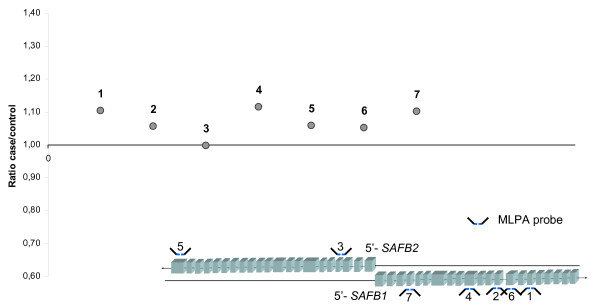
Mutation analysis in families showing linkage to the SAFB1/2 locus was performed by DNA sequencing. The complete coding sequence of the two genes SAFB1 and SAFB2 was analyzed in germline DNA from 31 affected women. No missense or frameshift mutations were detected. One polymorphism was found in SAFB1 and eight polymorphisms were detected in SAFB2. MLPA-anlysis showed that both alleles of the two genes were preserved which excludes gene inactivation by large deletions.
SAFB1 and SAFB2 are not likely to be causative of the hereditary breast cancer syndrome in west Swedish breast cancer families.
支架附着因子B1和B2基因,即SAFB1/SAFB2(均位于19号染色体p13.3),最近被认为是参与乳腺癌发生发展的肿瘤抑制基因。这一假设基于这两个基因的功能特性,而乳腺肿瘤中基因内标记杂合性的缺失进一步强化了这一假设。此外,瑞典乳腺癌家族的连锁研究也表明在19p位点存在乳腺癌易感基因。在乳腺肿瘤中已检测到SAFB1/SAFB2的体细胞突变,但据我们所知,尚未有关于种系突变的研究报道。在本研究中,我们通过这两个基因中任何一个的遗传突变来调查SAFB1/SAFB2在家族性乳腺癌中的可能作用。
通过DNA测序对与SAFB1/2位点连锁的家族进行突变分析。对31名患病女性的种系DNA分析了SAFB1和SAFB2这两个基因的完整编码序列。未检测到错义或移码突变。在SAFB1中发现一个多态性,在SAFB2中检测到八个多态性。MLPA分析表明这两个基因的两个等位基因均得以保留,排除了因大片段缺失导致的基因失活。
在瑞典西部乳腺癌家族中,SAFB1和SAFB2不太可能是遗传性乳腺癌综合征的病因。