Wu Lin, Guo Donglin, Li Hong, Hackett James, Yan Gan-Xin, Jiao Zhen, Antzelevitch Charles, Shryock John C, Belardinelli Luiz
Pharmacological Sciences, CV Therapeutics, Inc., Palo Alto, California 94304, USA.
Heart Rhythm. 2008 Dec;5(12):1726-34. doi: 10.1016/j.hrthm.2008.09.008. Epub 2008 Sep 6.
Quinidine is used to treat atrial fibrillation and ventricular arrhythmias. However, at low concentrations, it can induce torsade de pointes (TdP).
The purpose of this study was to examine the role of late sodium current (I(Na)) as a modulator of the arrhythmogenicity of quinidine in female rabbit isolated hearts and cardiomyocytes.
Epicardial and endocardial monophasic action potentials (MAPs), ECG signals, and ion channel currents were measured. The sea anemone toxin ATX-II was used to increase late I(Na).
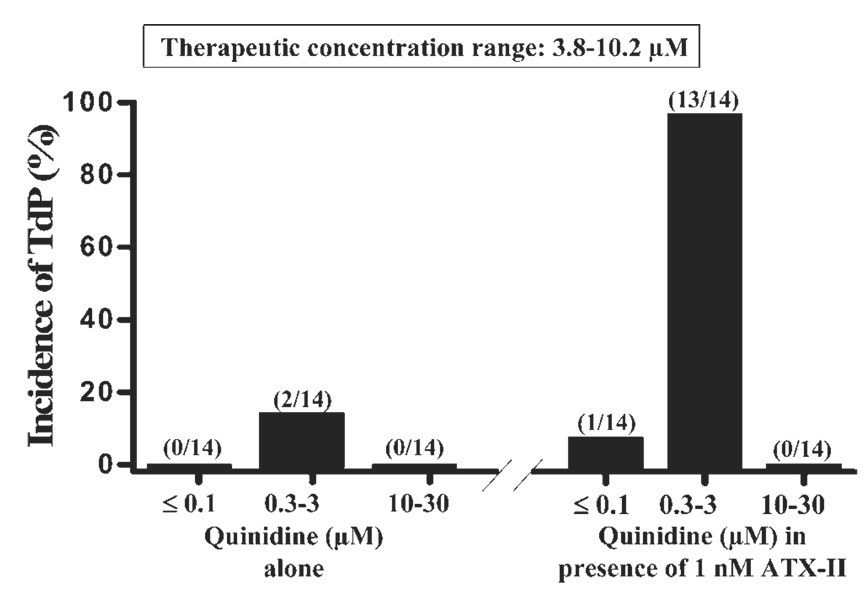
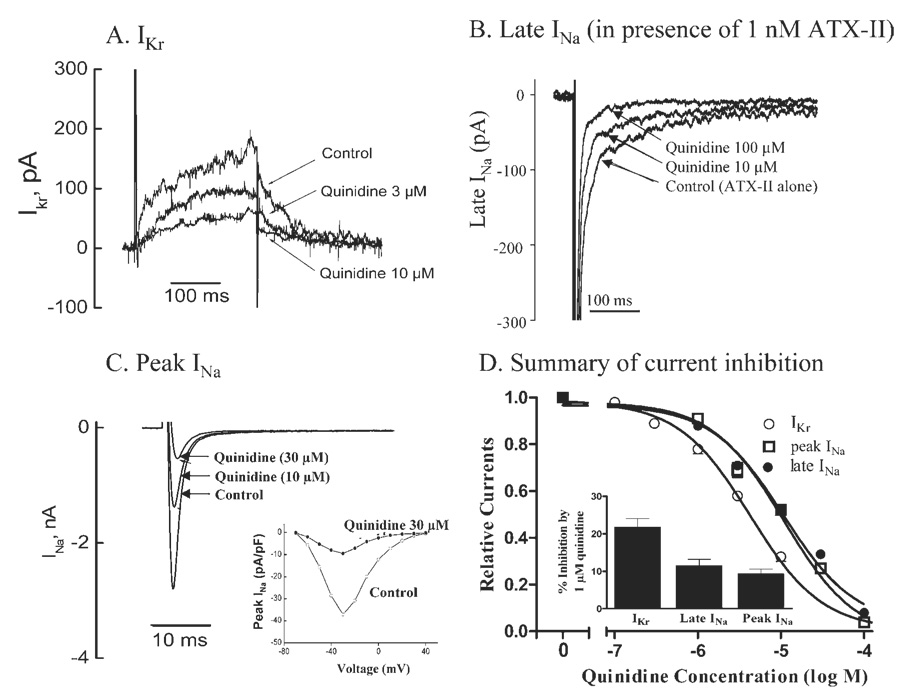
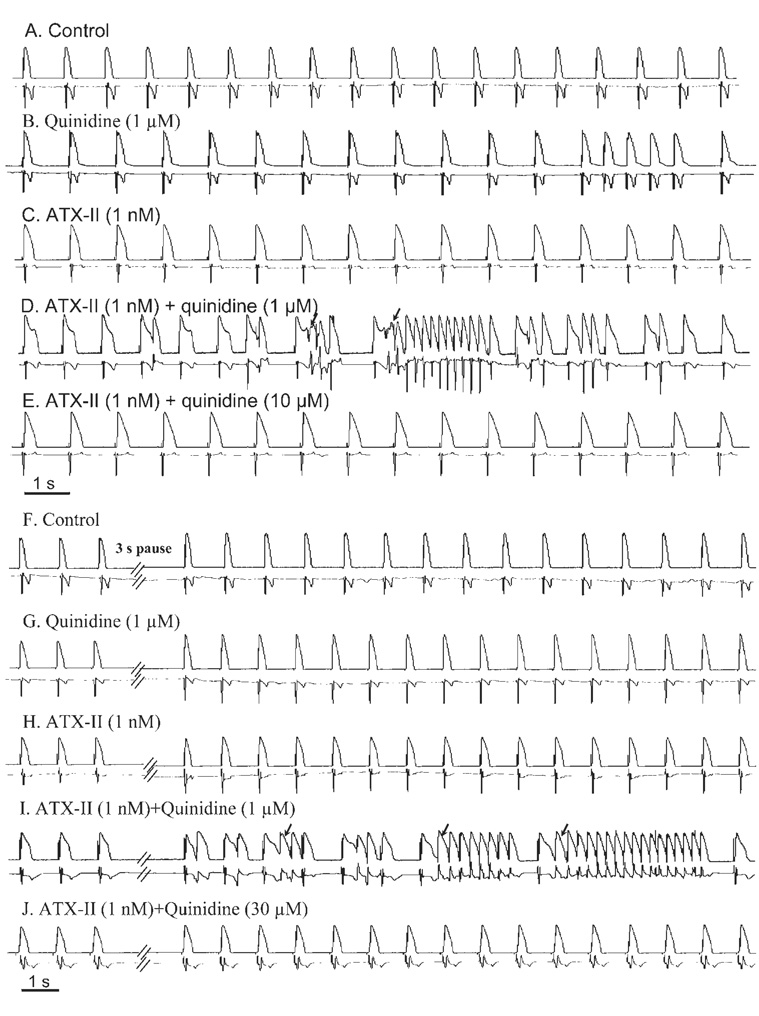
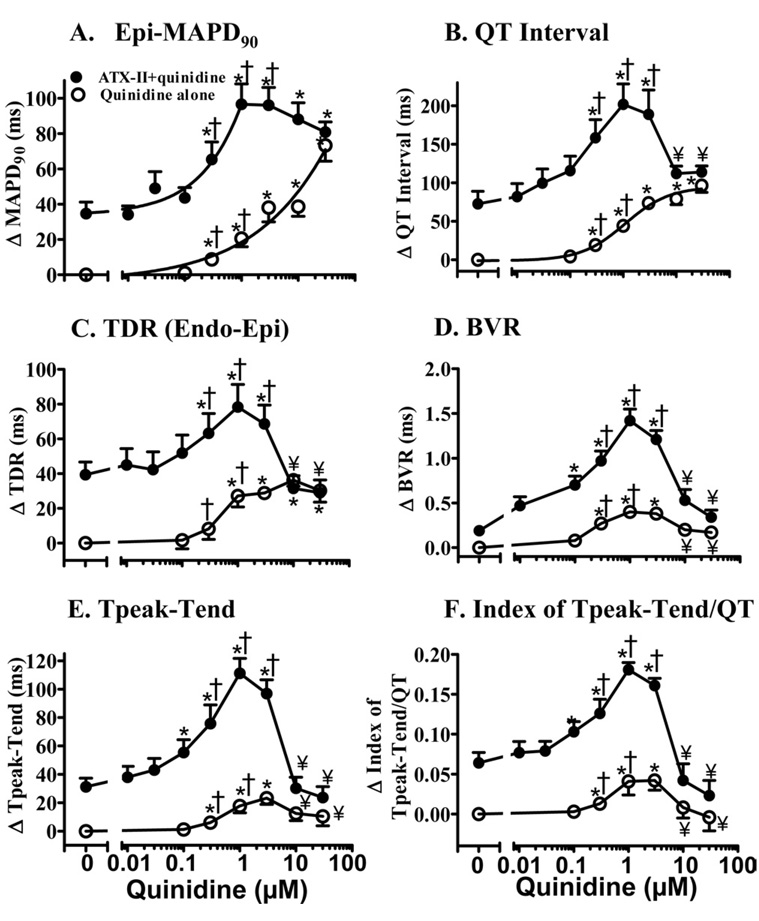
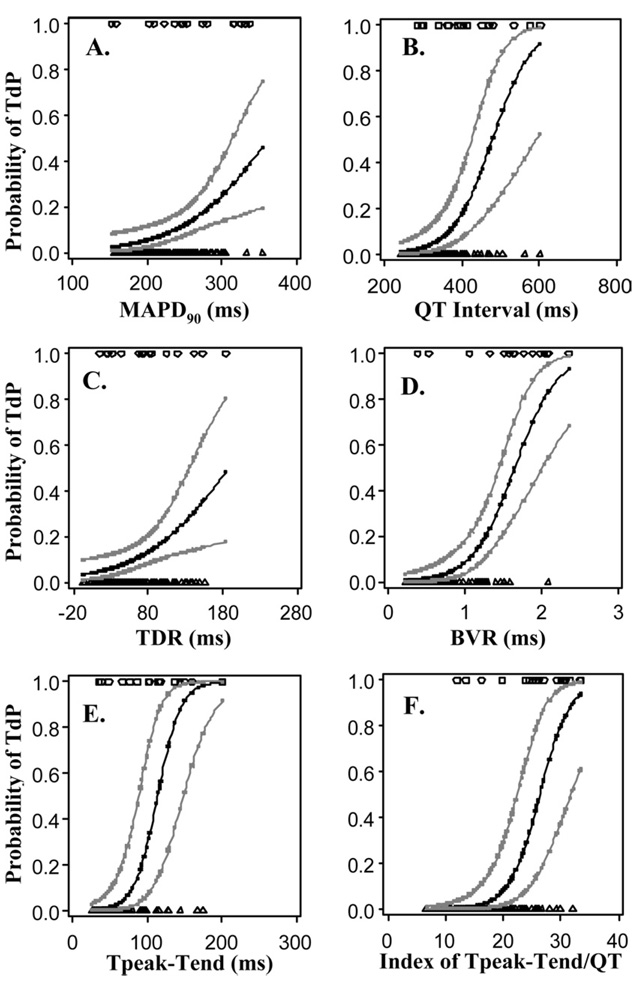
Quinidine had concentration-dependent and often biphasic effects on measures of arrhythmogenicity. Quinidine increased the duration of epicardial MAP (MAPD(90)), QT interval, transmural dispersion of repolarization (TDR), and ventricular effective refractory period. Beat-to-beat variability of MAPD(90) (BVR), the interval from peak to end of the T wave (Tpeak-Tend) and index of Tpeak-Tend/QT interval were greater at 0.1 to 3 micromol/L than at 10-30 micromol/L quinidine. In the presence of 1 nmol/L ATX-II, quinidine caused significantly greater concentration-dependent and biphasic changes of Tpeak-Tend, TDR, BVR, and index of Tpeak-Tend/QT interval. Quinidine (1 micromol/L) induced TdP in 2 and 13 of 14 hearts in the absence and presence of ATX-II, respectively. Increases of BVR, index of Tpeak-Tend/QT interval, and Tpeak-Tend were associated with quinidine-induced TdP. Quinidine inhibited I(Kr), peak I(Na), and late I(Na) with IC(50)s of 4.5 +/- 0.3 micromol/L, 11.0 +/- 0.7 micromol/L, and 12.0 +/- 0.7 micromol/L.
Quinidine had biphasic proarrhythmic effects in the presence of ATX-II, suggesting that late I(Na) is a modulator of the arrhythmogenicity of quinidine. Enhancement of late I(Na) increased proarrhythmia caused by low but not high concentrations of quinidine.
奎尼丁用于治疗心房颤动和室性心律失常。然而,在低浓度时,它可诱发尖端扭转型室性心动过速(TdP)。
本研究旨在探讨晚钠电流(I(Na))作为奎尼丁在雌性兔离体心脏和心肌细胞中致心律失常性调节因子的作用。
测量心外膜和心内膜单相动作电位(MAPs)、心电图信号和离子通道电流。使用海葵毒素ATX-II增加晚I(Na)。
奎尼丁对致心律失常性指标具有浓度依赖性且常呈双相性作用。奎尼丁增加了心外膜MAP持续时间(MAPD(90))、QT间期、复极跨壁离散度(TDR)和心室有效不应期。在0.1至3 μmol/L奎尼丁时,MAPD(90)的逐搏变异性(BVR)、T波峰值至终点的间期(Tpeak-Tend)以及Tpeak-Tend/QT间期指数均大于10 - 30 μmol/L奎尼丁时。在存在1 nmol/L ATX-II的情况下,奎尼丁导致Tpeak-Tend、TDR、BVR和Tpeak-Tend/QT间期指数出现显著更大的浓度依赖性和双相性变化。在不存在和存在ATX-II的情况下,奎尼丁(1 μmol/L)分别在14个心脏中的2个和13个中诱发了TdP。BVR、Tpeak-Tend/QT间期指数和Tpeak-Tend的增加与奎尼丁诱发的TdP相关。奎尼丁抑制I(Kr)、I(Na)峰值和晚I(Na),IC(50)分别为4.5±0.3 μmol/L、11.0±0.7 μmol/L和12.0±0.7 μmol/L。
在存在ATX-II的情况下,奎尼丁具有双相促心律失常作用,提示晚I(Na)是奎尼丁致心律失常性的调节因子。晚I(Na)的增强增加了低浓度而非高浓度奎尼丁引起的促心律失常作用。