Uhrig Markus, Brechlin Peter, Jahn Olaf, Knyazev Yuri, Weninger Annette, Busia Laura, Honarnejad Kamran, Otto Markus, Hartmann Tobias
Center for Molecular Biology of the University of Heidelberg, Heidelberg, Germany.
BMC Med. 2008 Dec 16;6:38. doi: 10.1186/1741-7015-6-38.
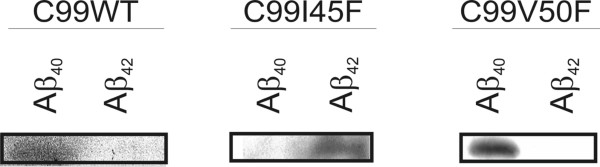
Alzheimer's disease (AD) is characterized by neurodegeneration and changes in cellular processes, including neurogenesis. Proteolytic processing of the amyloid precursor protein (APP) plays a central role in AD. Owing to varying APP processing, several beta-amyloid peptides (Abeta) are generated. In contrast to the form with 40 amino acids (Abeta40), the variant with 42 amino acids (Abeta42) is thought to be the pathogenic form triggering the pathological cascade in AD. While total-Abeta effects have been studied extensively, little is known about specific genome-wide effects triggered by Abeta42 or Abeta40 derived from their direct precursor C99.
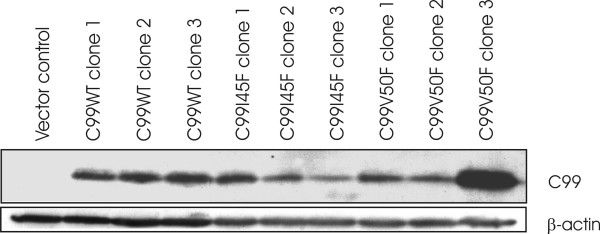
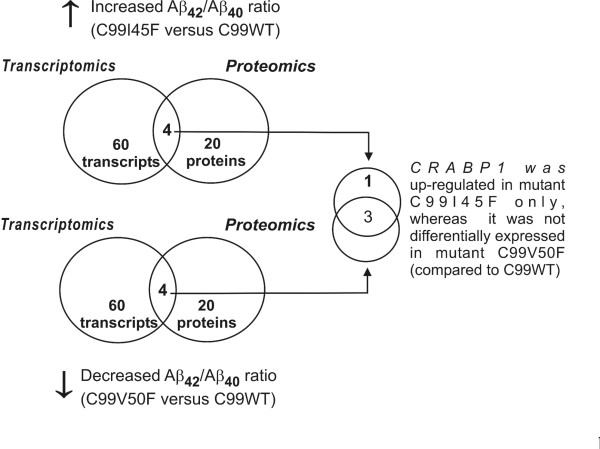
A combined transcriptomics/proteomics analysis was performed to measure the effects of intracellularly generated Abeta peptides in human neuroblastoma cells. Data was validated by real-time polymerase chain reaction (real-time PCR) and a functional validation was carried out using RNA interference.
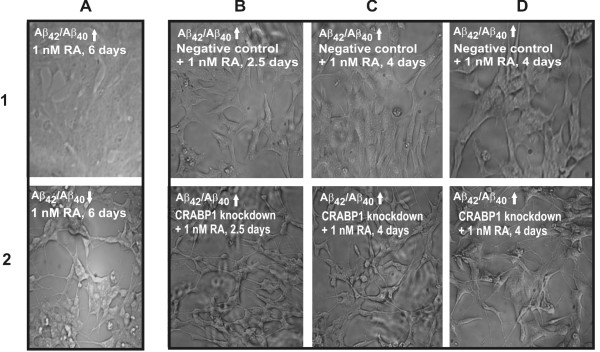
Here we studied the transcriptomic and proteomic responses to increased or decreased Abeta42 and Abeta40 levels generated in human neuroblastoma cells. Genome-wide expression profiles (Affymetrix) and proteomic approaches were combined to analyze the cellular response to the changed Abeta42- and Abeta40-levels. The cells responded to this challenge with significant changes in their expression pattern. We identified several dysregulated genes and proteins, but only the cellular retinoic acid binding protein 1 (CRABP1) was up-regulated exclusively in cells expressing an increased Abeta42/Abeta40 ratio. This consequently reduced all-trans retinoic acid (RA)-induced differentiation, validated by CRABP1 knock down, which led to recovery of the cellular response to RA treatment and cellular sprouting under physiological RA concentrations. Importantly, this effect was specific to the AD typical increase in the Abeta42/Abeta40 ratio, whereas a decreased ratio did not result in up-regulation of CRABP1.
We conclude that increasing the Abeta42/Abeta40 ratio up-regulates CRABP1, which in turn reduces the differentiation potential of the human neuroblastoma cell line SH-SY5Y, but increases cell proliferation. This work might contribute to the better understanding of AD neurogenesis, currently a controversial topic.
阿尔茨海默病(AD)的特征是神经退行性变以及包括神经发生在内的细胞过程发生改变。淀粉样前体蛋白(APP)的蛋白水解加工在AD中起核心作用。由于APP加工方式不同,会产生几种β-淀粉样肽(Aβ)。与含有40个氨基酸的形式(Aβ40)相比,含有42个氨基酸的变体(Aβ42)被认为是引发AD病理级联反应的致病形式。虽然对总Aβ的作用进行了广泛研究,但对于由其直接前体C99衍生的Aβ42或Aβ40引发的特定全基因组效应知之甚少。
进行了转录组学/蛋白质组学联合分析,以测量人神经母细胞瘤细胞内产生的Aβ肽的作用。数据通过实时聚合酶链反应(实时PCR)进行验证,并使用RNA干扰进行功能验证。
在此,我们研究了人神经母细胞瘤细胞中Aβ42和Aβ40水平升高或降低时的转录组学和蛋白质组学反应。将全基因组表达谱(Affymetrix)和蛋白质组学方法相结合,以分析细胞对Aβ42和Aβ40水平变化的反应。细胞对这一挑战的反应是其表达模式发生显著变化。我们鉴定出了几个失调的基因和蛋白质,但只有细胞视黄酸结合蛋白1(CRABP1)仅在表达升高的Aβ42/Aβ40比值的细胞中上调。通过敲低CRABP1验证,这进而降低了全反式视黄酸(RA)诱导的分化,导致细胞对RA处理的反应以及在生理RA浓度下的细胞发芽恢复。重要的是,这种效应是AD中典型的Aβ42/Aβ40比值增加所特有的,而比值降低不会导致CRABP1上调。
我们得出结论,增加Aβ42/Aβ40比值会上调CRABP1,这反过来会降低人神经母细胞瘤细胞系SH-SY5Y的分化潜能,但会增加细胞增殖。这项工作可能有助于更好地理解AD神经发生,这是目前一个有争议的话题。