Mizuno Yumi, Kurochkin Igor V, Herberth Marlis, Okazaki Yasushi, Schönbach Christian
Division of Functional Genomics and Systems Medicine, Research Center for Genomic Medicine, Saitama Medical University, Hidaka, Saitama 350-1241, Japan.
BMC Bioinformatics. 2008 Dec 12;9 Suppl 12(Suppl 12):S16. doi: 10.1186/1471-2105-9-S12-S16.
The import of most intraperoxisomal proteins is mediated by peroxisome targeting signals at their C-termini (PTS1) or N-terminal regions (PTS2). Both signals have been integrated in subcellular location prediction programs. However their present performance, particularly of PTS2-targeting did not seem fitting for large-scale screening of sequences.
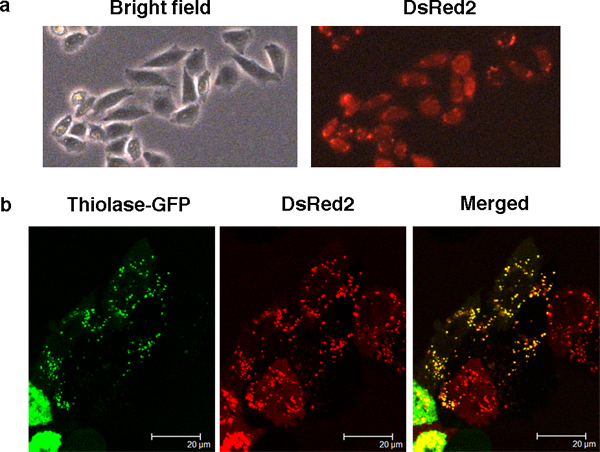
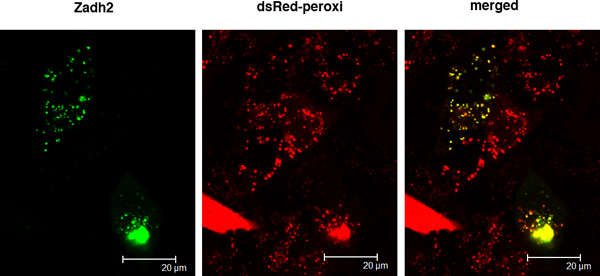
We modified an earlier reported PTS1 screening method to identify PTS2-containing mouse candidates using a combination of computational and manual annotation. For rapid confirmation of five new PTS2- and two previously identified PTS1-containing candidates we developed the new cell line CHO-perRed which stably expresses the peroxisomal marker dsRed-PTS1. Using CHO-perRed we confirmed the peroxisomal localization of PTS1-targeted candidate Zadh2. Preliminary characterization of Zadh2 expression suggested non-PPARalpha mediated activation. Notably, none of the PTS2 candidates located to peroxisomes.
In a few cases the PTS may oscillate from "silent" to "functional" depending on its surface accessibility indicating the potential for context-dependent conditional subcellular sorting. Overall, PTS2-targeting predictions are unlikely to improve without generation and integration of new experimental data from location proteomics, protein structures and quantitative Pex7 PTS2 peptide binding assays.
大多数过氧化物酶体内部蛋白的导入是由其C端(PTS1)或N端区域(PTS2)的过氧化物酶体靶向信号介导的。这两种信号都已整合到亚细胞定位预测程序中。然而,它们目前的性能,特别是PTS2靶向的性能,似乎并不适合大规模的序列筛选。
我们改进了一种先前报道的PTS1筛选方法,通过计算和人工注释相结合的方式来识别含PTS2的小鼠候选蛋白。为了快速确认五个新的含PTS2和两个先前鉴定的含PTS1的候选蛋白,我们开发了新的细胞系CHO-perRed,其稳定表达过氧化物酶体标记物dsRed-PTS1。使用CHO-perRed,我们确认了PTS1靶向候选蛋白Zadh2的过氧化物酶体定位。Zadh2表达的初步表征表明其激活不是由PPARα介导的。值得注意的是,没有一个PTS2候选蛋白定位于过氧化物酶体。
在少数情况下,PTS可能会根据其表面可及性从“沉默”状态转变为“功能”状态,这表明存在依赖于上下文的条件性亚细胞分选的可能性。总体而言,如果没有来自定位蛋白质组学、蛋白质结构和定量Pex7 PTS2肽结合测定的新实验数据的产生和整合,PTS2靶向预测不太可能得到改善。