Lovick T A, Devall A J
Department of Physiology, University of Birmingham, Birmingham B152TT, UK.
Neural Plast. 2009;2009:730902. doi: 10.1155/2009/730902. Epub 2008 Dec 2.
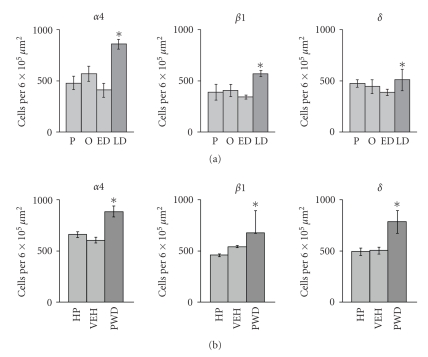
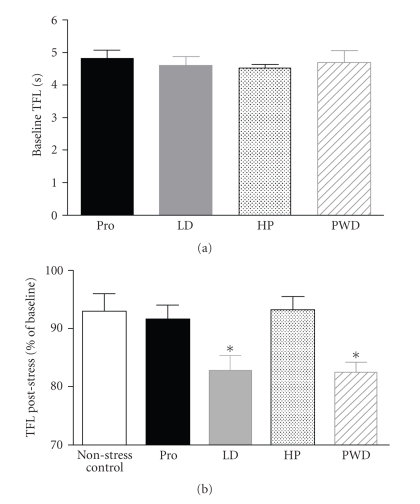
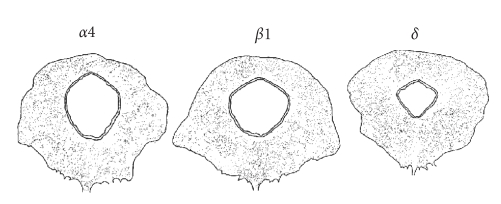
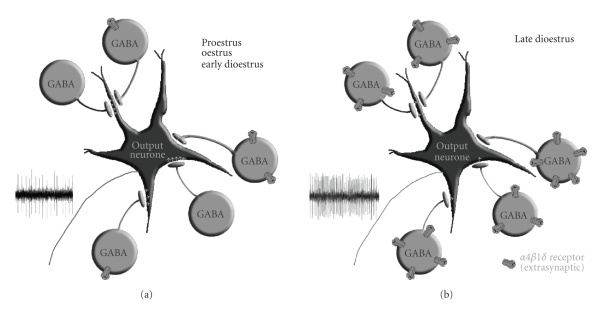
Cyclical changes in production of neuroactive steroids during the oestrous cycle induce significant changes in GABA(A) receptor expression in female rats. In the periaqueductal grey (PAG) matter, upregulation of alpha4beta1delta GABA(A) receptors occurs as progesterone levels fall during late dioestrus (LD) or during withdrawal from an exogenous progesterone dosing regime. The new receptors are likely to be extrasynaptically located on the GABAergic interneurone population and to mediate tonic currents. Electrophysiological studies showed that when alpha4beta1delta GABA(A) receptor expression was increased, the excitability of the output neurones in the PAG increased, due to a decrease in the level of ongoing inhibitory tone from the GABAergic interneurones. The functional consequences in terms of nociceptive processing were investigated in conscious rats. Baseline tail flick latencies were similar in all rats. However, acute exposure to mild vibration stress evoked hyperalgesia in rats in LD and after progesterone withdrawal, in line with the upregulation of alpha4beta1delta GABA(A) receptor expression.
在发情周期中,神经活性甾体生成的周期性变化会引起雌性大鼠GABA(A)受体表达的显著变化。在中脑导水管周围灰质(PAG)中,随着孕酮水平在动情后期(LD)下降或从外源性孕酮给药方案撤药期间,α4β1δ GABA(A)受体上调。新的受体可能位于GABA能中间神经元群体的突触外,并介导强直电流。电生理研究表明,当α4β1δ GABA(A)受体表达增加时,PAG中输出神经元的兴奋性增加,这是由于GABA能中间神经元持续抑制性张力水平降低所致。在清醒大鼠中研究了在伤害性处理方面的功能后果。所有大鼠的基线甩尾潜伏期相似。然而,急性暴露于轻度振动应激会在LD大鼠和孕酮撤药后诱发痛觉过敏,这与α4β1δ GABA(A)受体表达上调一致。