Matsumoto T, Hagino H, Shiraki M, Fukunaga M, Nakano T, Takaoka K, Morii H, Ohashi Y, Nakamura T
Department of Medicine and Bioregulatory Sciences, University of Tokushima Graduate School of Medical Science, Tokushima 770-8503, Japan.
Osteoporos Int. 2009 Aug;20(8):1429-37. doi: 10.1007/s00198-008-0816-7. Epub 2008 Dec 20.
SUMMARY; A randomized placebo-controlled trial was conducted to examine the effect of daily oral 1 mg minodronate on vertebral fractures in 704 postmenopausal women with established osteoporosis for 24 months. Minodronate treatment reduced vertebral fractures by 59% without serious adverse events. Minodronate is a safe and effective bisphosphonate for osteoporosis treatment.
Minodronate increases bone mineral density (BMD) in postmenopausal osteoporotic patients. However, its efficacy in reducing osteoporotic fractures has not been tested.
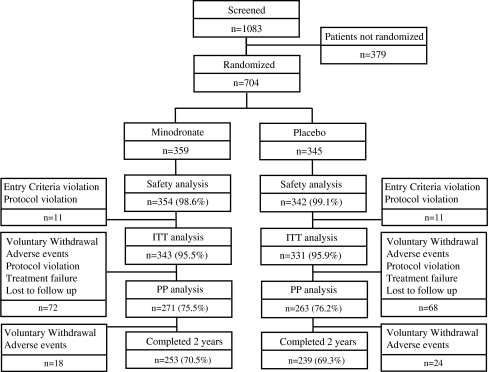
To examine anti-fracture efficacy and safety of daily oral minodronate in postmenopausal women with established osteoporosis, a randomized, double-blind, placebo-controlled trial was conducted in 704 postmenopausal women (55 to 80 years) with one to five vertebral fractures and low BMD. Subjects were randomly assigned to receive daily oral 1 mg minodronate (n = 359) or placebo (n = 345) for 24 months, with daily supplements of 600 mg calcium and 200 IU vitamin D(3).
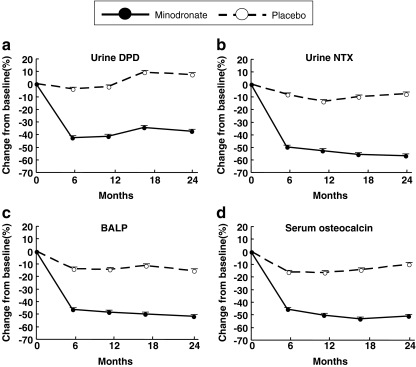
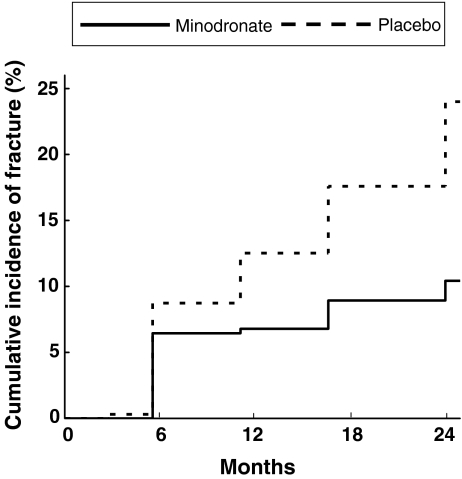
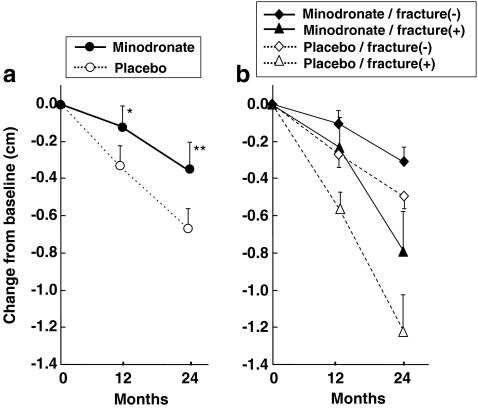
Daily 1 mg minodronate for 24 months reduced the risk of vertebral fractures by 59% (95% CI, 36.6-73.3%). Furthermore, when fractures during the first 6 months were eliminated, the risk of vertebral fractures from 6 to 24 months was reduced by 74% in minodronate-treated group. Minodronate treatment also reduced height loss. Bone turnover markers were suppressed by about 50% after 6 months of minodronate treatment and remained suppressed thereafter. The overall safety profile including gastrointestinal safety was similar between the two groups.
Daily oral minodronate is safe, well-tolerated, and is effective in reducing vertebral fracture risk in postmenopausal women with established osteoporosis.
总结;进行了一项随机安慰剂对照试验,以研究每日口服1毫克米诺膦酸对704名已确诊骨质疏松症的绝经后妇女椎体骨折的影响,为期24个月。米诺膦酸治疗使椎体骨折减少了59%,且无严重不良事件。米诺膦酸是一种用于骨质疏松症治疗的安全有效的双膦酸盐药物。
米诺膦酸可增加绝经后骨质疏松症患者的骨矿物质密度(BMD)。然而,其在降低骨质疏松性骨折方面的疗效尚未得到验证。
为研究每日口服米诺膦酸对已确诊骨质疏松症的绝经后妇女的抗骨折疗效和安全性,对704名年龄在55至80岁、有1至5处椎体骨折且骨密度低的绝经后妇女进行了一项随机、双盲、安慰剂对照试验。受试者被随机分配接受每日口服1毫克米诺膦酸(n = 359)或安慰剂(n = 345),为期24个月,同时每日补充600毫克钙和200国际单位维生素D3。
每日服用1毫克米诺膦酸24个月可使椎体骨折风险降低59%(95%可信区间,36.6 - 73.3%)。此外,排除前6个月的骨折情况后,米诺膦酸治疗组6至24个月的椎体骨折风险降低了74%。米诺膦酸治疗还减少了身高损失。米诺膦酸治疗6个月后,骨转换标志物被抑制约50%,此后一直保持抑制状态。两组在包括胃肠道安全性在内的总体安全性方面相似。
每日口服米诺膦酸安全、耐受性良好,且对降低已确诊骨质疏松症的绝经后妇女椎体骨折风险有效。