Division of Hand and Foot Surgery, Department of Orthopaedics and Traumatology, Queen Mary Hospital, 102 Pokfulam Road, Hong Kong.
J Orthop Surg Res. 2008 Dec 23;3:52. doi: 10.1186/1749-799X-3-52.
A cross-sectional study was performed to describe the upper limb deformity and function in cerebral palsy patients and to determine the correlation of deformity, spasticity, motor control, and sensation to hand function in the said population.
Thirty patients satisfying our inclusion criteria underwent physical, sensory, and functional assessment using a standard protocol. Physical assessment included documentation of the degree of spasticity, deformity and muscle control. Sensation was tested using static two-point discrimination test and stereognosis test. Melbourne Assessment of the Unilateral Upper Limb Function Test (MAULF), Functional Hand Grip Test (FHGT), and Functional Independence Measure for children (WeeFIM) were used to evaluate hand function. Deformity, spasticity, motor control, and sensation were analyzed for correlation with hand function using Pearson Correlation analysis. A p-value of less than 0.05 was considered statistically significant.
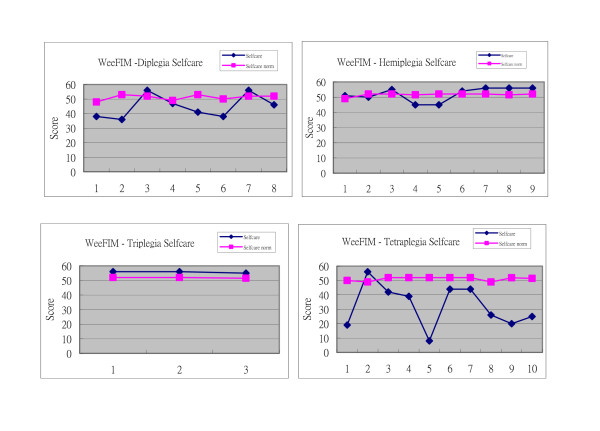
Functional deficits of the hand increased with increasing severity of deformity and spasticity. Tetraplegics were most affected by spasticity, deformity, poor motor control, sensory and functional deficits. Triplegics, followed by diplegics had more functional upper limbs in terms of the MAULF and FHGT scores. Unilaterally affected patients (triplegics and hemiplegics) scored better in performance of activities of daily living. The MAULF and FHGT had a stronger correlation to deformity, spasticity and motor control compared to the WeeFIM.
The degree of deformity, spasticity, sensory deficit, and motor control affected the hand function of a cerebral palsy patient significantly. The MAULF and FHGT more accurately represents hand function deficit in cerebral palsy patients.
本研究采用横断面研究的方法,旨在描述脑瘫患者的上肢畸形和功能,并确定畸形、痉挛、运动控制和感觉与该人群手功能的相关性。
符合纳入标准的 30 例患者采用标准方案进行体格、感觉和功能评估。体格评估包括痉挛程度、畸形和肌肉控制的记录。感觉测试采用静态两点辨别试验和实体觉测试。墨尔本单侧上肢功能评估(MAULF)、功能性手握力测试(FHGT)和儿童功能性独立性测量(WeeFIM)用于评估手功能。采用 Pearson 相关分析评估畸形、痉挛、运动控制和感觉与手功能的相关性。p 值<0.05 认为具有统计学意义。
手的功能缺陷随畸形和痉挛的严重程度增加而增加。四肢瘫患者受痉挛、畸形、运动控制差、感觉和功能缺陷影响最大。截瘫患者和双瘫患者的 MAULF 和 FHGT 评分上肢功能更健全。单侧受累(截瘫和偏瘫)患者在日常生活活动的完成方面表现更好。MAULF 和 FHGT 与畸形、痉挛和运动控制的相关性强于 WeeFIM。
畸形、痉挛、感觉缺失和运动控制的程度显著影响脑瘫患者的手功能。MAULF 和 FHGT 更准确地反映脑瘫患者手功能缺陷。