Ream Thomas S, Haag Jeremy R, Wierzbicki Andrzej T, Nicora Carrie D, Norbeck Angela D, Zhu Jian-Kang, Hagen Gretchen, Guilfoyle Thomas J, Pasa-Tolić Ljiljana, Pikaard Craig S
Biology Department, Washington University, St. Louis, MO 63130, USA.
Mol Cell. 2009 Jan 30;33(2):192-203. doi: 10.1016/j.molcel.2008.12.015. Epub 2008 Dec 24.
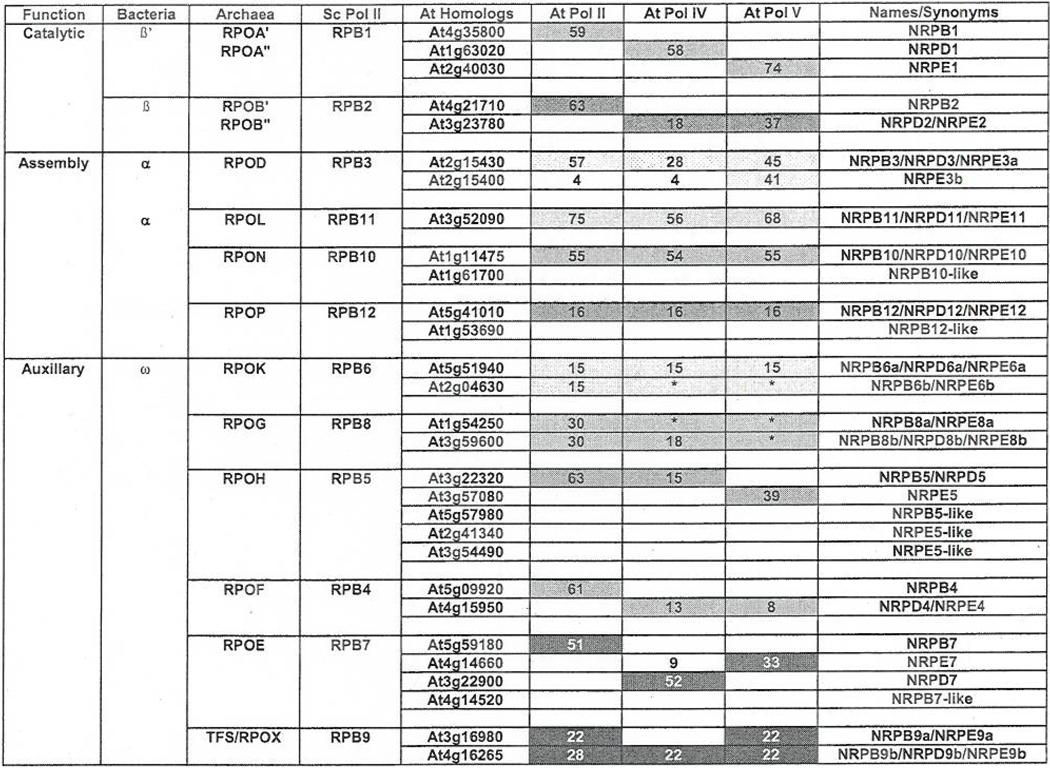
In addition to RNA polymerases I, II, and III, the essential RNA polymerases present in all eukaryotes, plants have two additional nuclear RNA polymerases, abbreviated as Pol IV and Pol V, that play nonredundant roles in siRNA-directed DNA methylation and gene silencing. We show that Arabidopsis Pol IV and Pol V are composed of subunits that are paralogous or identical to the 12 subunits of Pol II. Four subunits of Pol IV are distinct from their Pol II paralogs, six subunits of Pol V are distinct from their Pol II paralogs, and four subunits differ between Pol IV and Pol V. Importantly, the subunit differences occur in key positions relative to the template entry and RNA exit paths. Our findings support the hypothesis that Pol IV and Pol V are Pol II-like enzymes that evolved specialized roles in the production of noncoding transcripts for RNA silencing and genome defense.
除了所有真核生物中都存在的RNA聚合酶I、II和III外,植物还有另外两种核RNA聚合酶,简称为Pol IV和Pol V,它们在小干扰RNA(siRNA)介导的DNA甲基化和基因沉默中发挥着非冗余作用。我们发现,拟南芥中的Pol IV和Pol V由与Pol II的12个亚基同源或相同的亚基组成。Pol IV的四个亚基与其Pol II的同源亚基不同,Pol V的六个亚基与其Pol II的同源亚基不同,Pol IV和Pol V之间有四个亚基不同。重要的是,亚基差异发生在相对于模板进入和RNA出口路径的关键位置。我们的研究结果支持这样一种假设,即Pol IV和Pol V是类似于Pol II的酶,它们在产生用于RNA沉默和基因组防御的非编码转录本过程中演化出了特殊作用。