Wei Yongzhong, Whaley-Connell Adam T, Habibi Javad, Rehmer Jenna, Rehmer Nathan, Patel Kamlesh, Hayden Melvin, DeMarco Vincent, Ferrario Carlos M, Ibdah Jamal A, Sowers James R
Department of Medicine, Diabetes and Cardiovascular Center of Excellence, University of Missouri-Columbia, Columbia, MO 65212, USA.
Hypertension. 2009 Feb;53(2):158-65. doi: 10.1161/HYPERTENSIONAHA.108.121954. Epub 2008 Dec 29.
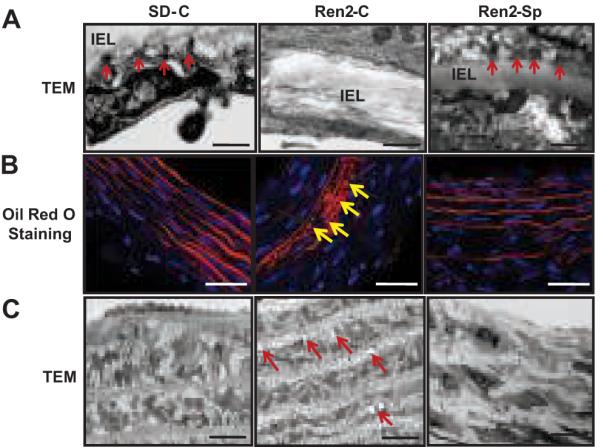
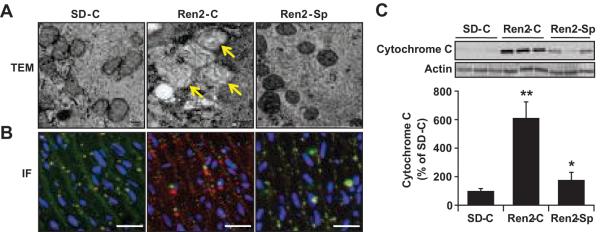
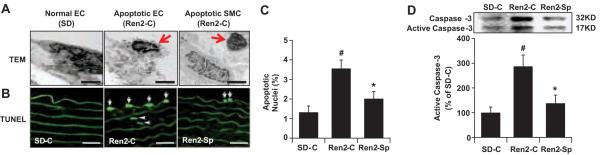
Emerging evidence indicates that mineralocorticoid receptor (MR) blockade reduces the risk of cardiovascular events beyond those predicted by its blood pressure-lowering actions; however, the underlying mechanisms remain unclear. To investigate whether protection elicited by MR blockade is through attenuation of vascular apoptosis and injury, independently of blood pressure lowering, we administered a low dose of the MR antagonist spironolactone or vehicle for 21 days to hypertensive transgenic Ren2 rats with elevated plasma aldosterone levels. Although Ren2 rats developed higher systolic blood pressures compared with Sprague-Dawley littermates, low-dose spironolactone treatment did not reduce systolic blood pressure compared with untreated Ren2 rats. Ren2 rats exhibited vascular injury as evidenced by increased apoptosis, hemidesmosome-like structure loss, mitochondrial abnormalities, and lipid accumulation compared with Sprague-Dawley rats, and these abnormalities were attenuated by MR antagonism. Protein kinase B activation is critical to vascular homeostasis via regulation of cell survival and expression of apoptotic genes. Protein kinase B serine(473) phosphorylation was impaired in Ren2 aortas and restored with MR antagonism. In vivo MR antagonist treatment promoted antiapoptotic effects by increasing phosphorylation of BAD serine(136) and expression of Bcl-2 and Bcl-xL, decreasing cytochrome c release and BAD expression, and suppressing caspase-3 activation. Furthermore, MR antagonism substantially reduced the elevated NADPH oxidase activity and lipid peroxidation, expression of angiotensin II, angiotensin type 1 receptor, and MR in Ren2 vasculature. These results demonstrate that MR antagonism protects the vasculature from aldosterone-induced vascular apoptosis and structural injury via rescuing protein kinase B activation, independent of blood pressure effects.
新出现的证据表明,盐皮质激素受体(MR)阻断剂降低心血管事件风险的作用超出了其降压作用所能预测的范围;然而,其潜在机制仍不清楚。为了研究MR阻断剂所引发的保护作用是否是通过减轻血管凋亡和损伤来实现的,而与血压降低无关,我们对血浆醛固酮水平升高的高血压转基因Ren2大鼠给予低剂量的MR拮抗剂螺内酯或赋形剂,持续21天。尽管与Sprague-Dawley同窝大鼠相比,Ren2大鼠的收缩压更高,但与未治疗的Ren2大鼠相比,低剂量螺内酯治疗并未降低收缩压。与Sprague-Dawley大鼠相比,Ren2大鼠表现出血管损伤,表现为凋亡增加、半桥粒样结构丧失、线粒体异常和脂质蓄积,而这些异常通过MR拮抗作用得以减轻。蛋白激酶B的激活通过调节细胞存活和凋亡基因的表达对血管稳态至关重要。Ren2大鼠主动脉中蛋白激酶B丝氨酸(473)磷酸化受损,而MR拮抗作用可使其恢复。在体内,MR拮抗剂治疗通过增加BAD丝氨酸(136)的磷酸化以及Bcl-2和Bcl-xL的表达,减少细胞色素c的释放和BAD的表达,并抑制caspase-3的激活,从而促进抗凋亡作用。此外,MR拮抗作用显著降低了Ren2血管中升高的NADPH氧化酶活性和脂质过氧化、血管紧张素II、血管紧张素1型受体和MR的表达。这些结果表明,MR拮抗作用通过挽救蛋白激酶B的激活,独立于血压效应,保护血管免受醛固酮诱导的血管凋亡和结构损伤。