Zhang Wei, Liu Wanqing, Poradosu Enrique, Ratain Mark J
Section of Hematology/Oncology, Department of Medicine, The University of Chicago, Chicago, IL 60637, USA.
Hum Genomics. 2008 Sep;3(1):53-70. doi: 10.1186/1479-7364-3-1-53.
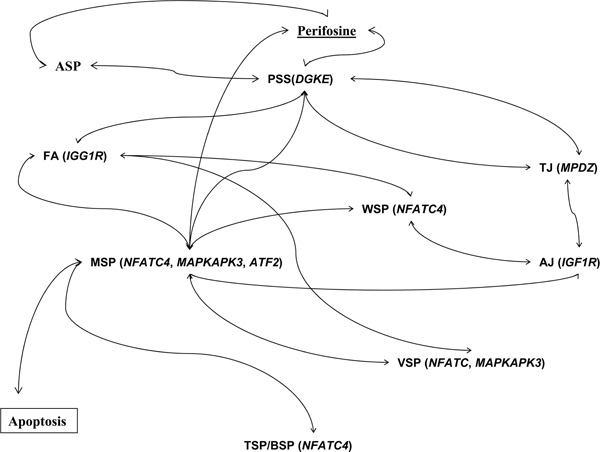
Perifosine belongs to the class of alkylphospholipid analogues, which act primarily at the cell membrane, thereby targeting signal transduction pathways. In phase I/II clinical trials, perifosine has induced tumour regression and caused disease stabilisation in a variety of tumour types. The genetic determinants responsible for its cytotoxicity have not been comprehensively studied, however. We performed a genome-wide analysis to identify genes whose expression levels or genotypic variation were correlated with the cytotoxicity of perifosine, using public databases on the US National Cancer Institute (NCI)-60 human cancer cell lines. For demonstrating drug specificity, the NCI Standard Agent Database (including 171 drugs acting through a variety of mechanisms) was used as a control. We identified agents with similar cytotoxicity profiles to that of perifosine in compounds used in the NCI drug screen. Furthermore, Gene Ontology and pathway analyses were carried out on genes more likely to be perifosine specific. The results suggested that genes correlated with perifosine cytotoxicity are connected by certain known pathways that lead to the mitogen-activated protein kinase signalling pathway and apoptosis. Biological processes such as 'response to stress', 'inflammatory response' and 'ubiquitin cycle' were enriched among these genes. Three single nucleotide polymorphisms (SNPs) located in CACNA2D1 and EXOC4 were found to be correlated with perifosine cytotoxicity. Our results provided a manageable list of genes whose expression levels or genotypic variation were strongly correlated with the cytotoxcity of perifosine. These genes could be targets for further studies using candidate-gene approaches. The results also provided insights into the pharmacodynamics of perifosine.
哌立福新属于烷基磷脂类似物类别,主要作用于细胞膜,从而靶向信号转导通路。在I/II期临床试验中,哌立福新已在多种肿瘤类型中诱导肿瘤消退并使疾病稳定。然而,尚未全面研究其细胞毒性的遗传决定因素。我们利用美国国立癌症研究所(NCI)-60人类癌细胞系的公共数据库进行了全基因组分析,以鉴定其表达水平或基因型变异与哌立福新细胞毒性相关的基因。为了证明药物特异性,使用NCI标准药物数据库(包括171种通过多种机制起作用的药物)作为对照。我们在NCI药物筛选中使用的化合物中鉴定出具有与哌立福新相似细胞毒性谱的药物。此外,对更可能是哌立福新特异性的基因进行了基因本体论和通路分析。结果表明,与哌立福新细胞毒性相关的基因通过某些已知通路相互连接,这些通路导致丝裂原活化蛋白激酶信号通路和细胞凋亡。在这些基因中富集了诸如“应激反应”、“炎症反应”和“泛素循环”等生物学过程。发现位于CACNA2D1和EXOC4中的三个单核苷酸多态性(SNP)与哌立福新细胞毒性相关。我们的结果提供了一份易于管理的基因清单,其表达水平或基因型变异与哌立福新的细胞毒性密切相关。这些基因可能是使用候选基因方法进行进一步研究的靶点。结果还为哌立福新的药效学提供了见解。