Wu X, Wanders A, Wardega P, Tinge B, Gedda L, Bergstrom S, Sooman L, Gullbo J, Bergqvist M, Hesselius P, Lennartsson J, Ekman S
Unit of Oncology, Department of Oncology, Radiology and Clinical Immunology, Uppsala University, Uppsala, Sweden.
Br J Cancer. 2009 Jan 27;100(2):334-43. doi: 10.1038/sj.bjc.6604855. Epub 2009 Jan 13.
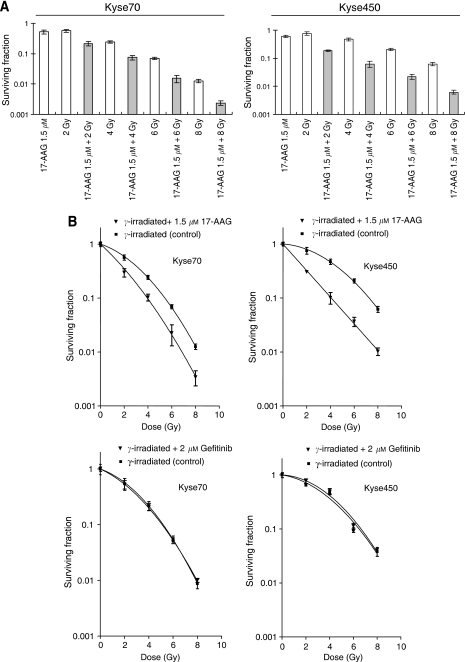
Heat shock protein 90 (Hsp90) has been demonstrated to protect oncogenic variants of signalling molecules from degradation and may consequently serve as a therapeutic target for the treatment of oesophageal cancer for which adequate therapy is often lacking. We studied the expression of Hsp90 in tumour tissues of human oesophageal cancer and the impact of Hsp90 inhibition on oesophageal cancer cell lines using the drug 17-allylamino-17-demethoxygeldanamycin (17-AAG). Quantitative immunohistochemistry was performed on formalin-fixed paraffin-embedded tissues from patients with oesophageal cancer. In squamous cell carcinoma, a marked upregulation of Hsp90 could be noted in dysplastic epithelium and invasive cancer compared with normal epithelium. In adenocarcinoma, Hsp90 was expressed in neoplastic epithelium and also in normal non-neoplastic glands weakly. The inhibition of Hsp90 using 17-AAG led to a significant decrease in cell proliferation and viability in human oesophageal cancer cell lines. Using a clonogenic cell survival assay, Hsp90 inhibition significantly sensitised the cells for gamma-photon irradiation. Heat shock protein 90 was found to be critical for proper signalling induced by both epidermal growth factor and insulin-like growth factor-1, in which the inhibition of signalling by 17-AAG correlated with the observed reduction in cell proliferation and viability. These results showed that Hsp90 was selectively expressed in oesophageal cancer tissue compared with the corresponding normal tissue, and the inhibition of Hsp90 resulted in decreased proliferation and viability as well as radiosensitisation of oesophageal cancer cells. Heat shock protein 90 represents a potential therapeutic target in the treatment of patients with oesophageal cancer, alone or in combination with radiotherapy.
热休克蛋白90(Hsp90)已被证明可保护信号分子的致癌变体不被降解,因此可能成为治疗食管癌的一个治疗靶点,而食管癌往往缺乏有效的治疗方法。我们使用药物17-烯丙基氨基-17-去甲氧基格尔德霉素(17-AAG)研究了Hsp90在人食管癌肿瘤组织中的表达以及Hsp90抑制对食管癌细胞系的影响。对来自食管癌患者的福尔马林固定石蜡包埋组织进行了定量免疫组织化学分析。在鳞状细胞癌中,与正常上皮相比,发育异常上皮和浸润性癌中Hsp90明显上调。在腺癌中,Hsp90在肿瘤上皮中表达,在正常非肿瘤腺体中也有微弱表达。使用17-AAG抑制Hsp90导致人食管癌细胞系的细胞增殖和活力显著下降。使用克隆形成细胞存活试验,Hsp90抑制使细胞对γ光子照射显著敏感。发现热休克蛋白90对于表皮生长因子和胰岛素样生长因子-1诱导的正常信号传导至关重要,其中17-AAG对信号传导的抑制与观察到的细胞增殖和活力降低相关。这些结果表明,与相应的正常组织相比,Hsp90在食管癌组织中选择性表达,抑制Hsp90导致食管癌细胞的增殖和活力下降以及放射增敏。热休克蛋白90是治疗食管癌患者的一个潜在治疗靶点,可单独使用或与放疗联合使用。