Department of Pharmacoepidemiology and Pharmacotherapy, Utrecht Institute for Pharmaceutical Sciences, Utrecht University, Utrecht, The Netherlands.
Osteoporos Int. 2009 Sep;20(9):1499-506. doi: 10.1007/s00198-008-0826-5. Epub 2009 Jan 21.
This case-control study showed that current use of conventional antipsychotics, but not atypical antipsychotics, seems to be associated with an increased risk of a hip/femur fracture, possibly related to the pharmacological properties of conventional antipsychotics. Furthermore, no evidence for a dose effect was found.
The aim of this study was to assess the risk of hip/femur fracture associated with antipsychotic use, with particular reference to any difference in risk with conventional versus atypical antipsychotics, dose, and pharmacological properties.
A case-control study was conducted using data from the PHARMO Record Linkage System among individuals aged 18 years and older between 1991 and 2002. Cases had a record of a hip or femur fracture, while controls had no evidence of ever having sustained any fracture.
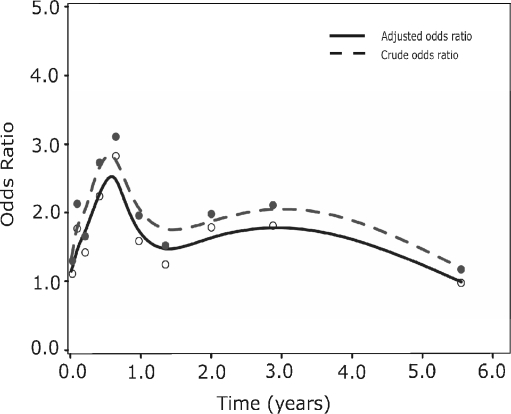
Most cases were elderly (77.6% aged > or = 70 years). We found an increased risk for hip/femur fracture associated with the use of antipsychotic drugs. The risk for current users (OR(adj) 1.68 [1.43, 1.99]) was significantly greater than with past use (OR(adj) 1.33 [1.14, 1.56]; p = 0.036). Current use of conventional antipsychotics (OR(adj) 1.76 [1.48, 2.08]) but not atypical antipsychotics (OR(adj) 0.83 [0.42, 1.65]) was associated with an increased risk. We did not find evidence for a dose effect.
The use of conventional, but not atypical antipsychotics, seems to be associated with an increased risk of hip/femur fracture, possibly related to the pharmacological properties of conventional antipsychotics. However, the numbers of atypical antipsychotic users were small, and therefore this observation needs further attention in other study populations.
本病例对照研究表明,目前使用传统抗精神病药而非新型抗精神病药似乎与髋部/股骨骨折风险增加相关,这可能与传统抗精神病药的药理学特性有关。此外,未发现剂量效应的证据。
本研究旨在评估使用抗精神病药与髋部/股骨骨折风险之间的关系,特别关注传统与新型抗精神病药、剂量和药理学特性方面的风险差异。
使用 1991 年至 2002 年间 PHARMO 记录链接系统的数据进行病例对照研究,纳入年龄在 18 岁及以上的个体。病例有髋部或股骨骨折记录,而对照则无任何骨折证据。
大多数病例为老年人(77.6%年龄≥70 岁)。我们发现使用抗精神病药物与髋部/股骨骨折风险增加相关。当前使用者的风险(调整后的 OR(adj)为 1.68 [1.43, 1.99])显著高于过去使用者(调整后的 OR(adj)为 1.33 [1.14, 1.56];p=0.036)。当前使用传统抗精神病药(调整后的 OR(adj)为 1.76 [1.48, 2.08])而非新型抗精神病药(调整后的 OR(adj)为 0.83 [0.42, 1.65])与风险增加相关。我们未发现剂量效应的证据。
使用传统而非新型抗精神病药似乎与髋部/股骨骨折风险增加相关,这可能与传统抗精神病药的药理学特性有关。然而,新型抗精神病药使用者数量较少,因此这一观察结果需要在其他研究人群中进一步关注。