Lawless M W, Norris S, O'Byrne K J, Gray S G
Centre for Liver Disease, School of Medicine and Medical Science, Mater Misericordiae University Hospital - University College Dublin, Dublin, Ireland.
J Cell Mol Med. 2009 May;13(5):826-52. doi: 10.1111/j.1582-4934.2008.00571.x. Epub 2008 Nov 3.
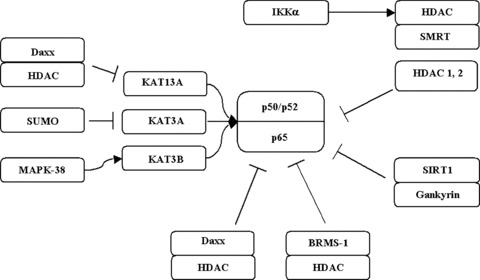
The 'histone code' is a well-established hypothesis describing the idea that specific patterns of post-translational modifications to histones act like a molecular 'code' recognized and used by non-histone proteins to regulate specific chromatin functions. One modification, which has received significant attention, is that of histone acetylation. The enzymes that regulate this modification are described as lysine acetyltransferases or KATs, and histone deacetylases or HDACs. Due to their conserved catalytic domain HDACs have been actively targeted as a therapeutic target. The pro-inflammatory environment is increasingly being recognized as a critical element for both degenerative diseases and cancer. The present review will discuss the current knowledge surrounding the clinical potential and current development of histone deacetylases for the treatment of diseases for which a pro-inflammatory environment plays important roles, and the molecular mechanisms by which such inhibitors may play important functions in modulating the pro-inflammatory environment.
“组蛋白密码”是一个已被充分证实的假说,它描述了这样一种观点:组蛋白翻译后修饰的特定模式就像一种分子“密码”,可被非组蛋白识别并用于调节特定的染色质功能。其中一种受到广泛关注的修饰是组蛋白乙酰化。调节这种修饰的酶被称为赖氨酸乙酰转移酶(KATs)和组蛋白去乙酰化酶(HDACs)。由于其保守的催化结构域,HDACs已成为积极的治疗靶点。促炎环境越来越被认为是退行性疾病和癌症的关键因素。本综述将讨论目前关于组蛋白去乙酰化酶在治疗以促炎环境起重要作用的疾病方面的临床潜力和当前进展的相关知识,以及此类抑制剂在调节促炎环境中发挥重要作用的分子机制。