Fukumura Kazuhiro, Taniguchi Ichiro, Sakamoto Hiroshi, Ohno Mutsuhito, Inoue Kunio
Department of Biology, Graduate School of Science, Kobe University, Nadaku, Kobe, Japan.
Nucleic Acids Res. 2009 Apr;37(6):1907-14. doi: 10.1093/nar/gkp050. Epub 2009 Feb 3.
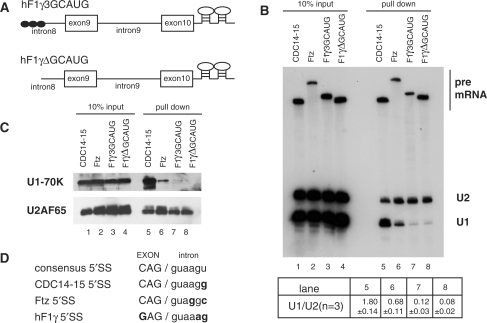
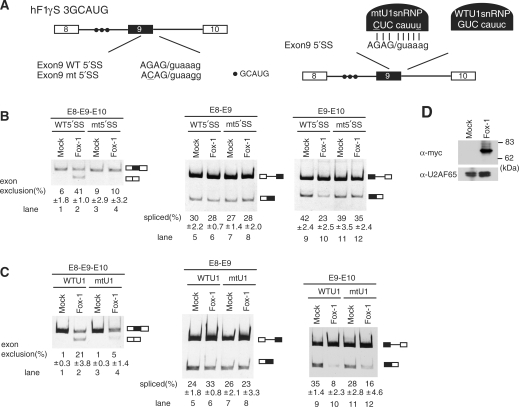
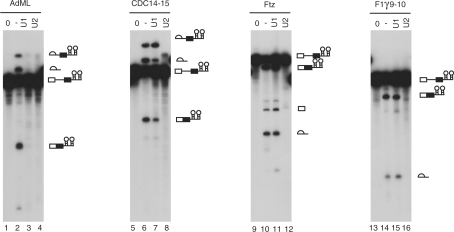
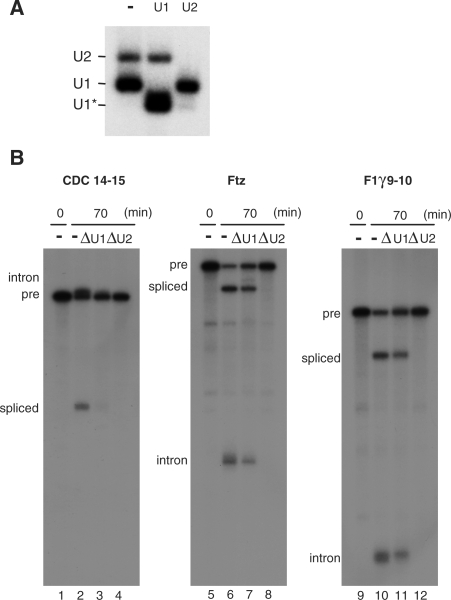
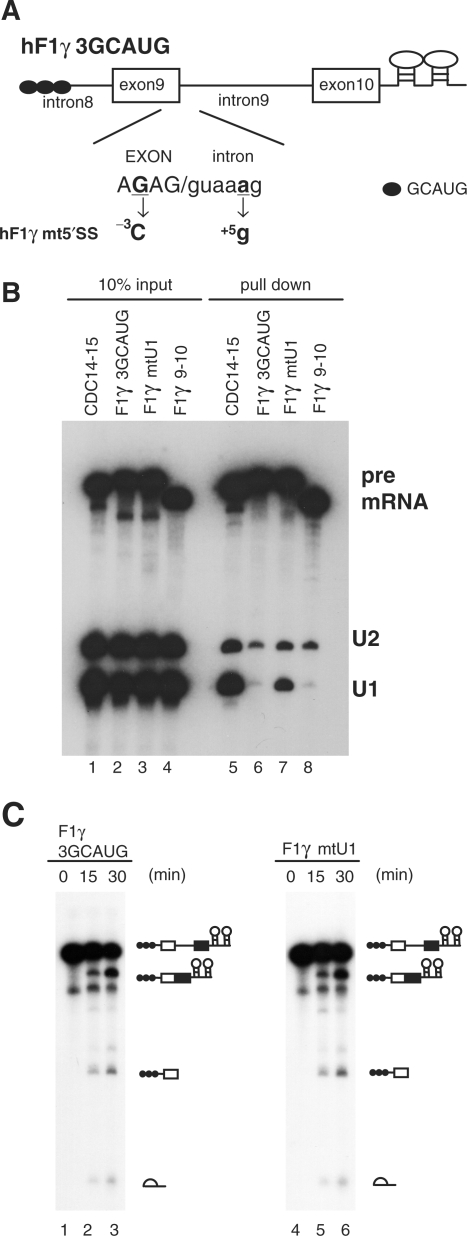
U1 snRNP plays a crucial role in the 5' splice site recognition during splicing. Here we report the first example of naturally occurring U1-independent U2-type splicing in humans. The U1 components were not included in the pre-spliceosomal E complex formed on the human F1gamma (hF1gamma) intron 9 in vitro. Moreover, hF1gamma intron 9 was efficiently spliced even in U1-disrupted Xenopus oocytes as well as in U1-inactivated HeLa nuclear extracts. Finally, hF1gamma exon 9 skipping induced by an alternative splicing regulator Fox-1 was impaired when intron 9 was changed to the U1-dependent one. Our results suggest that U1-independent splicing contributes to the regulation of alternative splicing of a class of pre-mRNAs.
U1 小核核糖核蛋白颗粒(U1 snRNP)在剪接过程中对 5' 剪接位点的识别起着关键作用。在此,我们报道了人类中自然发生的不依赖 U1 的 U2 型剪接的首个实例。在体外,人 F1γ(hF1γ)内含子 9 上形成的剪接前体 E 复合物中不包含 U1 成分。此外,即使在 U1 缺失的非洲爪蟾卵母细胞以及 U1 失活的 HeLa 细胞核提取物中,hF1γ 内含子 9 也能高效剪接。最后,当内含子 9 变为依赖 U1 的内含子时,由可变剪接调节因子 Fox-1 诱导的 hF1γ 外显子 9 跳跃受到损害。我们的结果表明,不依赖 U1 的剪接有助于一类前体 mRNA 的可变剪接调控。