Frias-Lopez Jorge, Thompson Anne, Waldbauer Jacob, Chisholm Sallie W
Department of Civil and Environmental Engineering, Massachusetts Institute of Technology, Cambridge, MA 02139, USA.
Environ Microbiol. 2009 Feb;11(2):512-25. doi: 10.1111/j.1462-2920.2008.01793.x.
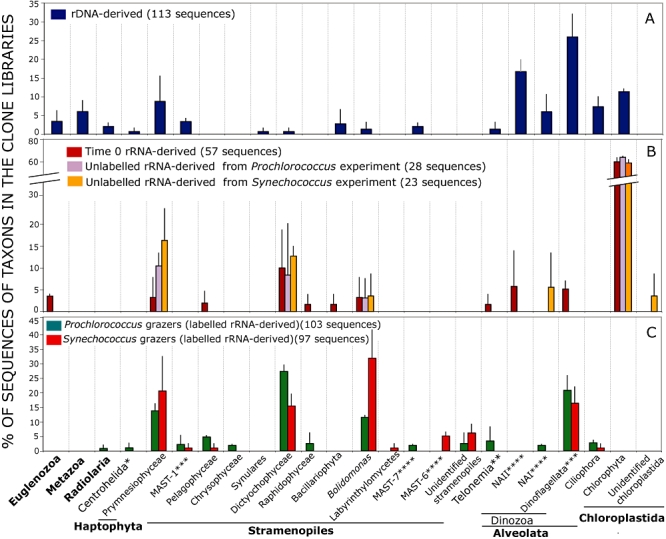
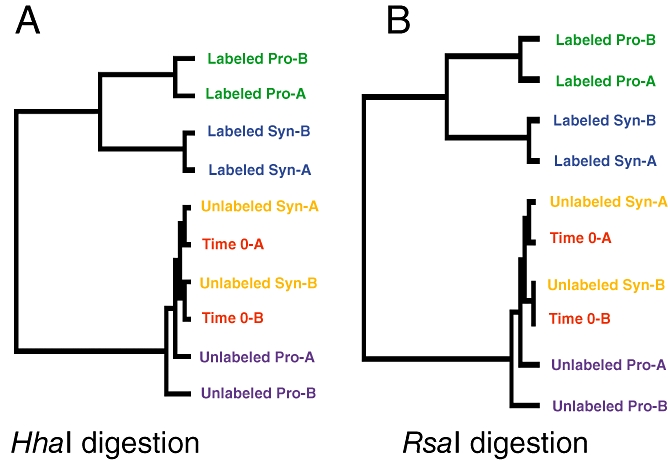
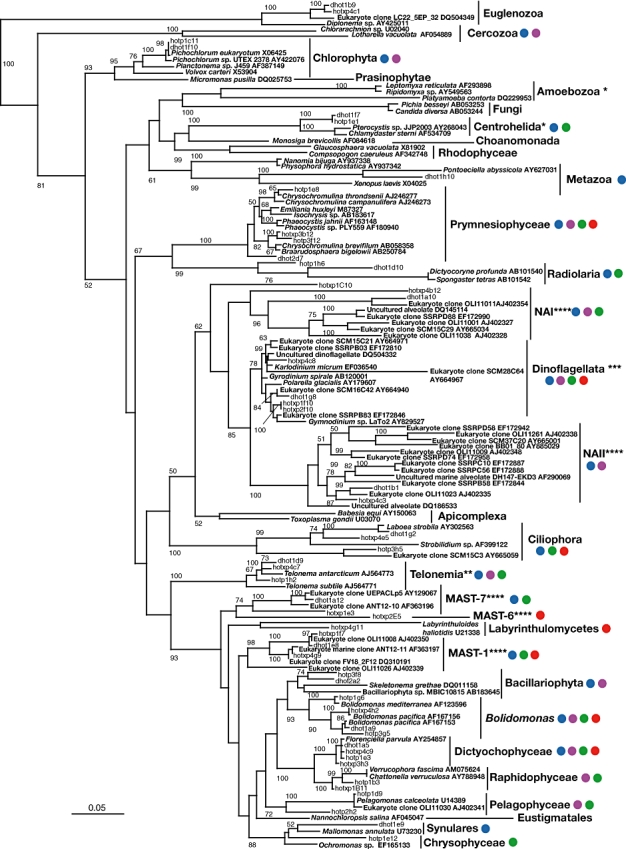
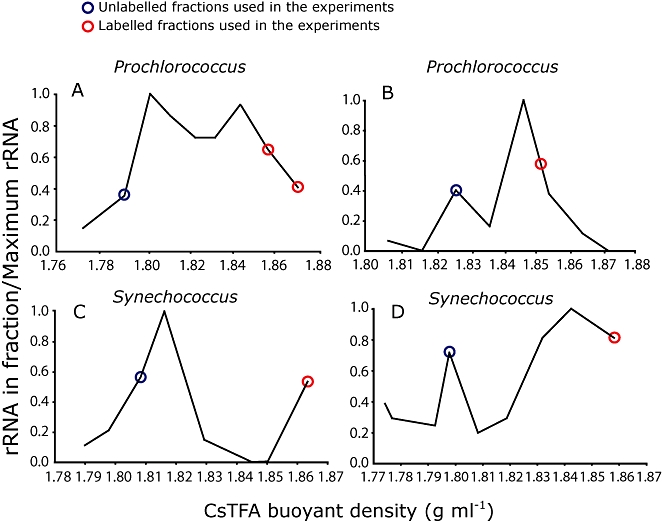
Prochlorococcus and Synechococcus are the two most abundant marine cyanobacteria. They represent a significant fraction of the total primary production of the world oceans and comprise a major fraction of the prey biomass available to phagotrophic protists. Despite relatively rapid growth rates, picocyanobacterial cell densities in open-ocean surface waters remain fairly constant, implying steady mortality due to viral infection and consumption by predators. There have been several studies on grazing by specific protists on Prochlorococcus and Synechococcus in culture, and of cell loss rates due to overall grazing in the field. However, the specific sources of mortality of these primary producers in the wild remain unknown. Here, we use a modification of the RNA stable isotope probing technique (RNA-SIP), which involves adding labelled cells to natural seawater, to identify active predators that are specifically consuming Prochlorococcus and Synechococcus in the surface waters of the Pacific Ocean. Four major groups were identified as having their 18S rRNA highly labelled: Prymnesiophyceae (Haptophyta), Dictyochophyceae (Stramenopiles), Bolidomonas (Stramenopiles) and Dinoflagellata (Alveolata). For the first three of these, the closest relative of the sequences identified was a photosynthetic organism, indicating the presence of mixotrophs among picocyanobacterial predators. We conclude that the use of RNA-SIP is a useful method to identity specific predators for picocyanobacteria in situ, and that the method could possibly be used to identify other bacterial predators important in the microbial food-web.
原绿球藻和聚球藻是两种数量最为丰富的海洋蓝细菌。它们在全球海洋的总初级生产力中占相当大的比例,并且在可供吞噬营养型原生生物食用的猎物生物量中占主要部分。尽管生长速度相对较快,但开阔海洋表层水体中的微微型蓝细菌细胞密度保持相当稳定,这意味着由于病毒感染和捕食者的消耗导致了稳定的死亡率。已经有多项关于特定原生生物在培养环境中对原绿球藻和聚球藻的捕食以及野外总体捕食导致的细胞损失率的研究。然而,这些初级生产者在自然环境中的具体死亡来源仍然未知。在此,我们使用了一种改进的RNA稳定同位素探测技术(RNA-SIP),该技术涉及向天然海水中添加标记细胞,以识别在太平洋表层水体中专门捕食原绿球藻和聚球藻的活跃捕食者。有四个主要类群被确定其18S rRNA高度标记:定鞭藻纲(定鞭藻门)、网柱藻纲(不等鞭毛类)、卵形藻属(不等鞭毛类)和甲藻纲(囊泡虫类)。对于其中前三个类群,所鉴定序列的最相近亲缘种是光合生物,这表明微微型蓝细菌捕食者中存在混合营养型生物。我们得出结论,RNA-SIP的使用是一种在原位识别微微型蓝细菌特定捕食者的有用方法,并且该方法可能可用于识别在微生物食物网中重要的其他细菌捕食者。