Sallaoui Ridha, Chamari Karim, Mossa Abbas, Tabka Zouhair, Chtara Moktar, Feki Youssef, Amri Mohamed
ISSEP-Sfax, Unité de Recherche Les déterminants psychoculturels et biologiques de l'accès à la haute performance sportive, Sfax, Tunisia.
BMC Pulm Med. 2009 Feb 5;9:8. doi: 10.1186/1471-2466-9-8.
This study is a cross sectional analysis, aiming to evaluate if atopy is as a risk factor for exercise induced bronchoconstriction (EIB) among Tunisian athletes.
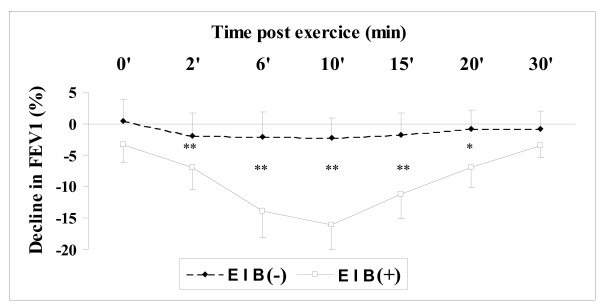
Atopy was defined by a skin prick test result and EIB was defined as a decrease of at least 15% in forced expiratory volume in one second (FEV1) after 8-min running at 80-85% HRmaxTheo. The study population was composed of 326 athletes (age: 20.8 +/- 2.7 yrs - mean +/- SD; 138 women and 188 men) of whom 107 were elite athletes.
Atopy was found in 26.9% (88/326) of the athletes. Post exercise spirometry revealed the presence of EIB in 9.8% of the athletes including 13% of the elite athletes. Frequency of atopy in athletes with EIB was significantly higher than in athletes without EIB [62.5% vs 23.1%, respectively].
This study showed that atopic Tunisian athletes presented a higher risk of developing exercise induced bronchoconstriction than non-atopic athletes.
本研究为横断面分析,旨在评估特应性是否为突尼斯运动员运动诱发支气管收缩(EIB)的危险因素。
特应性通过皮肤点刺试验结果定义,EIB定义为在以80 - 85%最大理论心率进行8分钟跑步后,一秒用力呼气量(FEV1)至少下降15%。研究人群由326名运动员组成(年龄:20.8 +/- 2.7岁 - 均值 +/- 标准差;138名女性和188名男性),其中107名是精英运动员。
26.9%(88/326)的运动员存在特应性。运动后肺功能测试显示9.8%的运动员存在EIB,其中精英运动员占13%。EIB运动员的特应性频率显著高于无EIB的运动员[分别为62.5%和23.1%]。
本研究表明,患有特应性的突尼斯运动员比非特应性运动员发生运动诱发支气管收缩的风险更高。