Marshall Melanie, Anilkumar Narayana, Layland Joanne, Walker Simon J, Kentish Jonathan C, Shah Ajay M, Cave Alison C
Cardiovascular Division, Department of Cardiology, King's College London, James Black Centre, London SE5 9NU, UK.
Cardiovasc Res. 2009 Apr 1;82(1):67-76. doi: 10.1093/cvr/cvp037. Epub 2009 Feb 6.
Sepsis-associated cardiac dysfunction represents an intrinsic impairment of cardiomyocyte function due in part to a decrease in myofilament Ca(2+) sensitivity associated with a sustained increase in cardiac troponin I (cTnI) phosphorylation at Ser23/24. Dephosphorylation of cTnI is under regulatory control. Thus, muscarinic and adenosine A(1)-receptor agonists antagonize beta-adrenergic stimulation via activation of protein phosphatase 2A (PP2A). The aim of this study was to determine whether modulation of PP2A and thus cTnI phosphorylation could improve sepsis-induced contractile dysfunction.
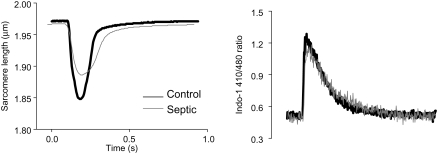
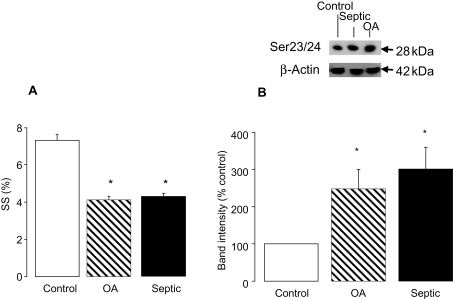
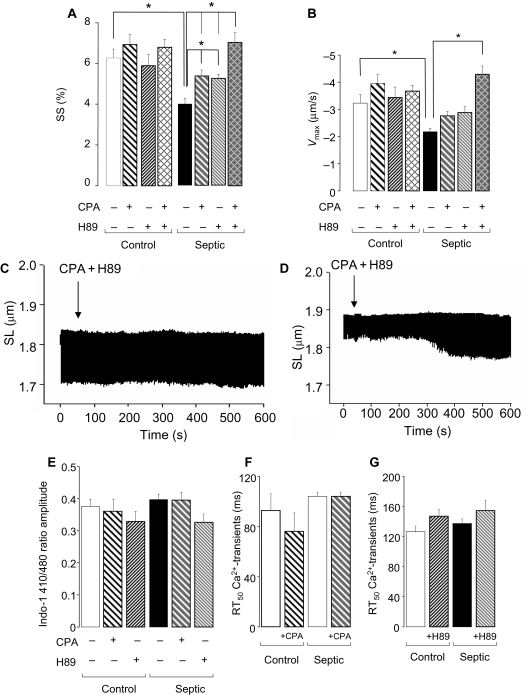
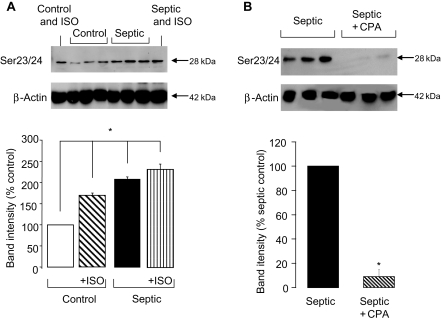
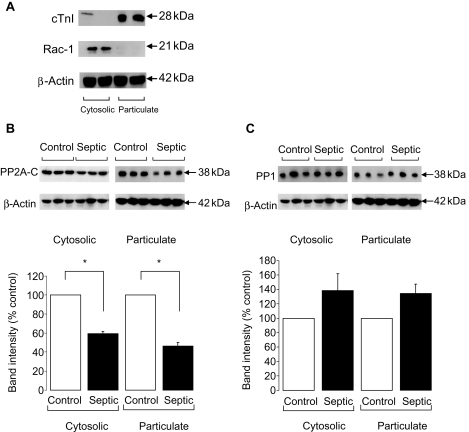
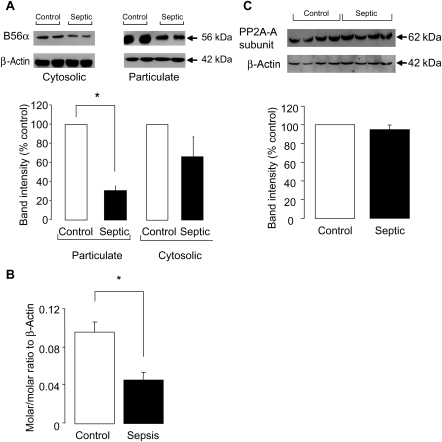
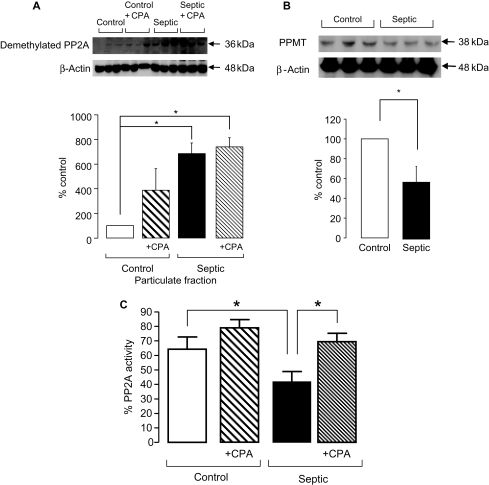
Cardiomyocytes were isolated from control or septic mice 16-18 h after an injection of vehicle or lipopolysaccharide (LPS; 9 mg/kg ip) respectively. Protein expression and phosphatase activity were determined in homogenates of control and septic hearts. Our data showed that LPS significantly increased cTnI phosphorylation at Ser23/24 in cardiomyocytes and reduced contraction amplitude without affecting Ca(2+)-transients. Treatment of cardiomyocytes with the A(1) agonist cyclopentyladenosine (CPA) or the protein kinase A inhibitor H89 significantly attenuated the LPS-induced contractile dysfunction without effect on Ca(2+)-transients. Co-treatment with CPA and H89 completely reversed the contractile dysfunction. Increased cTnI phosphorylation in septic hearts was associated with a significant reduction in the protein expression of both the catalytic and regulatory subunits (B56 alpha) of PP2A and a decrease in PP2A activity. CPA treatment of septic hearts increased PP2A activity. An increase in the protein expression of demethylated PP2A and a decrease in the PP2A-methyltransferase (PPMT; the methyltransferase that catalyses this reaction) were also observed.
These data support the hypothesis that sustained cTnI phosphorylation underlies the contractile dysfunction seen in sepsis.
脓毒症相关的心脏功能障碍代表心肌细胞功能的内在损伤,部分原因是肌丝钙敏感性降低,这与心肌肌钙蛋白I(cTnI)在丝氨酸23/24处的磷酸化持续增加有关。cTnI的去磷酸化受调控控制。因此,毒蕈碱和腺苷A(1)受体激动剂通过激活蛋白磷酸酶2A(PP2A)拮抗β-肾上腺素能刺激。本研究的目的是确定PP2A的调节以及由此引起的cTnI磷酸化是否可以改善脓毒症诱导的收缩功能障碍。
分别在注射溶媒或脂多糖(LPS;9mg/kg腹腔注射)后16-18小时,从对照或脓毒症小鼠中分离心肌细胞。测定对照和脓毒症心脏匀浆中的蛋白表达和磷酸酶活性。我们的数据表明,LPS显著增加心肌细胞中cTnI在丝氨酸23/24处的磷酸化,并降低收缩幅度,而不影响钙瞬变。用A(1)激动剂环戊腺苷(CPA)或蛋白激酶A抑制剂H89处理心肌细胞,可显著减轻LPS诱导的收缩功能障碍,而对钙瞬变无影响。CPA和H89联合处理可完全逆转收缩功能障碍。脓毒症心脏中cTnI磷酸化增加与PP2A催化亚基和调节亚基(B56α)的蛋白表达显著降低以及PP2A活性降低有关。CPA处理脓毒症心脏可增加PP2A活性。还观察到去甲基化PP2A的蛋白表达增加以及PP2A甲基转移酶(PPMT;催化此反应的甲基转移酶)减少。
这些数据支持以下假设,即脓毒症中持续的cTnI磷酸化是收缩功能障碍的基础。