Roberts Anthony J, Numata Naoki, Walker Matt L, Kato Yusuke S, Malkova Bara, Kon Takahide, Ohkura Reiko, Arisaka Fumio, Knight Peter J, Sutoh Kazuo, Burgess Stan A
Astbury Centre for Structural Molecular Biology and Institute of Molecular and Cellular Biology, University of Leeds, Leeds LS2 9JT, UK.
Cell. 2009 Feb 6;136(3):485-95. doi: 10.1016/j.cell.2008.11.049.
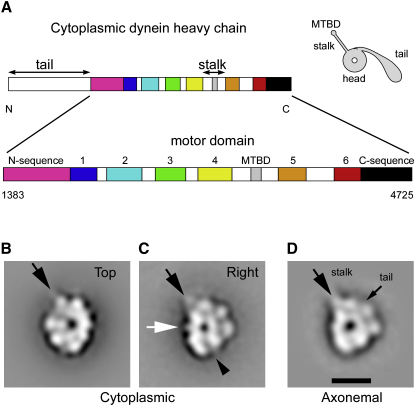
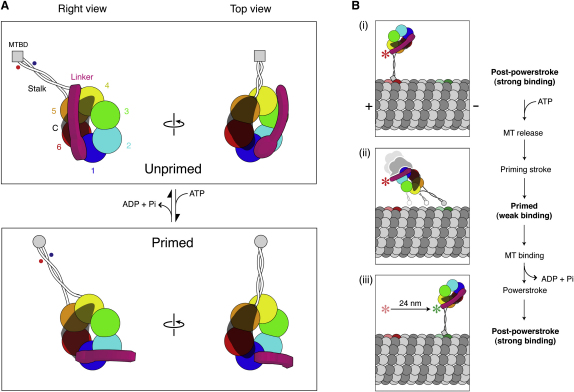
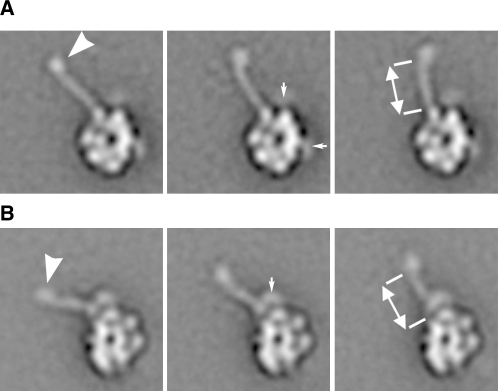
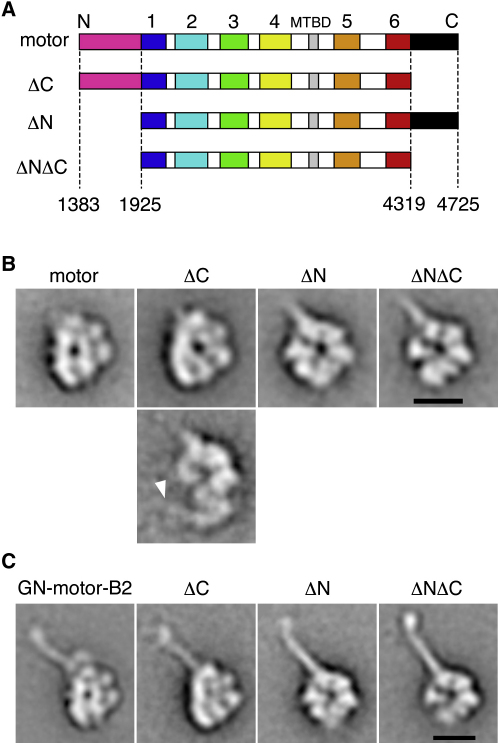
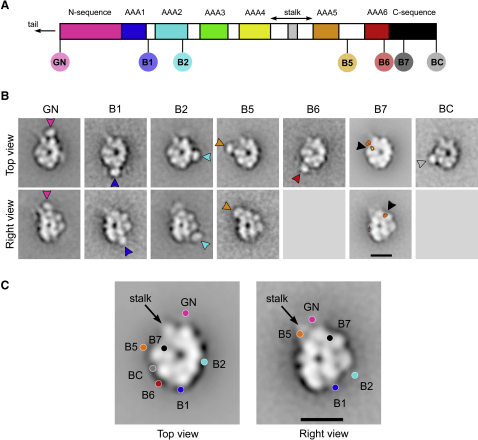
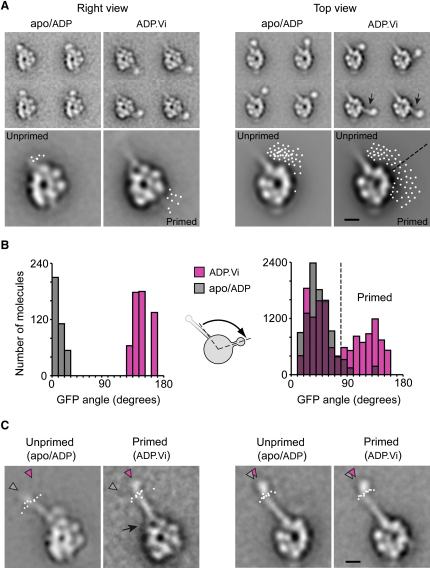
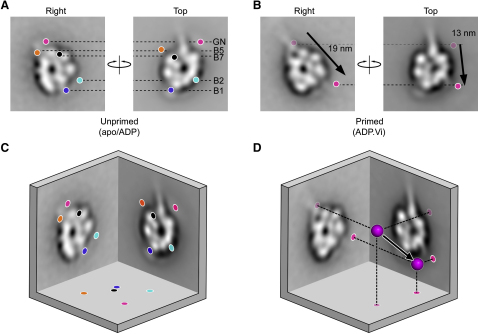
Dynein ATPases power diverse microtubule-based motilities. Each dynein motor domain comprises a ring-like head containing six AAA+ modules and N- and C-terminal regions, together with a stalk that binds microtubules. How these subdomains are arranged and generate force remains poorly understood. Here, using electron microscopy and image processing of tagged and truncated Dictyostelium cytoplasmic dynein constructs, we show that the heart of the motor is a hexameric ring of AAA+ modules, with the stalk emerging opposite the primary ATPase site (AAA1). The C-terminal region is not an integral part of the ring but spans between AAA6 and near the stalk base. The N-terminal region includes a lever-like linker whose N terminus swings by approximately 17 nm during the ATPase cycle between AAA2 and the stalk base. Together with evidence of stalk tilting, which may communicate changes in microtubule binding affinity, these findings suggest a model for dynein's structure and mechanism.
动力蛋白ATP酶驱动多种基于微管的运动。每个动力蛋白运动结构域都包含一个环状头部,该头部含有六个AAA+模块以及N端和C端区域,还有一个与微管结合的柄部。这些亚结构域是如何排列并产生力的,目前仍知之甚少。在这里,我们利用电子显微镜以及对标记和截短的盘基网柄菌细胞质动力蛋白构建体进行图像处理,结果表明,动力蛋白的核心是一个由AAA+模块组成的六聚体环,柄部从主要ATP酶位点(AAA1)的对面伸出。C端区域不是环的组成部分,而是横跨AAA6和靠近柄基部之间。N端区域包括一个杠杆状连接体,其N端在AAA2和柄基部之间的ATP酶循环过程中摆动约17纳米。再加上柄部倾斜的证据,这可能传递微管结合亲和力的变化,这些发现提示了一种关于动力蛋白结构和机制的模型。