Yang Zhikuan, Xiao Xueshan, Li Shiqiang, Zhang Qingjiong
State Key Laboratory of Ophthalmology, Zhongshan Ophthalmic Center, Sun Yat-sen University, Guangzhou, P. R. China.
Mol Vis. 2009;15:312-8. Epub 2009 Feb 9.
A linkage study on autosomal recessive high myopia (arHM) has not been reported, although several loci for autosomal dominant high myopia (adHM) have been mapped. Data from a consanguineous Chinese family with arHM were collected to map the genetic locus associated with this condition.
Phenotypic information and DNA samples were collected from family members. A genome-wide linkage scan combined with homozygosity mapping was performed by using 382 microsatellite DNA markers from the entire genome spaced at intervals of about 10 cM.
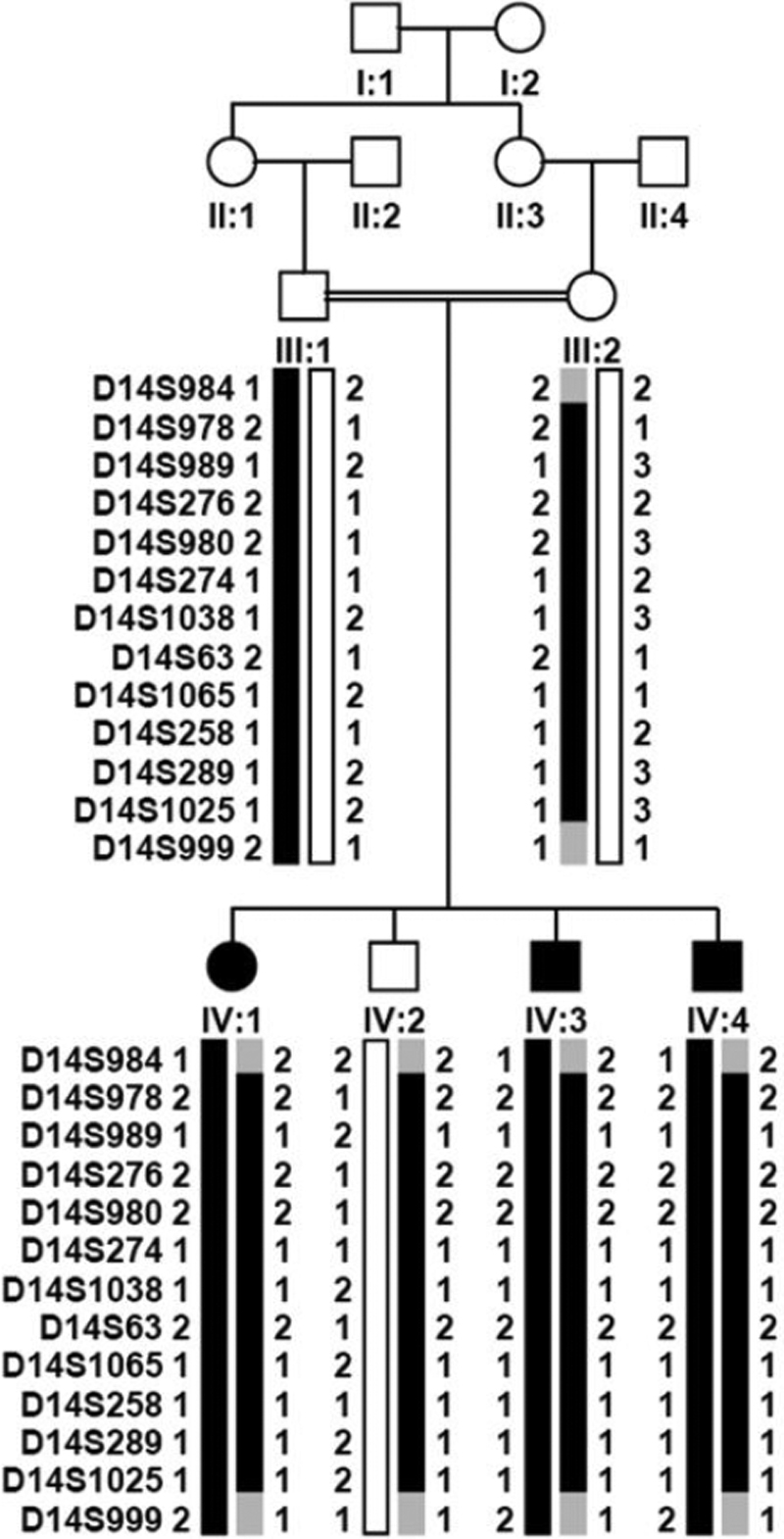
The pedigree and clinical data of the family indicate that the high myopia is autosomal recessive. A genome-wide scan of chromosomes 1-22 gave a LOD score greater than 1.0 for 22 markers. Linkage to most of these markers was not supported by closely flanking markers except for three possible loci on chromosomes 11, 14, and 17. Fine mapping and haplotype analysis provide evidence for a locus at 14q22.1-q24.2 in a 25.23 Mb region between markers D14S984 and D14S999 with a maximum LOD score of 2.19. All 11 microsatellite markers inside the linkage interval as well as haplotype construction point to a gene at this locus. Linkage elsewhere on chromosome 11 and chromosome 17 could not be excluded due to the small size of the family.
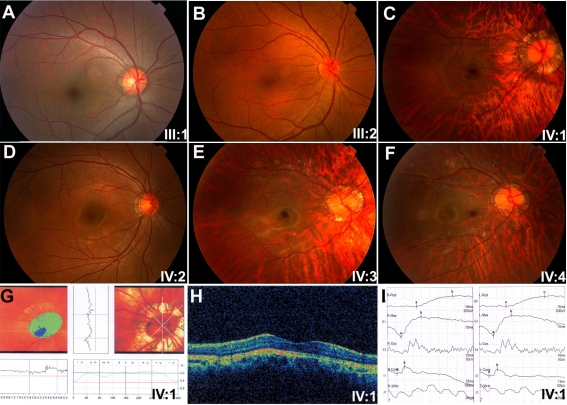
Pedigree and clinical data suggest that an autosomal recessive gene is responsible for high myopia in a consanguineous Chinese family. Genome-wide linkage analysis was used to map the gene for high myopia to a few limited loci. The resultant information should help future studies identify the gene for arHM. To our knowledge, this report is the first clinical and linkage study on a consanguineous family with arHM.
尽管已定位了几个常染色体显性高度近视(adHM)的基因座,但常染色体隐性高度近视(arHM)的连锁研究尚未见报道。收集了一个患arHM的近亲中国家系的数据,以定位与此病症相关的基因座。
从家庭成员中收集表型信息和DNA样本。使用来自全基因组的382个微卫星DNA标记,间隔约10厘摩(cM),进行全基因组连锁扫描并结合纯合性定位。
该家系的系谱和临床数据表明高度近视是常染色体隐性遗传。对1 - 22号染色体进行全基因组扫描,22个标记的对数优势(LOD)得分大于1.0。除了11号、14号和17号染色体上的三个可能基因座外,大多数这些标记的连锁关系未得到紧密侧翼标记的支持。精细定位和单倍型分析为14q22.1 - q24.2区域(位于标记D14S984和D14S999之间,跨度为25.23 Mb)的一个基因座提供了证据,最大LOD得分为2.19。连锁区间内的所有11个微卫星标记以及单倍型构建均指向该基因座处的一个基因。由于家系规模较小,不能排除11号染色体和17号染色体其他位置存在连锁关系的可能性。
系谱和临床数据表明,一个常染色体隐性基因导致了一个近亲中国家系中的高度近视。全基因组连锁分析用于将高度近视基因定位到几个有限的基因座。所得信息应有助于未来研究鉴定arHM的基因。据我们所知,本报告是关于一个患arHM的近亲家系的首次临床和连锁研究。