Department of Psychology, University of Turin, Turin, Italy;
Ther Clin Risk Manag. 2008 Oct;4(5):1127-34. doi: 10.2147/tcrm.s2719.
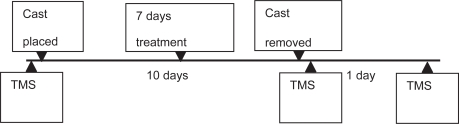
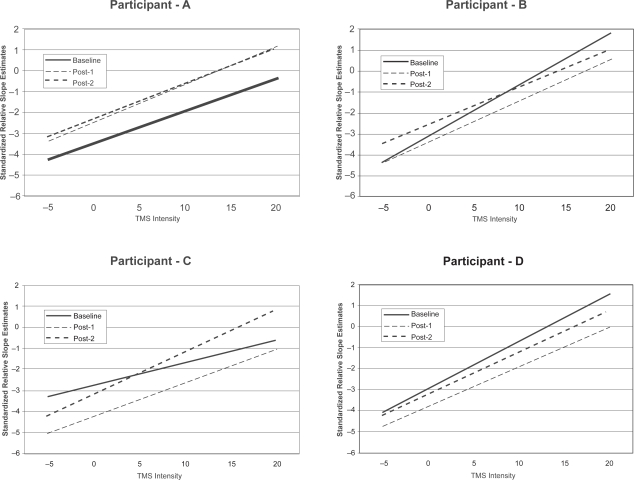
Short term immobilization of the lower limb is associated with increased corticospinal excitability at 24 hours post cast removal. We wondered whether daily stimulation of the motor cortex might decrease brain reorganization during casting. We tested the feasibility of this approach. Using transcranial magnetic stimulation (TMS), resting motor threshold and recruitment curves were obtained at baseline in 6 healthy participants who then had leg casts placed for 10 days. On 7 of the 10 days subjects received 20 minutes of 1 Hz repetitive TMS (rTMS). TMS measures were then recorded immediately after and 24 hours post cast removal. Four of 6 subjects completed the study. At the group level there were no changes in excitability following cast removal. At the individual level, two participants did not show any change, 1 participant had higher and one lower excitability 24 hours after cast removal. Daily rTMS over motor cortex is feasible during casting and may modify neuroplastic changes occurring during limb disuse. A prospective double blind study is warranted to test whether daily rTMS might improve outcome in subjects undergoing casting, and perhaps in other forms of limb disuse such as those following brain injury or weightlessness in space flight.
下肢短期固定会导致石膏去除后 24 小时皮质脊髓兴奋性增加。我们想知道运动皮层的每日刺激是否会减少石膏固定期间的大脑重组。我们测试了这种方法的可行性。使用经颅磁刺激 (TMS),在 6 名健康参与者的基线时获得静息运动阈值和募集曲线,然后让他们的腿部石膏固定 10 天。在 10 天中的 7 天中,受试者接受了 20 分钟 1 Hz 重复 TMS (rTMS)。然后在石膏去除后立即和 24 小时记录 TMS 测量值。4 名受试者完成了研究。在组水平上,石膏去除后兴奋性没有变化。在个体水平上,2 名参与者没有任何变化,1 名参与者的兴奋性在石膏去除后 24 小时升高,1 名参与者的兴奋性降低。在石膏固定期间,对运动皮层进行每日 rTMS 是可行的,并且可能会改变肢体失用时发生的神经可塑性变化。需要进行前瞻性双盲研究,以测试每日 rTMS 是否可以改善接受石膏固定的受试者的结果,也许可以改善其他形式的肢体失用,例如脑损伤或太空飞行失重后的肢体失用。