Brown Medical School, The Miriam Hospital, Weight Control and Diabetes Research Center, Providence, Rhode Island, USA.
Int J Behav Nutr Phys Act. 2009 Feb 16;6:10. doi: 10.1186/1479-5868-6-10.
To determine the feasibility of recruiting and retaining young adults in a brief behavioral weight loss intervention tailored for this age group, and to assess the preliminary efficacy of an intervention that emphasizes daily self-weighing within the context of a self-regulation model.
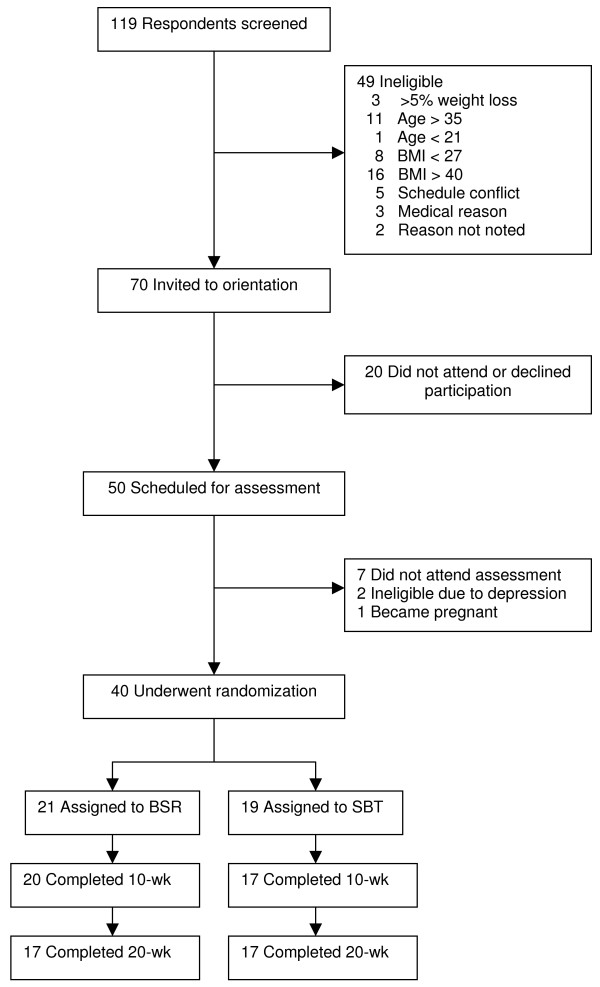
Forty young adults (29.1 +/- 3.9 years, range 21-35, average BMI of 33.36 +/- 3.4) were randomized to one of two brief behavioral weight loss interventions: behavioral self-regulation (BSR) or adapted standard behavioral treatment (SBT). Assessments were conducted at baseline, post-treatment (10 weeks), and follow-up (20 weeks). Intent to treat analyses were conducted using general linear modeling in SPSS version 14.0.
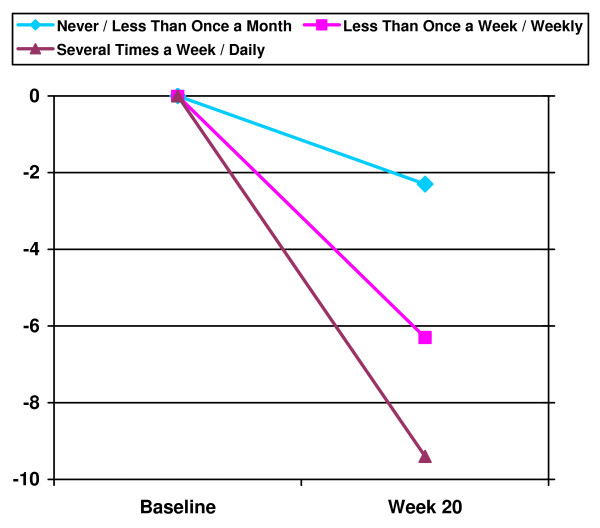
Participants in both groups attended an average of 8.7 out of 10 group meetings, and retention rates were 93% and 88% for post-treatment and follow-up assessments, respectively. Both groups achieved significant weight losses at post-treatment (BSR = -6.4 kg (4.0); SBT = -6.2 kg (4.5) and follow-up (BSR = -6.6 kg (5.5); SBT = -5.8 kg (5.2), p < .001; but the interaction of group x time was not statistically significant, p = .84. Across groups, there was a positive association between frequency of weighing at follow-up and overall weight change at follow-up (p = .01). Daily weighing was not associated with any adverse changes in psychological symptoms.
Young adults can be recruited and retained in a behavioral weight loss program tailored to their needs, and significant weight losses can be achieved and maintained through this brief intervention. Future research on the longer-term efficacy of a self-regulation approach using daily self-weighing for weight loss in this age group is warranted.
确定为该年龄段量身定制的简短行为减肥干预措施招募和保留年轻成年人的可行性,并评估强调自我调节模式下每日自我称重的干预措施的初步效果。
将 40 名年轻成年人(29.1±3.9 岁,范围 21-35,平均 BMI 为 33.36±3.4)随机分为两种简短行为减肥干预措施之一:行为自我调节(BSR)或适应性标准行为治疗(SBT)。评估在基线、治疗后(10 周)和随访(20 周)进行。使用 SPSS 版本 14.0 中的一般线性建模进行意向治疗分析。
两组参与者平均参加了 10 次小组会议中的 8.7 次,治疗后和随访评估的保留率分别为 93%和 88%。两组在治疗后(BSR =-6.4kg(4.0);SBT =-6.2kg(4.5)和随访(BSR =-6.6kg(5.5);SBT =-5.8kg(5.2)时体重均显著减轻,p<0.001;但组 x 时间的交互作用无统计学意义,p=0.84。在两组中,随访时称重的频率与随访时的总体体重变化呈正相关(p=0.01)。每日称重与任何心理症状的不良变化无关。
可以招募和保留适合年轻成年人需求的行为减肥计划,通过这种简短的干预可以实现并维持显著的体重减轻。需要进一步研究自我调节方法使用每日自我称重在该年龄段减肥的长期效果。
#NCT00488228。