Tong Chaobo, Guo Baocheng, He Shunping
Laboratory of Fish Phylogenetics and Biogeography, Institute of Hydrobiology, Chinese Academy of Sciences, Wuhan, PR China.
BMC Genomics. 2009 Feb 19;10:83. doi: 10.1186/1471-2164-10-83.
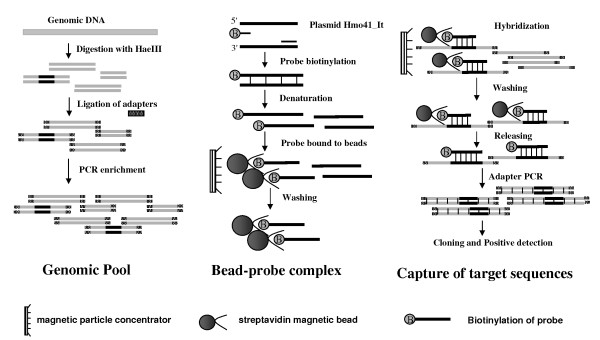
Short and long interspersed elements (SINEs and LINEs, respectively), two types of retroposons, are active in shaping the architecture of genomes and powerful tools for studies of phylogeny and population biology. Here we developed special protocol to apply biotin-streptavidin bead system into isolation of interspersed repeated sequences rapidly and efficiently, in which SINEs and LINEs were captured directly from digested genomic DNA by hybridization to bead-probe complex in solution instead of traditional strategy including genomic library construction and screening.
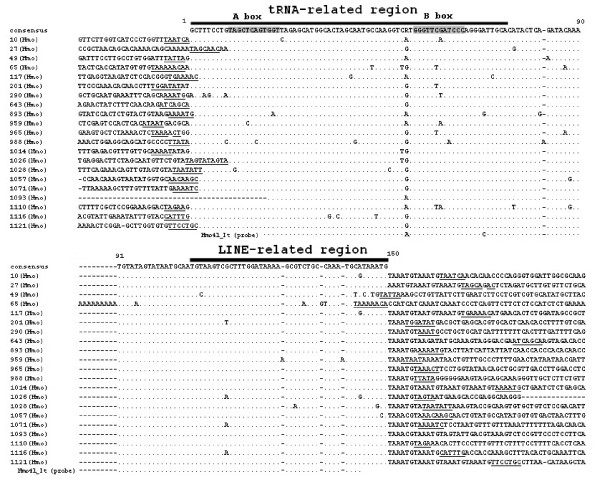
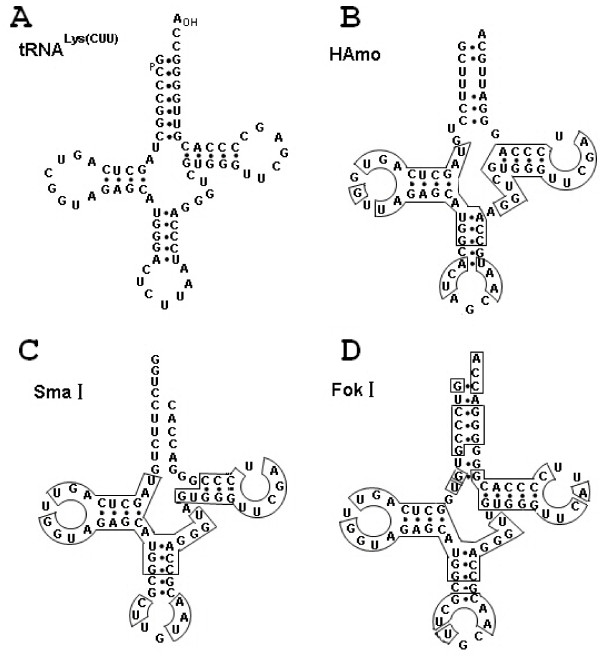
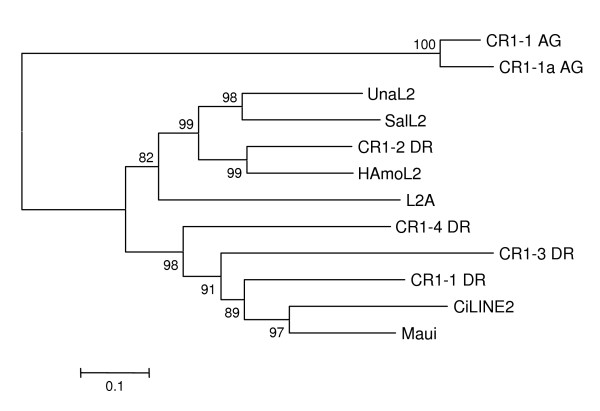
A new couple of SINEs and LINEs that shared an almost identical 3'tail was isolated and characterized in silver carp and bighead carp of two closely related species. These SINEs (34 members), designated HAmo SINE family, were little divergent in sequence and flanked by obvious TSD indicated that HAmo SINE was very young family. The copy numbers of this family was estimated to 2 x 10⁵ and 1.7 x 10⁵ per haploid genome by Real-Time qPCR, respectively. The LINEs, identified as the homologs of LINE2 in other fishes, had a conserved primary sequence and secondary structures of the 3'tail region that was almost identical to that of HAmo SINE. These evidences suggest that HAmo SINEs are active and amplified recently utilizing the enzymatic machinery for retroposition of HAmoL2 through the recognition of higher-order structures of the conserved 42-tail region. We analyzed the possible structures of HAmo SINE that lead to successful amplification in genome and then deduced that HAmo SINE, SmaI SINE and FokI SINE that were similar in sequence each other, were probably generated independently and created by LINE family within the same lineage of a LINE phylogeny in the genomes of different hosts.
The presented results show the advantage of the novel method for retroposons isolation and a pair of young SINE family and its partner LINE family in two carp fishes, which strengthened the hypotheses containing the slippage model for initiation of reverse transcription, retropositional parasitism of SINEs on LINEs, the formation of the stem loop structure in 3'tail region of some SINEs and LINEs and the mechanism of template switching in generating new SINE family.
短散在元件(SINEs)和长散在元件(LINEs)是两类逆转座子,它们在塑造基因组结构方面发挥着重要作用,也是系统发育和群体生物学研究的有力工具。在此,我们开发了一种特殊方法,将生物素 - 链霉亲和素磁珠系统快速高效地应用于散布重复序列的分离,其中SINEs和LINEs是通过与溶液中的磁珠 - 探针复合物杂交,直接从消化后的基因组DNA中捕获,而不是采用包括基因组文库构建和筛选在内的传统策略。
在两个亲缘关系密切的物种——鲢鱼和鳙鱼中,分离并鉴定出了一对具有几乎相同3'末端的新型SINEs和LINEs。这些SINEs(34个成员)被命名为HAmo SINE家族,其序列差异较小,两侧有明显的靶位点重复(TSD),表明HAmo SINE是一个非常年轻的家族。通过实时定量PCR估计,该家族在每个单倍体基因组中的拷贝数分别为2×10⁵和1.7×10⁵。这些LINEs被鉴定为其他鱼类中LINE2的同源物,其3'末端区域具有保守的一级序列和二级结构,与HAmo SINE的几乎相同。这些证据表明,HAmo SINEs是活跃的,并且最近通过识别保守的42个碱基的3'末端区域的高级结构,利用HAmoL2逆转座的酶机制进行了扩增。我们分析了HAmo SINE在基因组中成功扩增的可能结构,然后推断出彼此序列相似的HAmo SINE、SmaI SINE和FokI SINE可能是独立产生的,并且是由不同宿主基因组中LINE系统发育同一谱系内的LINE家族产生的。
本文结果展示了这种用于逆转座子分离的新方法的优势,以及在两种鲤鱼中发现的一对年轻的SINE家族及其对应的LINE家族,这强化了包含逆转录起始的滑动模型、SINEs对LINEs的逆转座寄生、一些SINEs和LINEs的3'末端区域茎环结构的形成以及产生新SINE家族的模板转换机制在内的假说。