Yang Sufang, Alkayed Nabil J, Hurn Patricia D, Kirsch Jeffrey R
Department of Anesthesiology and Perioperative Medicine, Oregon Health Sciences University, 3181 SW Sam Jackson Park Rd., Portland, OR 97239-3098, USA.
Anesth Analg. 2009 Mar;108(3):964-70. doi: 10.1213/ane.0b013e318192442c.
Previous studies show that the potent, prototypical sigma(1)-receptor agonist 4-phenyl-1-(4-phenylbutyl) piperidine (PPBP) prevents cell death after oxygen-glucose deprivation (OGD) in primary cortical neuronal cultures. We tested the hypothesis that PPBP protects neurons by a mechanism involving activation of the transcription factor cyclic adenosine monophosphate response element-binding protein (CREB).
Primary cultured cortical neurons were exposed to 2 h of OGD and allowed to recover for 24 h, and PPBP treatment was initiated 15 min before the insult in the presence and absence of the sigma(1)-receptor antagonist rimcazole and inhibitors against protein kinases known to activate signal transduction cascades that result in CREB phosphorylation, such as H89 (protein kinase A inhibitor), LY294002 (PI3K inhibitor), U0126 (MEK1/2 inhibitor), or KN62 calmodulin kinase II inhibitor). Neuronal cell death was assayed by lactate dehydrogenase measurement 24 h after OGD. CREB phosphorylation was measured by immunoblot analysis at 30 min, 1 h, and 3 h of reoxygenation. Blots were quantitatively analyzed using Quantity One image analysis software.
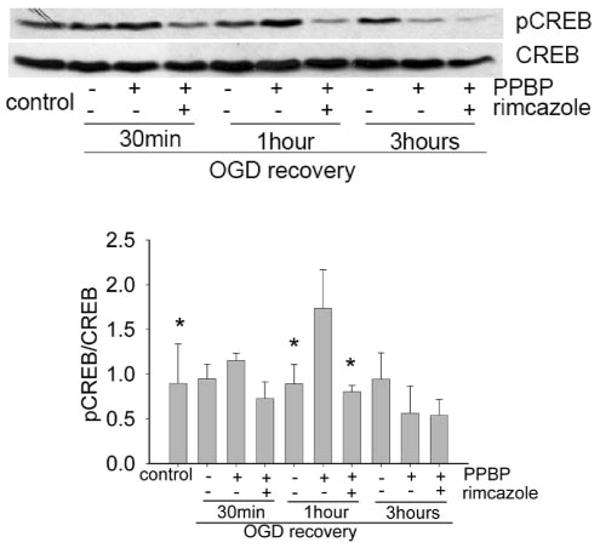
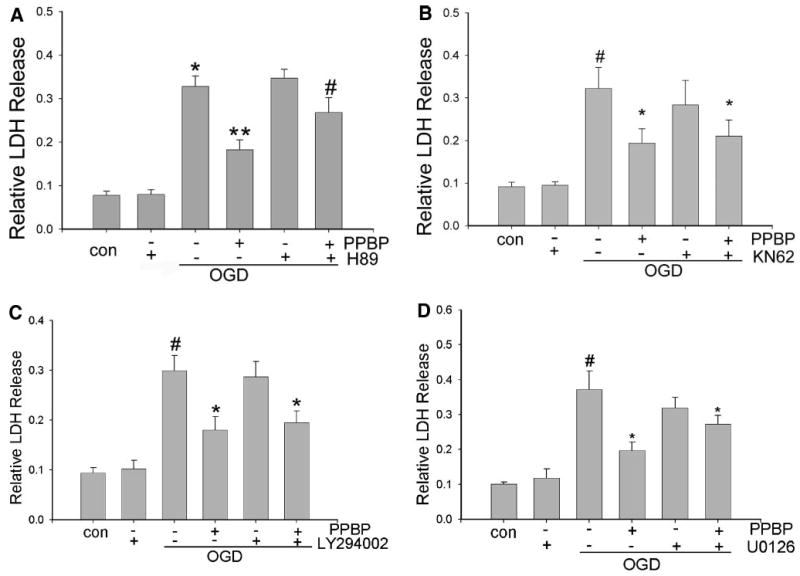
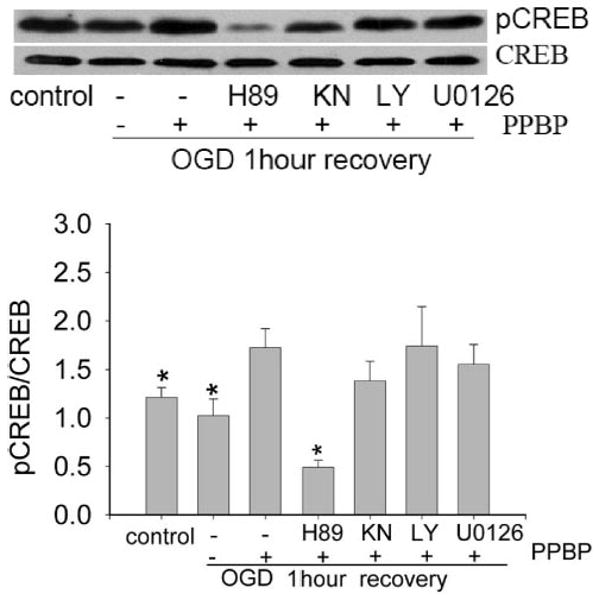
PPBP increased CREB phosphorylation at 1 h after recovery from OGD, which was abolished by rimcazole (1.7 +/- 0.2 in PPBP and 0.8 +/- 0.1 in PPBP plus rimcazole with OGD compared with 0.9 +/- 0.1 in OGD alone, p-CREB/CREB). The PPBP-induced increase in CREB phosphorylation was blocked by H89 (0.5 +/- 0.07) but not U0126, KN62, or LY294002. PPBP treatment prevented OGD-induced cell death and pretreatment with H89 blocked this protection (0.18 +/- 0.02 in PPBP and 0.27 +/- 0.03 in PPBP plus H89 with OGD compared with 0.33 +/- 0.02 in OGD alone, lactate dehydrogenase assay). Pretreatment with LY294002, UO126, or KN62 had no effect on neuronal protection by PPBP.
These data suggest that the mechanism of neuroprotection by PPBP may be linked to CREB phosphorylation.
先前的研究表明,强效的、典型的σ1受体激动剂4-苯基-1-(4-苯基丁基)哌啶(PPBP)可防止原代皮质神经元培养物中氧糖剥夺(OGD)后的细胞死亡。我们验证了如下假设:PPBP通过涉及激活转录因子环磷酸腺苷反应元件结合蛋白(CREB)的机制来保护神经元。
将原代培养的皮质神经元暴露于OGD 2小时,然后恢复24小时,在有或没有σ1受体拮抗剂利米卡唑以及针对已知可激活导致CREB磷酸化的信号转导级联反应的蛋白激酶的抑制剂(如H89(蛋白激酶A抑制剂)、LY294002(PI3K抑制剂)、U0126(MEK1/2抑制剂)或KN62(钙调蛋白激酶II抑制剂))存在的情况下,在损伤前15分钟开始进行PPBP处理。在OGD后24小时通过乳酸脱氢酶测量来检测神经元细胞死亡。在复氧30分钟、1小时和3小时时通过免疫印迹分析来测量CREB磷酸化。使用Quantity One图像分析软件对印迹进行定量分析。
PPBP在从OGD恢复后1小时增加了CREB磷酸化,这被利米卡唑消除(与单独OGD时的0.9±0.1相比,OGD时PPBP组的p-CREB/CREB为1.7±0.2,PPBP加rimcazole组为0.8±0.1)。PPBP诱导的CREB磷酸化增加被H89阻断(0.5±0.07),但未被U0126、KN62或LY294002阻断。PPBP处理可防止OGD诱导的细胞死亡,用H89预处理可阻断这种保护作用(与单独OGD时的0.33±0.02相比,OGD时PPBP组的乳酸脱氢酶测定值为0.18±0.02,PPBP加H89组为0.27±0.03)。用LY294002、UO126或KN62预处理对PPBP的神经元保护作用没有影响。
这些数据表明,PPBP的神经保护机制可能与CREB磷酸化有关。