Singh Sangita, Madzelan Peter, Stasser Jay, Weeks Colin L, Becker Donald, Spiro Thomas G, Penner-Hahn James, Banerjee Ruma
Department of Biological Chemistry, University of Michigan, Ann Arbor, 48109-0606, United States.
J Inorg Biochem. 2009 May;103(5):689-97. doi: 10.1016/j.jinorgbio.2009.01.009. Epub 2009 Jan 22.
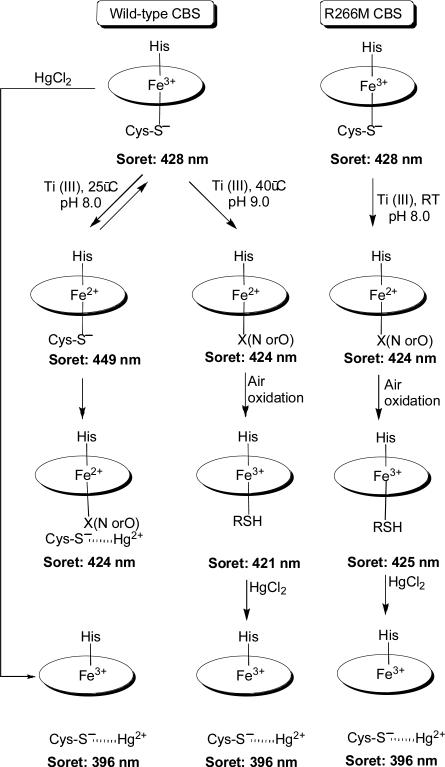
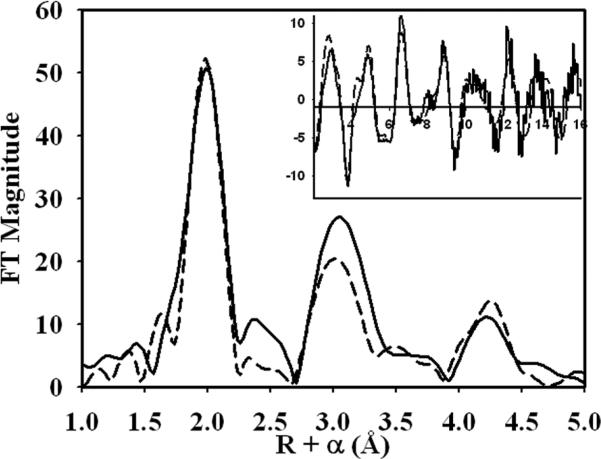
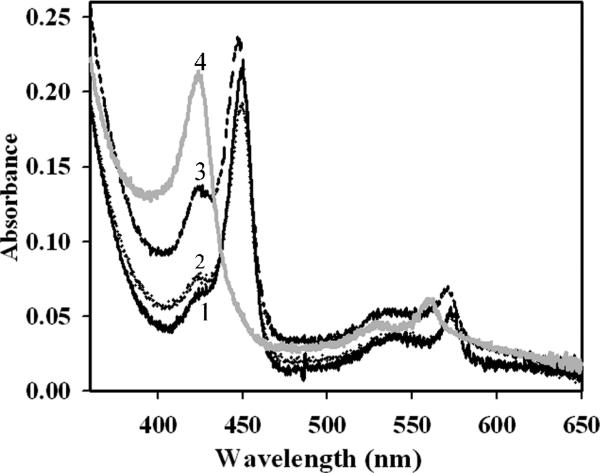
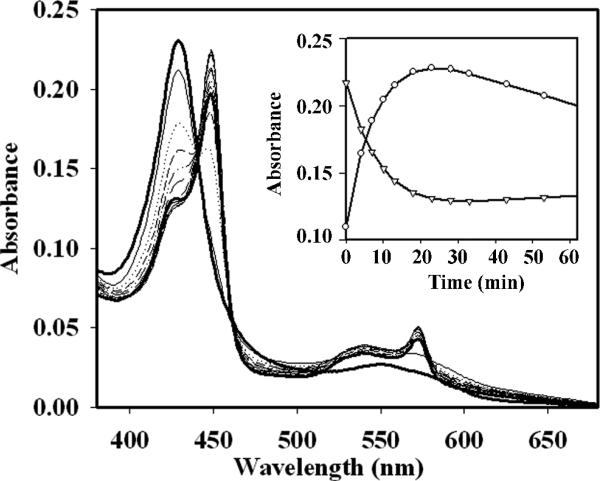
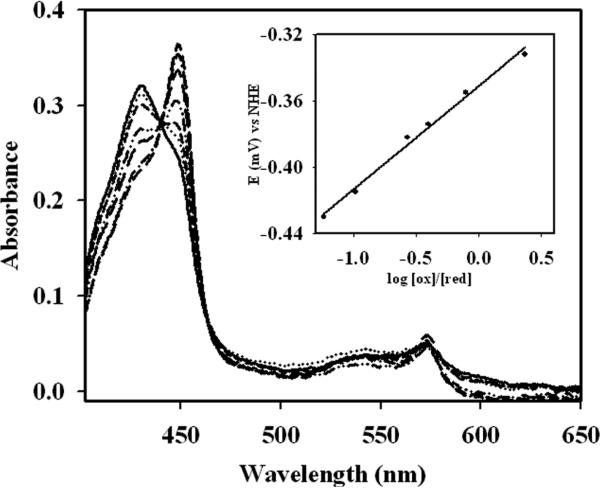
In humans, cystathionine beta-synthase (CBS) is a hemeprotein, which catalyzes a pyridoxal phosphate (PLP)-dependent condensation reaction. Changes in the heme environment are communicated to the active site, which is approximately 20A away. In this study, we have examined the role of H67 and R266, which are in the second coordination sphere of the heme ligands, H65 and C52, respectively, in modulating the heme's electronic properties and in transmitting information between the heme and active sites. While the H67A mutation is comparable to wild-type CBS, interesting differences are revealed by mutations at the R266 site. The pathogenic mutant, R266K, is moderately PLP-responsive while the R266M mutation shows dramatic differences in the ferrous state. The electrostatic interaction between C52 and R266 is critical for stabilizing the ferrous heme and its disruption leads to the facile formation of a 424nm (C-424) absorbing ferrous species, which is inactive, compared to the active 449nm ferrous species for wild-type CBS. Resonance Raman studies on the R266M mutant reveal that the kinetics of C52 rebinding after Fe-CO photolysis are comparable to that of wild-type CBS. EXAFS studies on C-424 CBS are consistent with the presence of two axial N/O low Z scatters with only one being a rigid unit of a histidine residue while the other could be a solvent molecule, an oxygen atom from the peptide backbone or a side chain nitrogen. The redox potential for the heme in full-length CBS is -350+/-4mV and is substantially lower than the value of -287+/-2mV determined for truncated CBS. A redox-regulated ligand change has the potential to serve as an allosteric on/off switch in human CBS and the second sphere ligand, R266, plays an important role in this transition.
在人类中,胱硫醚β-合酶(CBS)是一种血红素蛋白,它催化一种依赖磷酸吡哆醛(PLP)的缩合反应。血红素环境的变化会传递到约20埃外的活性位点。在本研究中,我们研究了分别位于血红素配体H65和C52的第二配位层中的H67和R266在调节血红素电子性质以及在血红素与活性位点之间传递信息方面的作用。虽然H67A突变体与野生型CBS相当,但R266位点的突变揭示了有趣的差异。致病突变体R266K对PLP有中度反应,而R266M突变在亚铁状态下表现出显著差异。C52与R266之间的静电相互作用对于稳定亚铁血红素至关重要,其破坏会导致形成一种吸收亚铁物种的424nm(C-424),与野生型CBS的活性449nm亚铁物种相比,该物种无活性。对R266M突变体的共振拉曼研究表明,Fe-CO光解后C52重新结合的动力学与野生型CBS相当。对C-424 CBS的扩展X射线吸收精细结构(EXAFS)研究表明,存在两个轴向N/O低Z散射体,其中只有一个是组氨酸残基的刚性单元,另一个可能是溶剂分子、肽主链的氧原子或侧链氮。全长CBS中血红素的氧化还原电位为-350±4mV,大大低于截短型CBS测定的-287±2mV的值。氧化还原调节的配体变化有可能作为人类CBS中的变构开/关开关,第二配位层配体R266在这一转变中起重要作用。