Ma Yueyun, Qi Xiaofei, Du Jianjun, Song Shaojun, Feng Dongyun, Qi Jia, Zhu Zhidong, Zhang Xin, Xiao Huasheng, Han Zeguang, Hao Xiaoke
Center for Clinical Laboratory Medicine of PLA, Xijing Hospital, Fourth Military Medical University, Xi'an 710032, PR China.
BMC Genomics. 2009 Mar 15;10:109. doi: 10.1186/1471-2164-10-109.
The pituitary is a critical neuroendocrine gland that is comprised of five hormone-secreting cell types, which develops in tandem during the embryonic stage. Some essential genes have been identified in the early stage of adenohypophysial development, such as PITX1, FGF8, BMP4 and SF-1. However, it is likely that a large number of signaling molecules and transcription factors essential for determination and terminal differentiation of specific cell types remain unidentified. High-throughput methods such as microarray analysis may facilitate the measurement of gene transcriptional levels, while Expressed sequence tag (EST) sequencing, an efficient method for gene discovery and expression level analysis, may no-redundantly help to understand gene expression patterns during development.
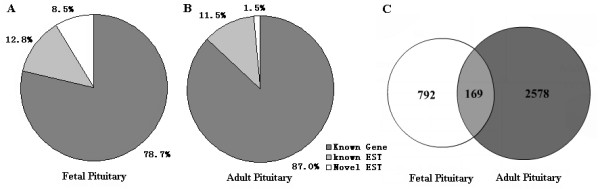
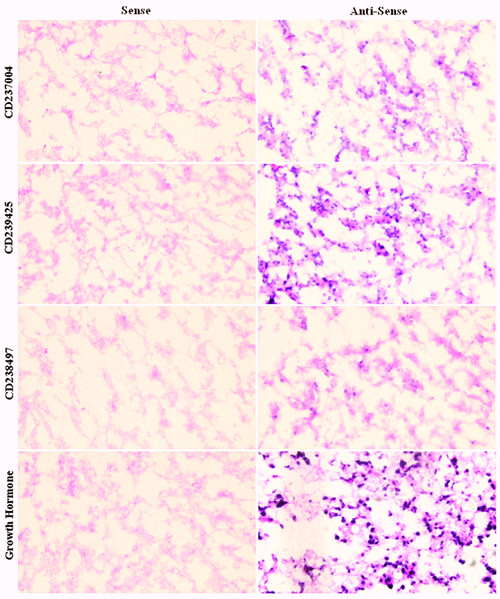
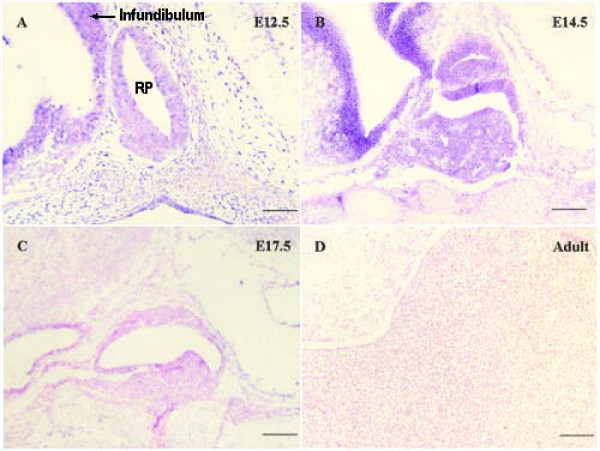
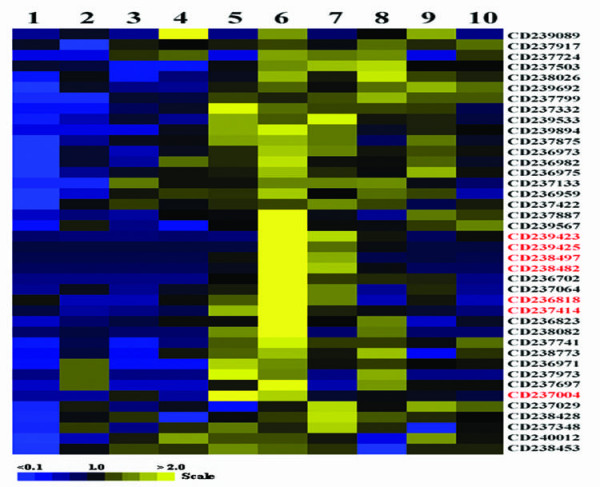
A total of 9,271 ESTs were generated from both fetal and adult pituitaries, and assigned into 961 gene/EST clusters in fetal and 2,747 in adult pituitary by homology analysis. The transcription maps derived from these data indicated that developmentally relevant genes, such as Sox4, ST13 and ZNF185, were dominant in the cDNA library of fetal pituitary, while hormones and hormone-associated genes, such as GH1, GH2, POMC, LHbeta, CHGA and CHGB, were dominant in adult pituitary. Furthermore, by using RT-PCR and in situ hybridization, Sox4 was found to be one of the main transcription factors expressed in fetal pituitary for the first time. It was expressed at least at E12.5, but decreased after E17.5. In addition, 40 novel ESTs were identified specifically in this tissue.
The significant changes in gene expression in both tissues suggest a distinct and dynamic switch between embryonic and adult pituitaries. All these data along with Sox4 should be confirmed to further understand the community of multiple signaling pathways that act as a cooperative network that regulates maturation of the pituitary. It was also suggested that EST sequencing is an efficient means of gene discovery.
垂体是一个关键的神经内分泌腺,由五种分泌激素的细胞类型组成,在胚胎期同步发育。在腺垂体发育的早期已经鉴定出一些重要基因,如PITX1、FGF8、BMP4和SF-1。然而,对于特定细胞类型的确定和终末分化所必需的大量信号分子和转录因子可能仍未被鉴定出来。诸如微阵列分析等高通量方法可能有助于测量基因转录水平,而表达序列标签(EST)测序作为一种用于基因发现和表达水平分析的有效方法,可能有助于无冗余地了解发育过程中的基因表达模式。
从胎儿和成人垂体中总共产生了9271个EST,并通过同源性分析将其分为胎儿垂体中的961个基因/EST簇和成人垂体中的2747个。从这些数据得出的转录图谱表明,与发育相关的基因,如Sox4、ST13和ZNF185,在胎儿垂体的cDNA文库中占主导地位,而激素和激素相关基因,如GH1、GH2、POMC、LHβ、CHGA和CHGB,在成人垂体中占主导地位。此外,通过使用逆转录聚合酶链反应(RT-PCR)和原位杂交,首次发现Sox4是胎儿垂体中表达的主要转录因子之一。它至少在胚胎第12.5天表达,但在胚胎第17.5天后下降。此外,在该组织中特异性鉴定出40个新的EST。
两种组织中基因表达的显著变化表明胚胎垂体和成人垂体之间存在明显的动态转变。所有这些数据以及Sox4都应得到证实,以进一步了解作为调节垂体成熟的合作网络的多种信号通路群落。还表明EST测序是一种有效的基因发现手段。