Bren Gary D, Trushin Sergey A, Whitman Joe, Shepard Brett, Badley Andrew D
Division of Infectious Diseases, Mayo Clinic, Rochester, MN, USA.
PLoS One. 2009;4(3):e4875. doi: 10.1371/journal.pone.0004875. Epub 2009 Mar 16.
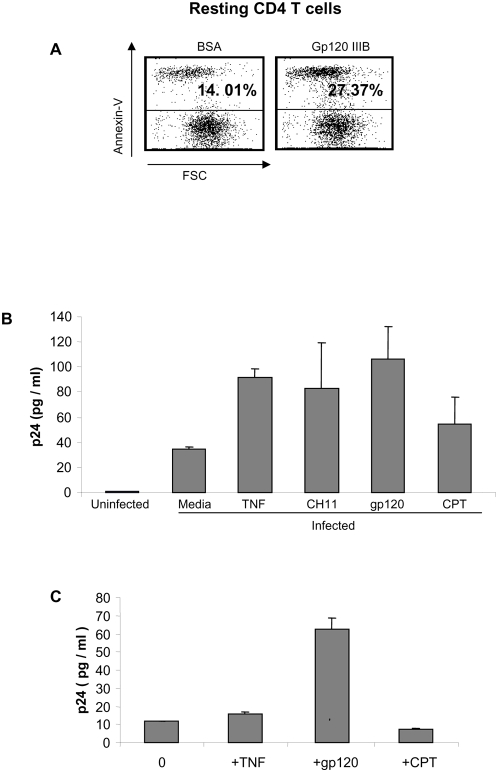
HIV envelope glycoprotein gp120 causes cellular activation resulting in anergy, apoptosis, proinflammatory cytokine production, and through an unknown mechanism, enhanced HIV replication.
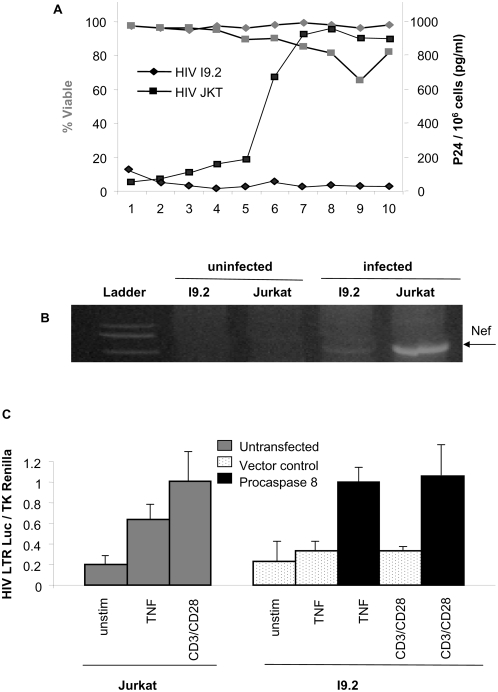
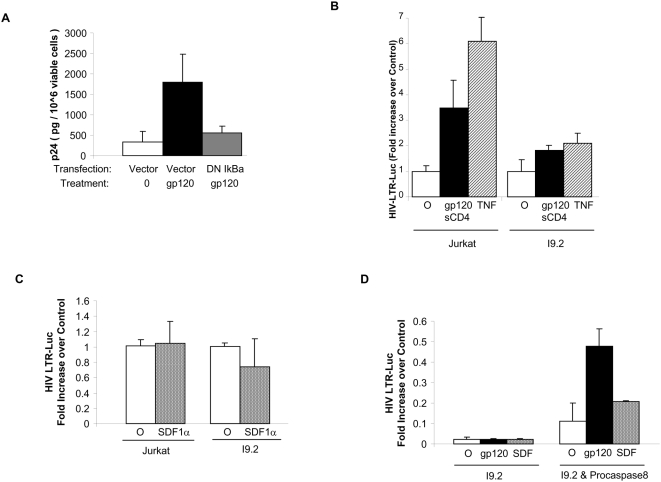
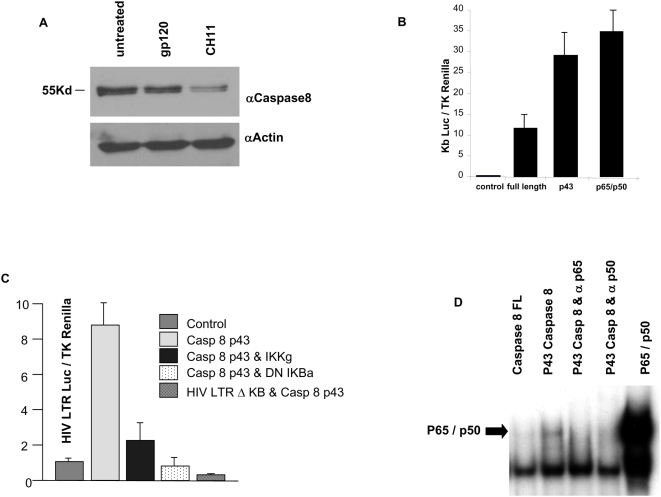
METHODOLOGY/PRINCIPAL FINDINGS: We describe that the signals which promote apoptosis are also responsible for the enhanced HIV replication. Specifically, we demonstrate that the caspase 8 cleavage fragment Caspase8p43, activates p50/p65 Nuclear Factor kappaB (NF-kappaB), in a manner which is inhibited by dominant negative IkappaBalpha. This caspase 8 dependent NF-kappaB activation occurs following stimulation with gp120, TNF, or CD3/CD28 crosslinking, but these treatments do not activate NF-kappaB in cells deficient in caspase 8. The Casp8p43 cleavage fragment also transactivates the HIV LTR through NF-kappaB, and the absence of caspase 8 following HIV infection greatly inhibits HIV replication.
CONCLUSION/SIGNIFICANCE: Gp120 induced caspase 8 dependent NF-kappaB activation is a novel pathway of HIV replication which increases understanding of the biology of T-cell death, as well as having implications for understanding treatment and prevention of HIV infection.
HIV包膜糖蛋白gp120可导致细胞活化,进而引起无反应性、细胞凋亡、促炎细胞因子产生,并通过一种未知机制增强HIV复制。
方法/主要发现:我们描述了促进细胞凋亡的信号也与HIV复制增强有关。具体而言,我们证明半胱天冬酶8裂解片段Caspase8p43以一种被显性负性IκBα抑制的方式激活p50/p65核因子κB(NF-κB)。这种半胱天冬酶8依赖性NF-κB激活发生在gp120、肿瘤坏死因子(TNF)或CD3/CD28交联刺激之后,但这些处理在缺乏半胱天冬酶8的细胞中不会激活NF-κB。Casp8p43裂解片段还通过NF-κB反式激活HIV长末端重复序列(LTR),并且HIV感染后半胱天冬酶8的缺失极大地抑制了HIV复制。
结论/意义:Gp120诱导的半胱天冬酶8依赖性NF-κB激活是HIV复制的一条新途径,这增加了我们对T细胞死亡生物学的理解,同时也对理解HIV感染的治疗和预防具有重要意义。