Moss Nicholas G, Riguera Dorothy A, Solinga Robert M, Kessler Marco M, Zimmer Daniel P, Arendshorst William J, Currie Mark G, Goy Michael F
University of North Carolina at Chapel Hill, Department of Cell and Molecular Physiology, 111 Mason Farm Rd, Chapel Hill, NC 27599, USA.
Hypertension. 2009 May;53(5):867-76. doi: 10.1161/HYPERTENSIONAHA.108.128264. Epub 2009 Mar 16.
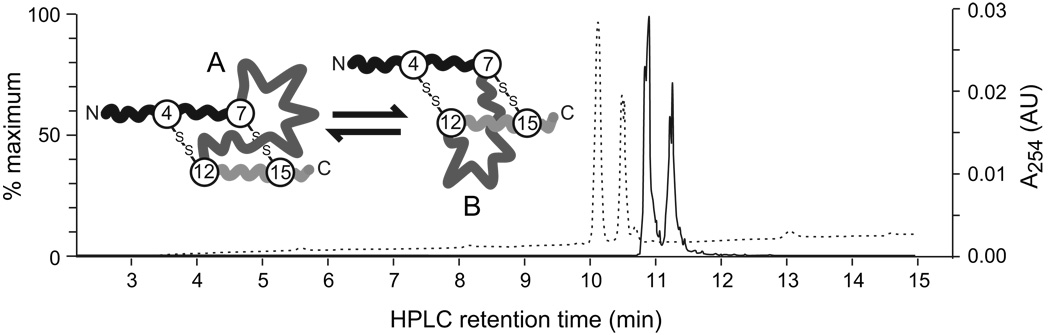
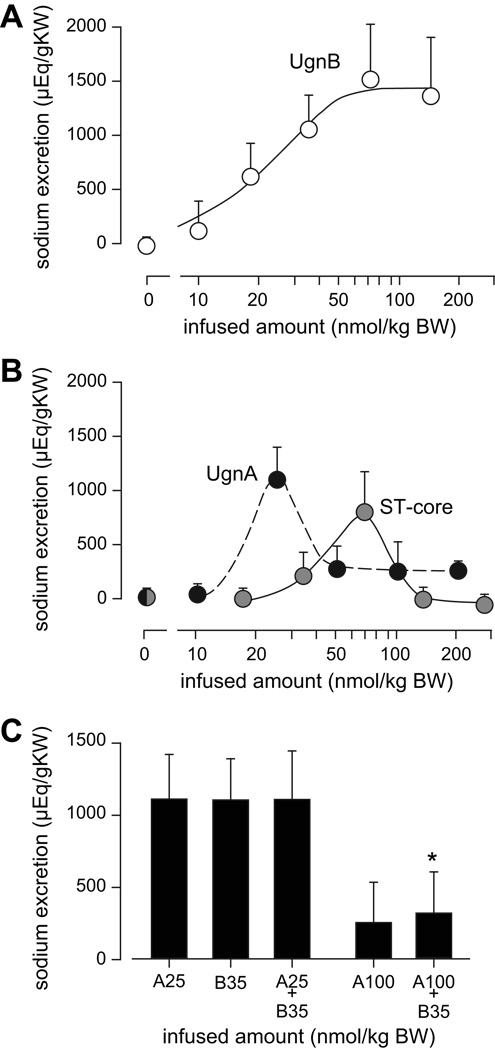
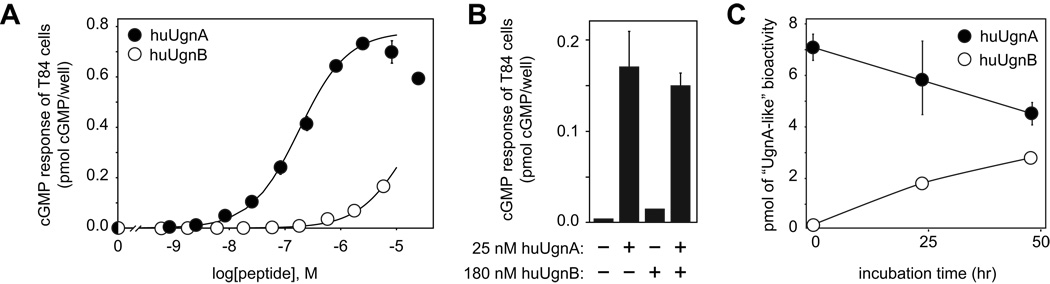
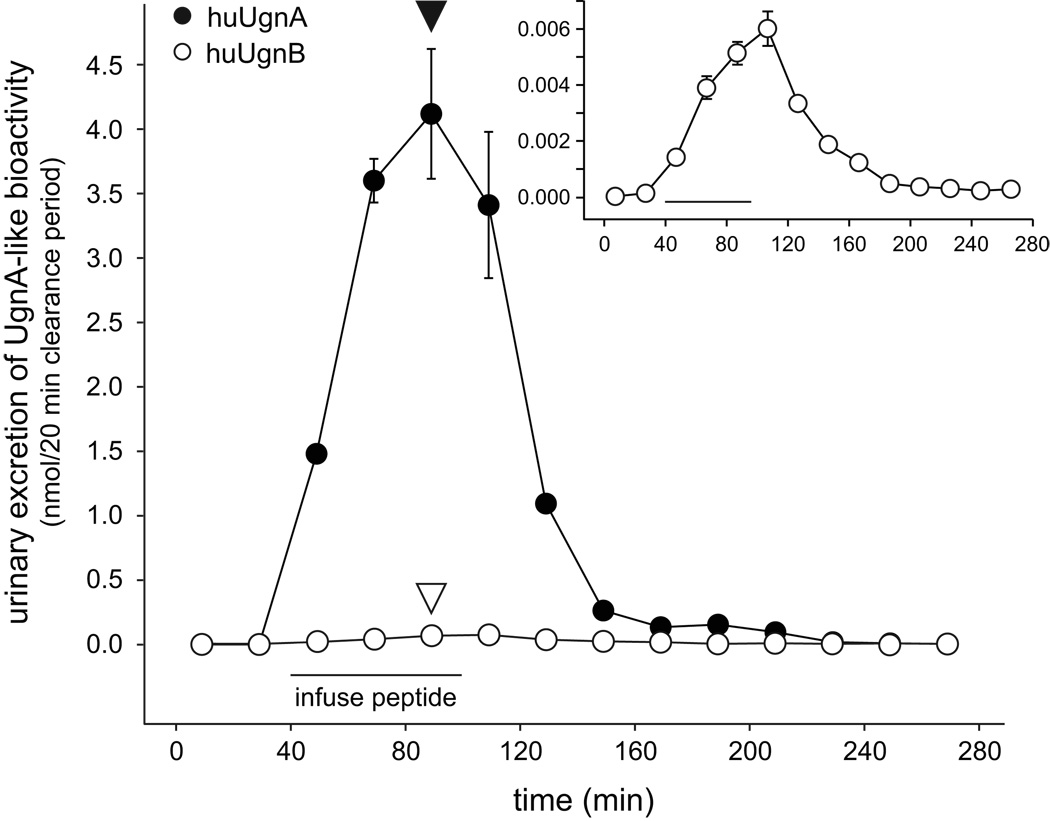
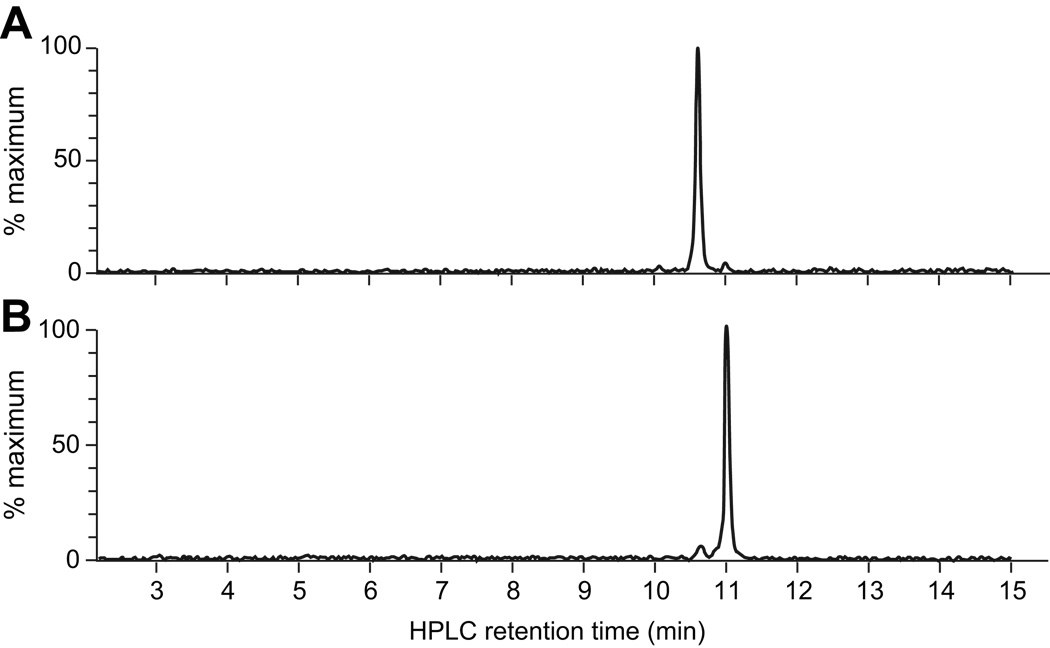
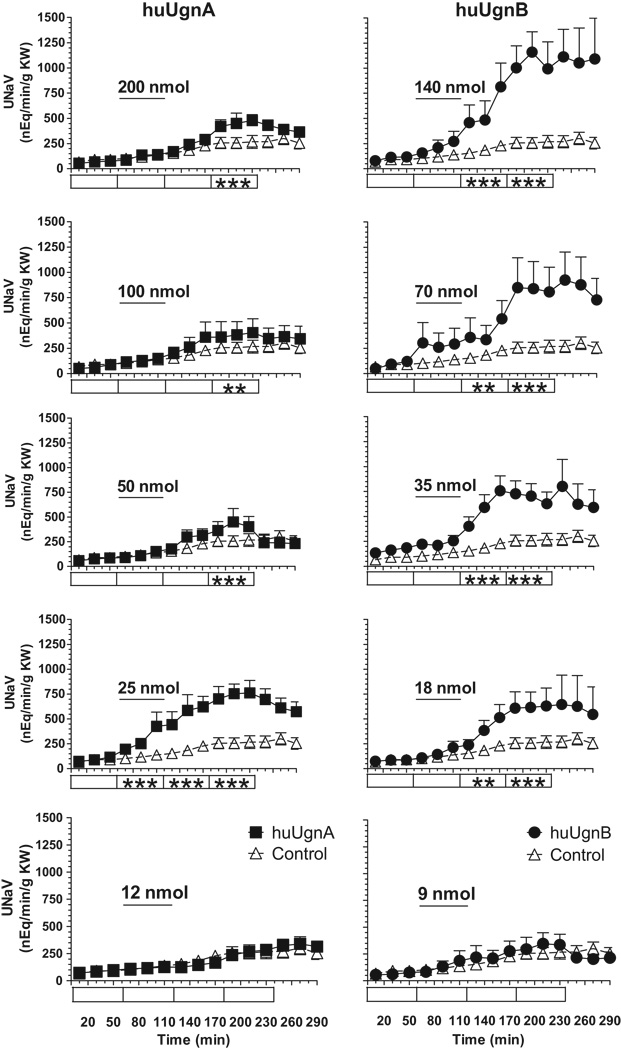
The peptide uroguanylin regulates electrolyte transport in the intestine and kidney. Human uroguanylin has 2 conformations that can be stably isolated because of their slow interconversion rate. The A isomer potently activates the guanylate cyclase C receptor found primarily in the intestine. The B isomer, by contrast, is a very weak agonist of this receptor, leading to a widely held assumption that it is physiologically irrelevant. We show here, however, that human uroguanylin B has potent natriuretic activity in the kidney. Interestingly, uroguanylin A and B both induce saluretic responses, but the activity profiles for the 2 peptides differ markedly. The uroguanylin B dose-response curve is sigmoidal with a threshold dose of approximately 10 nmol/kg of body weight, whereas uroguanylin A has a comparable threshold but a bell-shaped dose-response curve. In addition, our study indicates a unique interplay between the A and B isoforms, such that the A form at high concentrations antagonizes the natriuretic action of the B form. These data show that the kidney contains a uroguanylin receptor of which the pharmacological profile does not match that of the well-defined intestinal uroguanylin receptor (guanylate cyclase C), an observation consistent with previous studies showing that the kidney of the guanylate cyclase C knockout mouse remains responsive to uroguanylin. The results presented here also support the unconventional notion that distinct conformations of a single endocrine peptide can elicit different responses in different tissues.
肽类尿鸟苷素可调节肠道和肾脏中的电解质转运。人尿鸟苷素有两种构象,由于它们之间的相互转化速率较慢,因此可以稳定分离。A异构体可有效激活主要存在于肠道中的鸟苷酸环化酶C受体。相比之下,B异构体是该受体的非常弱的激动剂,这导致人们普遍认为它在生理上无关紧要。然而,我们在此表明,人尿鸟苷素B在肾脏中具有强大的利钠活性。有趣的是,尿鸟苷素A和B均诱导利盐反应,但这两种肽的活性谱明显不同。尿鸟苷素B的剂量反应曲线呈S形,阈值剂量约为10 nmol/kg体重,而尿鸟苷素A具有相当的阈值,但呈钟形剂量反应曲线。此外,我们的研究表明A和B异构体之间存在独特的相互作用,使得高浓度的A形式拮抗B形式的利钠作用。这些数据表明,肾脏中存在一种尿鸟苷素受体,其药理学特征与明确的肠道尿鸟苷素受体(鸟苷酸环化酶C)不匹配,这一观察结果与先前的研究一致,即鸟苷酸环化酶C基因敲除小鼠的肾脏对尿鸟苷素仍有反应。这里给出的结果也支持了一个非常规的观点,即单一内分泌肽的不同构象可以在不同组织中引发不同的反应。