Gilfillan Alasdair M, Rivera Juan
Laboratory of Allergic Diseases, National Institute of Allergy and Infectious Diseases, National Institutes of Health, Bethesda, MD 20892-1930, USA.
Immunol Rev. 2009 Mar;228(1):149-69. doi: 10.1111/j.1600-065X.2008.00742.x.
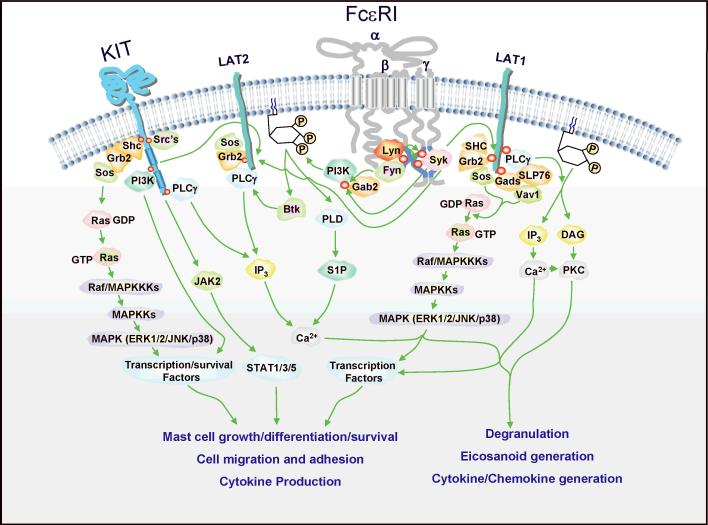
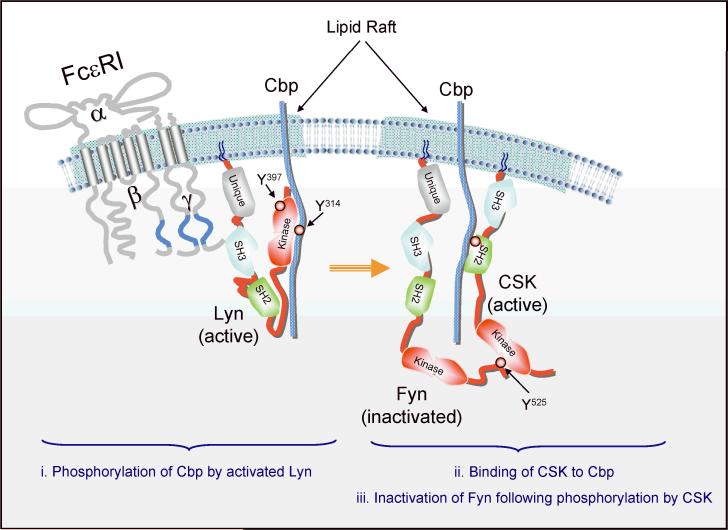
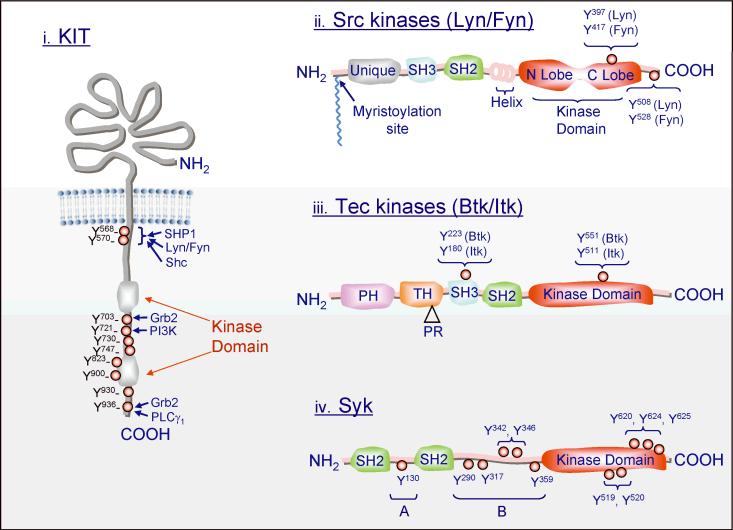
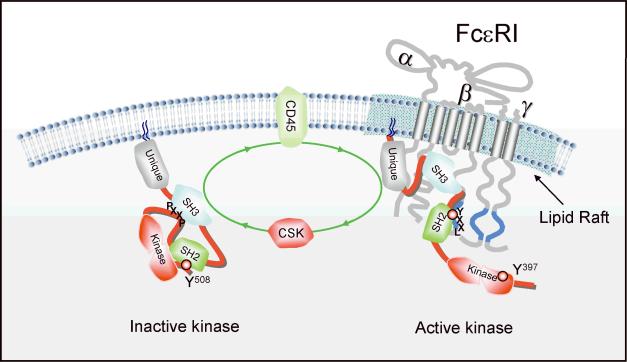
Mast cell mediator release represents a pivotal event in the initiation of inflammatory reactions associated with allergic disorders. These responses follow antigen-mediated aggregation of immunoglobulin E (IgE)-occupied high-affinity receptors for IgE (Fc epsilon RI) on the mast cell surface, a response which can be further enhanced following stem cell factor-induced ligation of the mast cell growth factor receptor KIT (CD117). Activation of tyrosine kinases is central to the ability of both Fc epsilon RI and KIT to transmit downstream signaling events required for the regulation of mast cell activation. Whereas KIT possesses inherent tyrosine kinase activity, Fc epsilon RI requires the recruitment of Src family tyrosine kinases and Syk to control the early receptor-proximal signaling events. The signaling pathways propagated by these tyrosine kinases can be further upregulated by the Tec kinase Bruton's tyrosine kinase and downregulated by the actions of the tyrosine Src homology 2 domain-containing phosphatase 1 (SHP-1) and SHP-2. In this review, we discuss the regulation and role of specific members of this tyrosine kinase network in KIT and Fc epsilon RI-mediated mast cell activation.
肥大细胞介质释放是与过敏性疾病相关的炎症反应启动中的关键事件。这些反应是在肥大细胞表面抗原介导的免疫球蛋白E(IgE)占据的IgE高亲和力受体(FcεRI)聚集之后发生的,在干细胞因子诱导肥大细胞生长因子受体KIT(CD117)连接后,这种反应会进一步增强。酪氨酸激酶的激活对于FcεRI和KIT传递调节肥大细胞激活所需的下游信号事件的能力至关重要。虽然KIT具有固有的酪氨酸激酶活性,但FcεRI需要募集Src家族酪氨酸激酶和Syk来控制早期受体近端信号事件。这些酪氨酸激酶传播的信号通路可被Tec激酶布鲁顿酪氨酸激酶进一步上调,并被含酪氨酸Src同源2结构域的磷酸酶1(SHP-1)和SHP-2的作用下调。在本综述中,我们讨论了该酪氨酸激酶网络的特定成员在KIT和FcεRI介导的肥大细胞激活中的调节和作用。