Khalil Sammar, Alsanius Beatrix W
Department of Horticulture, Microbial Horticulture Laboratory, Swedish University of Agricultural Sciences, P.O. Box 103, SE- 230 53, Alnarp.
Open Microbiol J. 2009;3:9-14. doi: 10.2174/1874285800903010009. Epub 2009 Jan 15.
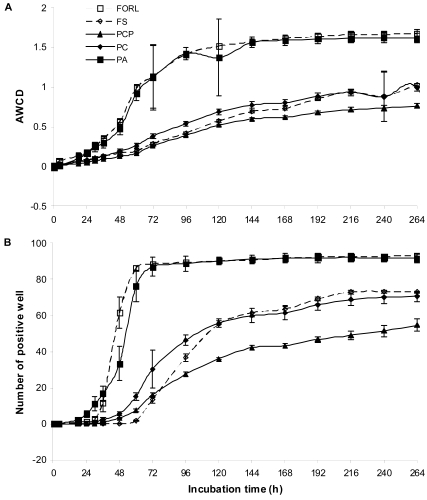
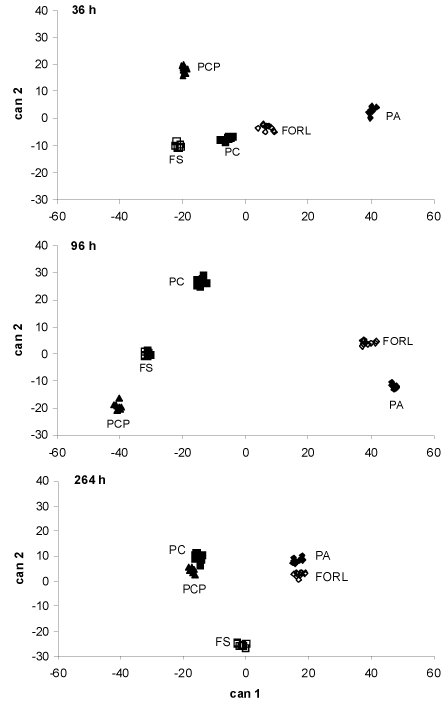
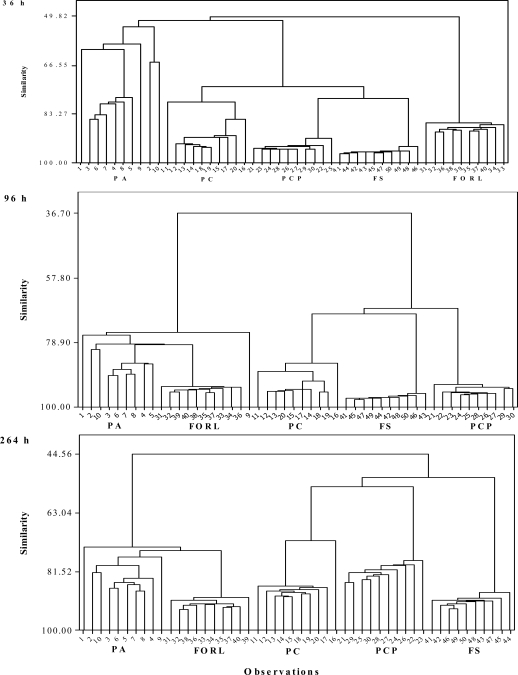
This study examined the metabolic activity of pure cultures of five root pathogens commonly found in closed hydroponic cultivation systems (Phytophthora cryptogea (PC), Phytophthora capsici (PCP), Pythium aphanidermatum (PA), Fusariumoxysporum f.sp. radicis-lycopersici (FORL) and Fusarium solani (FS)) using sole carbon source utilisation in order to develop effective biocontrol strategies against these pathogens. Aliquots of 150 microL of the mycelial suspension were inoculated in each well of GN2 microtitre plates. On the basis of average well colour development and number of positive wells, the pathogens were divided into two groups, (i) PA and FORL and (ii) PC, PCP and FS. Group (i) was characterised by a short lag-phase, a rapid exponential phase involving almost all carbon sources offered and a long stationary phase, while group (ii) had a more extended lag-phase and a slower utilisation rate of the carbon sources offered. The three isolates in group (ii) differed significantly during their exponential phase. The lowest utilisation rate of carbon sources and number of sources utilised was found for PCP. Of the major group of carbon sources, six carbohydrates, three carboxylic acids and four amino acids were rapidly used by all isolates tested at an early stage. The carbon sources gentibiose, alpha-D-glucose, maltose, sucrose, D-trehalose, L-aspartic acid, L-glutamic acid, L-proline persisted to the end of the exponential phase.Moreover, similarities between the metabolic profiles of the tested pathogen and the those of the resident microflora could also be found. These findings are of great importance as regards the role of the resident microflora in the biocontrol.
本研究通过单一碳源利用情况,检测了封闭水培栽培系统中常见的五种根部病原体(隐地疫霉(PC)、辣椒疫霉(PCP)、瓜果腐霉(PA)、番茄根腐尖孢镰刀菌(FORL)和茄形镰刀菌(FS))纯培养物的代谢活性,以便制定针对这些病原体的有效生物防治策略。将150微升菌丝体悬浮液的等分试样接种到GN2微量滴定板的每个孔中。根据平均孔显色情况和阳性孔数量,将病原体分为两组:(i)PA和FORL,以及(ii)PC、PCP和FS。第一组的特点是延迟期短,涉及几乎所有提供碳源的快速指数期和长稳定期,而第二组的延迟期更长,对提供碳源的利用率更低。第二组中的三个分离株在指数期有显著差异。PCP的碳源利用率最低,利用的碳源数量也最少。在主要的碳源组中,六种碳水化合物、三种羧酸和四种氨基酸在早期被所有测试分离株快速利用。碳源龙胆二糖、α-D-葡萄糖、麦芽糖、蔗糖、D-海藻糖、L-天冬氨酸、L-谷氨酸、L-脯氨酸持续到指数期末期。此外,还可以发现测试病原体与常驻微生物群落代谢谱之间的相似性。这些发现对于常驻微生物群落在生物防治中的作用具有重要意义。