Institute of Biology, Leiden University, PO Box 9516, 2300 RA Leiden, The Netherlands.
Arch Sex Behav. 2010 Feb;39(1):57-62. doi: 10.1007/s10508-009-9485-7. Epub 2009 Mar 20.
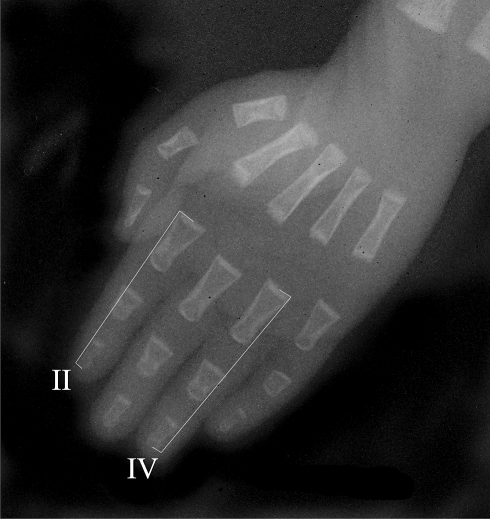
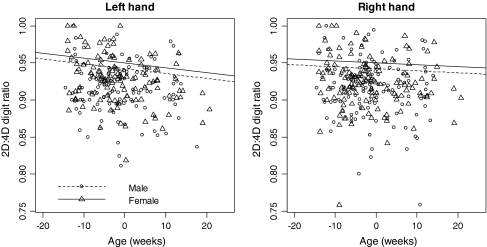
The second to fourth digit ratio (2D:4D) is smaller in human males than in females and hence this trait is sexually dimorphic. The digit ratio is thought to be established during early prenatal development under the influence of prenatal sex hormones. However, the general assumption of early establishment has hardly been studied. In our study, we analyzed the 2D:4D ratio in 327 deceased human fetuses. We measured digit lengths in 169 male and 158 female fetuses ranging from 14 to 42 weeks old. Our results showed a slight, but significant, sexual dimorphism in the expected direction, i.e., females had, on average, a ratio of 0.924 and males a ratio of 0.916. There was no significant relationship with the presence or absence of minor and major or single and multiple congenital abnormalities. There was a minimal, but significant difference between digit ratios based on digit lengths including and excluding the non-bony fingertip with the values being strongly correlated (r = .98). The prenatal 2D:4D ratio was lower than has thus far been reported for children and adults both for males and females. The extent of the sexual dimorphism in fetuses was similar to that found for children, but lower than for adults. The 2D:4D ratio, thus, seems to increase after birth in both men and women, with the second digit growing faster than the fourth digit (positive allometric growth of digit two) and perhaps more so in women than in men. Therefore, the sexual dimorphism is probably determined by prenatal as well as by postnatal developmental processes.
人类男性的第二至第四指长比(2D:4D)小于女性,因此该特征具有性别二态性。人们认为,指长比是在受产前性激素影响的早期产前发育过程中形成的。然而,人们几乎没有研究过这种早期建立的普遍假设。在我们的研究中,我们分析了 327 名已故人类胎儿的 2D:4D 比值。我们测量了 14 至 42 周龄的 169 名男性和 158 名女性胎儿的手指长度。我们的结果显示出轻微但具有统计学意义的预期性别二态性,即女性的比值平均为 0.924,男性的比值为 0.916。手指长度包括和不包括非骨性指尖的 2D:4D 比值与轻微和重大畸形或单一和多个先天性异常的存在与否均无显著关系。存在微小但显著的差异,基于包括和不包括非骨性指尖的手指长度的 2D:4D 比值之间存在差异,且这些值具有很强的相关性(r =.98)。男性和女性胎儿的产前 2D:4D 比值均低于目前报道的儿童和成人的比值。胎儿的性别二态性程度与儿童相似,但低于成人。因此,2D:4D 比值在男性和女性出生后都会增加,第二指的生长速度快于第四指(第二指的正异速生长),女性可能比男性更快。因此,性别二态性可能是由产前和产后发育过程决定的。