Jimenez Monik, Dietrich Thomas, Shih Mei-Chiung, Li Yi, Joshipura Kaumudi J
Harvard School of Public Health, Boston, MA, USA.
Community Dent Oral Epidemiol. 2009 Jun;37(3):267-75. doi: 10.1111/j.1600-0528.2009.00466.x. Epub 2009 Mar 19.
To compare the associations between socioeconomic factors and tooth loss among White, Black, and Mexican-American people.
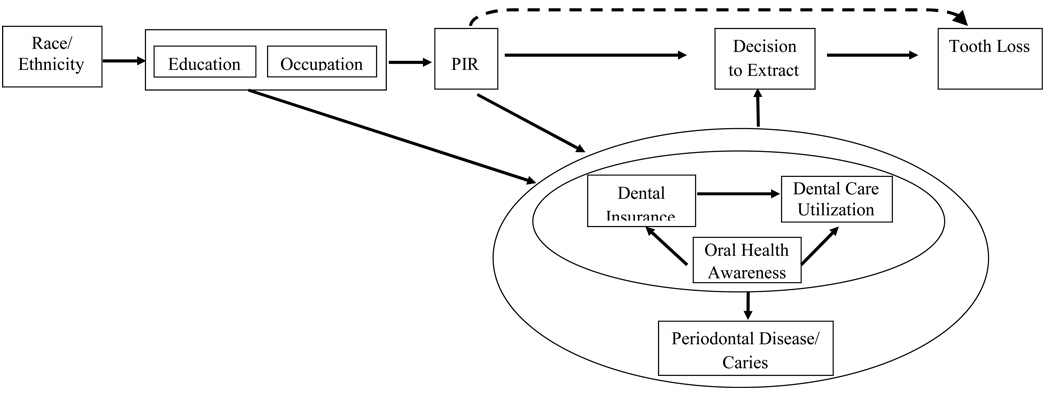
Analyses were conducted on 16,821 adults, using data from the National Health and Nutrition Examination Survey-III. Age- and multivariate-adjusted negative binomial regressions were used to explore the relation of socioeconomic factors, region of residence, gender, and foreign birth with the number of missing teeth. Effect modification by race/ethnicity was assessed by the inclusion of interaction terms.
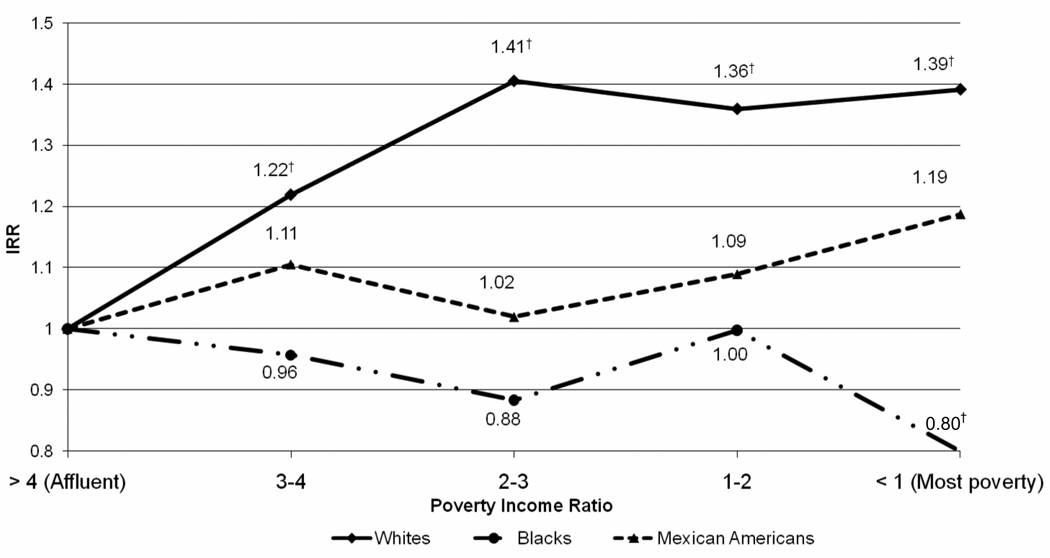
In multivariate-adjusted analyses, non-Hispanic White people with 9-12 years of education exhibited 71% higher mean number of missing teeth than those with >12 years of education [incidence rate ratio (IRR) = 1.71, 95% confidence interval (CI): 1.52-1.92]. Education was unrelated to the number of teeth among non-Hispanic Black people (IRR = 1.16; 95% CI: 1.00-1.35) or Mexican-Americans (IRR = 1.10, 95% CI: 0.93-1.31). The poorest White people exhibited 39% more missing teeth, on average, than the most affluent White people, but no association between poverty and number of teeth was observed among Black or Mexican-American people.
The associations between socioeconomic factors and tooth loss vary across race/ethnicity. This suggests that the health benefits associated with high socioeconomic status are not equally shared across racial/ethnic groups.
比较白种人、黑人和墨西哥裔美国人社会经济因素与牙齿缺失之间的关联。
利用第三次全国健康与营养检查调查的数据,对16821名成年人进行分析。采用年龄和多变量调整的负二项回归,探讨社会经济因素、居住地区、性别和外国出生情况与缺失牙数量之间的关系。通过纳入交互项评估种族/族裔的效应修正。
在多变量调整分析中,接受9 - 12年教育的非西班牙裔白人平均缺失牙数量比接受超过12年教育的人高71%[发病率比(IRR)= 1.71,95%置信区间(CI):1.52 - 1.92]。教育与非西班牙裔黑人(IRR = 1.16;95% CI:1.00 - 1.35)或墨西哥裔美国人(IRR = 1.10,95% CI:0.93 - 1.31)的牙齿数量无关。最贫困的白人平均缺失牙数量比最富裕的白人多39%,但在黑人或墨西哥裔美国人中未观察到贫困与牙齿数量之间的关联。
社会经济因素与牙齿缺失之间的关联因种族/族裔而异。这表明与高社会经济地位相关的健康益处并非在各种族/族裔群体中平均分配。