Department of Microbiology, Immunology and Genetics, Faculty of Medicine, Urmia University of Medical Sciences, Urmia, Iran.
J Inflamm (Lond). 2009 Mar 27;6:7. doi: 10.1186/1476-9255-6-7.
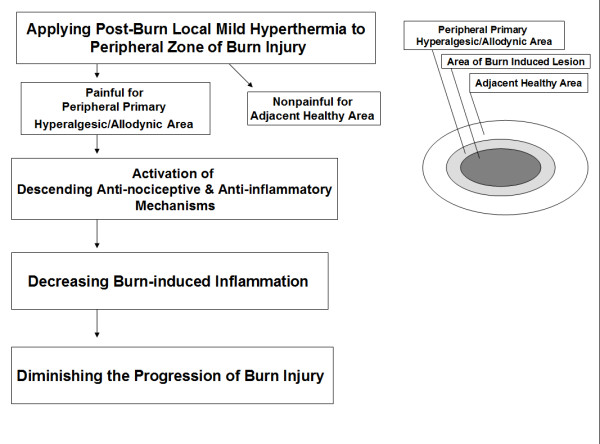
We previously showed that the progression of burn-induced injury was inhibited by exposing the peripheral area of injured skin to sublethal hyperthermia following the burn. We called this phenomenon post-heat shock tolerance. Here we suggest a mechanism for this phenomenon. Exposure of the peripheral primary hyperalgesic/allodynic area of burned skin to local hyperthermia (45 degrees C, 30 seconds), which is a non-painful stimulus for normal skin, results in a painful sensation transmitted by nociceptors. This hyperthermia is too mild to induce any tissue injury, but it does result in pain due to burn-induced hyperalgesia/allodynia. This mild painful stimulus can result in the induction of descending anti-nociceptive mechanisms, especially in the adjacent burned area. Some of these inhibitory mechanisms, such as alterations of sympathetic outflow and the production of endogenous opioids, can modify peripheral tissue inflammation. This decrease in burn-induced inflammation can diminish the progression of burn injury.
我们之前曾表明,在烧伤后使受伤皮肤的外周区域暴露于亚致死性热疗中可以抑制烧伤引起的损伤进展。我们将这种现象称为热休克后耐受。在此,我们提出了这种现象的一种机制。将烧伤皮肤的外周原发性痛觉过敏/感觉异常区域暴露于局部热疗(45°C,30 秒)中,这对于正常皮肤来说是一种无痛刺激,但会导致伤害感受器传递的疼痛感觉。这种热疗太温和,不会引起任何组织损伤,但会因烧伤引起的痛觉过敏/感觉异常而引起疼痛。这种轻微的疼痛刺激可以导致下行抗伤害机制的诱导,特别是在相邻的烧伤区域。其中一些抑制机制,如交感传出的改变和内源性阿片类物质的产生,可以改变外周组织炎症。这种烧伤引起的炎症减少可以减轻烧伤损伤的进展。