Medical Technology Department, Faculty of Applied Medical Sciences, Genomic Medicine Unit, Center of Excellence of Genomic Research. P. O. Box 80216, King Abdulaziz University-Jeddah, Kingdom of Saudi Arabia.
Hematology Department, Faculty of Medicine, King Abdulaziz University- Jeddah, Kingdom of Saudi Arabia.
Int J Mol Sci. 2008 Nov;9(11):2194-2204. doi: 10.3390/ijms9112194. Epub 2008 Nov 11.
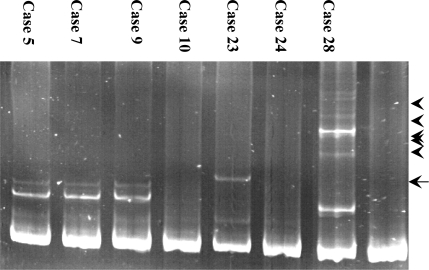
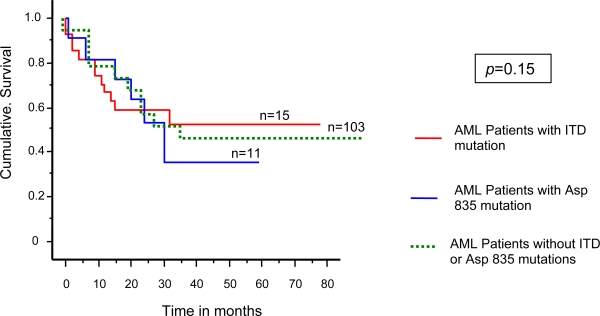
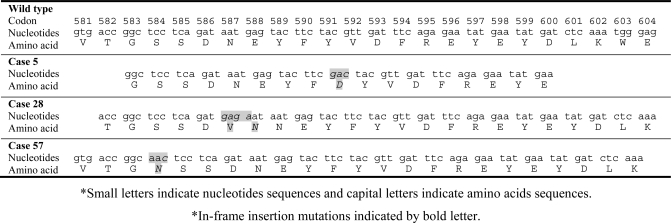
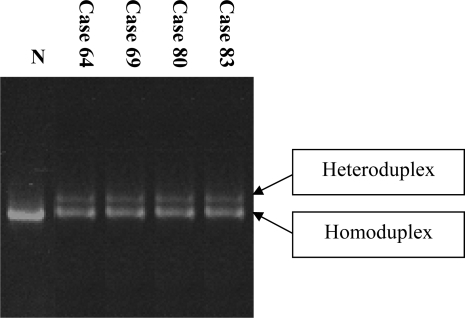
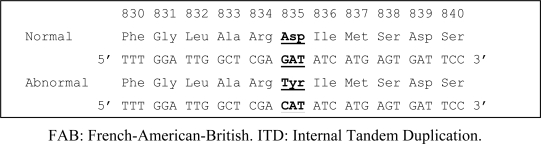
FLT3 (fms-related tyrosine kinase 3) is a receptor tyrosine kinase class III that is expressed on by early hematopoietic progenitor cells and plays an important role in hematopoietic stem cell proliferation, differentiation and survival. FLT3 is also expressed on leukemia blasts in most cases of acute myeloid leukemia (AML). In order to determine the frequency of FLT3 oncogene mutations, we analyzed genomic DNA of adult de novo acute myeloid leukemia (AML). Polymerase chain reaction (PCR) and conformation-sensitive gel electrophoresis (CSGE) were used for FLT3 exons 11, 14, and 15, followed by direct DNA sequencing. Two different types of functionally important FLT 3 mutations have been identified. Those mutations were unique to patients with inv(16), t(15:17) or t(8;21) and comprised fifteen cases with internal tandem duplication (ITD) mutation in the juxtamembrane domain and eleven cases with point mutation (exon 20, Asp835Tyr). The high frequency of the flt3 proto-oncogene mutations in acute myeloid leukemia AML suggests a key role for the receptor function. The association of FLT3 mutations with chromosomal abnormalities invites speculation as to the link between these two changes in the pathogenesis of acute myeloid leukemiaAML. Furthermore, CSGE method has shown to be a rapid and sensitive screening method for detection of nucleotide alteration in FLT3 gene. Finally, this study reports, for the first time in Saudi Arabia, mutations in the human FLT3 gene in acute myeloid leukemia AML patients.
FLT3(fms 相关酪氨酸激酶 3)是一种受体酪氨酸激酶 III 类,在早期造血祖细胞上表达,并在造血干细胞增殖、分化和存活中发挥重要作用。FLT3 在大多数急性髓系白血病(AML)病例的白血病母细胞上也有表达。为了确定 FLT3 癌基因突变的频率,我们分析了成人初发急性髓系白血病(AML)的基因组 DNA。聚合酶链反应(PCR)和构象敏感凝胶电泳(CSGE)用于 FLT3 外显子 11、14 和 15,然后直接进行 DNA 测序。已鉴定出两种不同类型的具有重要功能的 FLT3 突变。这些突变是 inv(16)、t(15:17)或 t(8;21)患者所特有的,包括 15 例膜内串联重复(ITD)突变和 11 例点突变(外显子 20,Asp835Tyr)。急性髓系白血病 AML 中 flt3 原癌基因突变的高频提示受体功能的关键作用。FLT3 突变与染色体异常相关,提示这两种变化在急性髓系白血病 AML 的发病机制中存在联系。此外,CSGE 方法已被证明是一种快速而敏感的筛选方法,可用于检测 FLT3 基因中的核苷酸改变。最后,本研究首次在沙特阿拉伯报告了急性髓系白血病 AML 患者中人类 FLT3 基因突变。