Laffaire Julien, Rivals Isabelle, Dauphinot Luce, Pasteau Fabien, Wehrle Rosine, Larrat Benoit, Vitalis Tania, Moldrich Randal X, Rossier Jean, Sinkus Ralph, Herault Yann, Dusart Isabelle, Potier Marie-Claude
Laboratoire de Neurobiologie, CNRS UMR7637, ESPCI, Paris, France.
BMC Genomics. 2009 Mar 30;10:138. doi: 10.1186/1471-2164-10-138.
Down syndrome is a chromosomal disorder caused by the presence of three copies of chromosome 21. The mechanisms by which this aneuploidy produces the complex and variable phenotype observed in people with Down syndrome are still under discussion. Recent studies have demonstrated an increased transcript level of the three-copy genes with some dosage compensation or amplification for a subset of them. The impact of this gene dosage effect on the whole transcriptome is still debated and longitudinal studies assessing the variability among samples, tissues and developmental stages are needed.
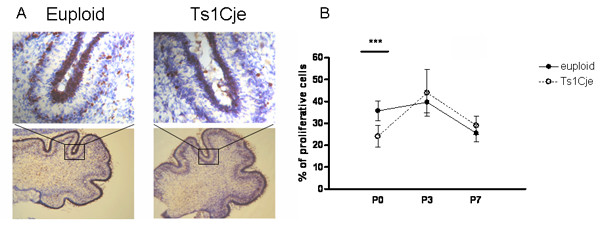
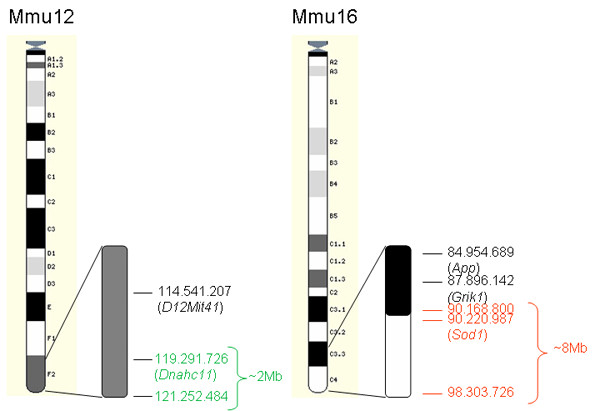
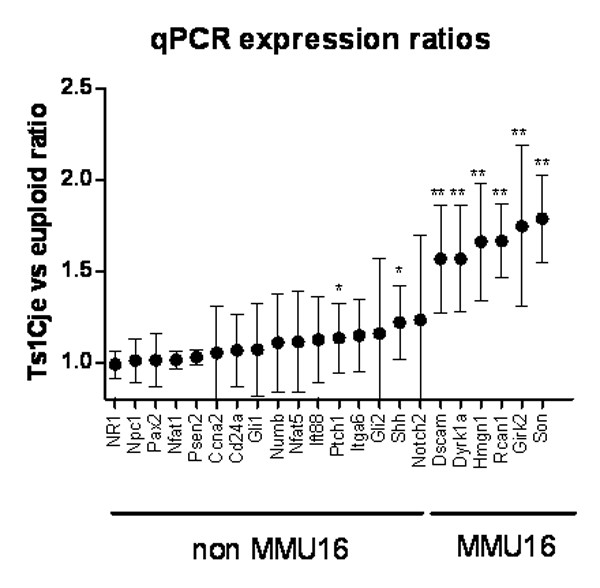
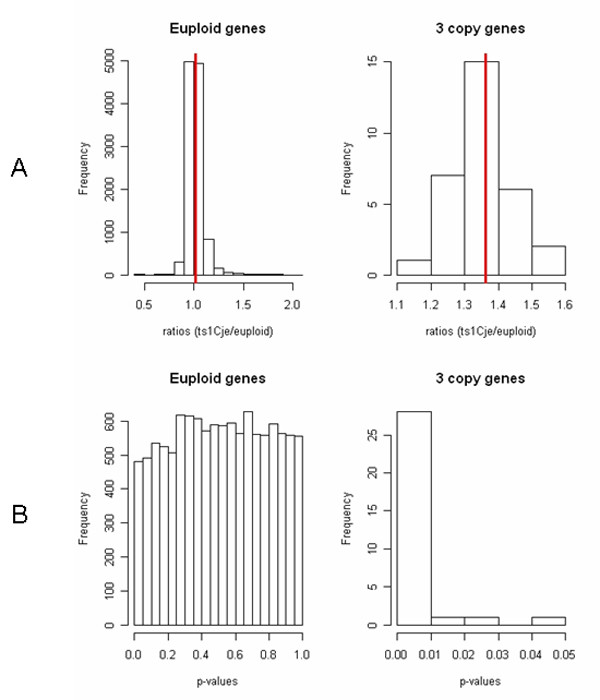
We thus designed a large scale gene expression study in mice (the Ts1Cje Down syndrome mouse model) in which we could measure the effects of trisomy 21 on a large number of samples (74 in total) in a tissue that is affected in Down syndrome (the cerebellum) and where we could quantify the defect during postnatal development in order to correlate gene expression changes to the phenotype observed. Statistical analysis of microarray data revealed a major gene dosage effect: for the three-copy genes as well as for a 2 Mb segment from mouse chromosome 12 that we show for the first time as being deleted in the Ts1Cje mice. This gene dosage effect impacts moderately on the expression of euploid genes (2.4 to 7.5% differentially expressed). Only 13 genes were significantly dysregulated in Ts1Cje mice at all four postnatal development stages studied from birth to 10 days after birth, and among them are 6 three-copy genes. The decrease in granule cell proliferation demonstrated in newborn Ts1Cje cerebellum was correlated with a major gene dosage effect on the transcriptome in dissected cerebellar external granule cell layer.
High throughput gene expression analysis in the cerebellum of a large number of samples of Ts1Cje and euploid mice has revealed a prevailing gene dosage effect on triplicated genes. Moreover using an enriched cell population that is thought responsible for the cerebellar hypoplasia in Down syndrome, a global destabilization of gene expression was not detected. Altogether these results strongly suggest that the three-copy genes are directly responsible for the phenotype present in cerebellum. We provide here a short list of candidate genes.
唐氏综合征是一种由21号染色体三体导致的染色体疾病。这种非整倍体产生唐氏综合征患者所观察到的复杂且多样表型的机制仍在探讨之中。近期研究表明,三拷贝基因的转录水平有所增加,其中一部分存在一定程度的剂量补偿或扩增。这种基因剂量效应在整个转录组上的影响仍存在争议,因此需要进行纵向研究以评估样本、组织和发育阶段之间的变异性。
我们因此在小鼠(Ts1Cje唐氏综合征小鼠模型)中设计了一项大规模基因表达研究,在此研究中,我们能够测量21号染色体三体对大量样本(总共74个)在唐氏综合征中受影响的组织(小脑)中的作用,并且我们能够量化出生后发育过程中的缺陷,以便将基因表达变化与所观察到的表型相关联。微阵列数据的统计分析揭示了一种主要的基因剂量效应:对于三拷贝基因以及首次显示在Ts1Cje小鼠中缺失的小鼠12号染色体上的一个2 Mb片段而言。这种基因剂量效应适度影响整倍体基因的表达(2.4%至7.5%差异表达)。在从出生到出生后10天研究的所有四个出生后发育阶段,Ts1Cje小鼠中只有13个基因显著失调,其中有6个是三拷贝基因。新生Ts1Cje小鼠小脑中颗粒细胞增殖的减少与解剖的小脑外颗粒细胞层中转录组上的主要基因剂量效应相关。
对大量Ts1Cje小鼠和整倍体小鼠样本的小脑进行高通量基因表达分析,揭示了对三重复基因普遍存在的基因剂量效应。此外,使用被认为与唐氏综合征中小脑发育不全有关的富集细胞群体,未检测到基因表达的整体不稳定。总之,这些结果强烈表明三拷贝基因直接导致了小脑中存在的表型。我们在此提供了一份候选基因的简短清单。