Zhang Kaiwei, Duan Hong, Xiang Zhou, Tu Chongqi
Department of Orthopedics, West China Hospital, Sichuan University, Chengdu, 610041, PR China.
J Exp Clin Cancer Res. 2009 Apr 1;28(1):45. doi: 10.1186/1756-9966-28-45.
Progress in developing effective surgical techniques, such as scapular allograft reconstruction, enhance shoulder stability and extremity function, in patients following scapular tumor resection.
Case details from seven patients who underwent scapular allograft reconstruction following scapular tumor resection were reviewed. A wide marginal resection (partial scapulectomy) was performed in all patients and all affected soft tissues were resected to achieve a clean surgical margin. The glenoid-resected and glenoid-saved reconstructions were performed in three and four patients, respectively. The residual host scapula were fixed to the size-matched scapular allografts with plates and screws. The rotator cuff was affected frequently and was mostly resected. The deltoid and articular capsule were infrequently involved, but reconstructed preferentially. The remaining muscles were reattached to the allografts.
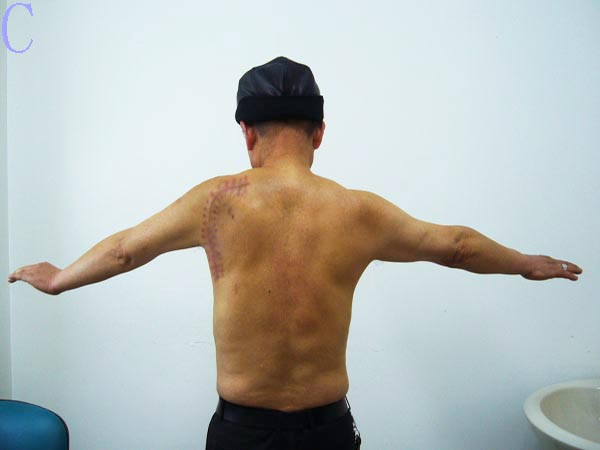
The median follow-up was 26 months (range, 14-50 months). The average function scores were 24 points (80%) according to the International Society of Limb Salvage criteria. The range of active shoulder abduction and forward flexion motion were 40 degrees -110 degrees and 30 degrees -90 degrees, respectively. There was no difference between the glenoid-saved and glenoid-resected reconstructions in the total scores (mean, 24.5 points/81% versus 24 points/79%), but the glenoid-saved procedure was superior to the later in terms of abduction/flexion motion (mean, 72 degrees /61 degrees versus 55 degrees /43 degrees). During the study follow-up period, one patient died following a relapse, one patient lived despite of local recurrence, and five patients survived with no evidence of recurrence of the original cancer. Post-surgical complications such as shoulder dislocations, non-unions, and articular degeneration were not noted during this study period.
Scapular allograft reconstruction had a satisfactory functional, cosmetic, and oncological outcome in this case series. Preservation and reconstruction of the articular capsule and deltoid are proposed to be a prerequisite for using scapular allografts and rotator cuff reconstruction is recommended, although technically challenging to perform.
诸如肩胛异体骨重建等有效手术技术的发展取得了进展,可增强肩胛肿瘤切除术后患者的肩部稳定性和肢体功能。
回顾了7例肩胛肿瘤切除术后接受肩胛异体骨重建患者的病例详情。所有患者均进行了广泛的边缘切除(部分肩胛骨切除术),并切除了所有受影响的软组织以获得清晰的手术切缘。分别对3例和4例患者进行了切除关节盂和保留关节盂的重建。将残留的宿主肩胛骨用钢板和螺钉固定在尺寸匹配的肩胛异体骨上。肩袖经常受到影响,大多被切除。三角肌和关节囊很少受累,但优先进行重建。其余肌肉重新附着于异体骨上。
中位随访时间为26个月(范围14 - 50个月)。根据国际肢体保全协会标准,平均功能评分为24分(80%)。主动肩部外展和前屈运动范围分别为40度至110度和30度至90度。保留关节盂和切除关节盂的重建在总分上无差异(平均24.5分/81%对24分/79%),但保留关节盂的手术在外展/屈曲运动方面优于后者(平均72度/61度对55度/43度)。在研究随访期间,1例患者复发后死亡,1例患者尽管局部复发仍存活,5例患者存活且无原发癌症复发迹象。本研究期间未发现术后并发症,如肩关节脱位、骨不连和关节退变。
在本病例系列中,肩胛异体骨重建在功能、美容和肿瘤学方面均取得了令人满意的结果。建议保留和重建关节囊及三角肌是使用肩胛异体骨的前提条件,尽管肩袖重建技术上具有挑战性,但仍建议进行。