Kotnik Katarina, Popova Elena, Todiras Mihail, Mori Marcelo A, Alenina Natalia, Seibler Jost, Bader Michael
Max Delbrück Center for Molecular Medicine (MDC), Berlin, Germany.
PLoS One. 2009;4(4):e5124. doi: 10.1371/journal.pone.0005124. Epub 2009 Apr 2.
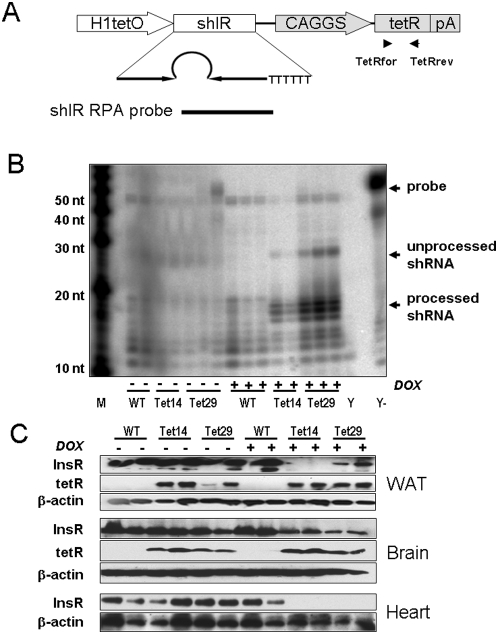
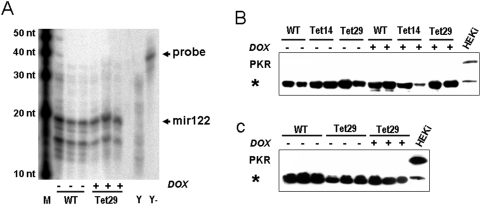
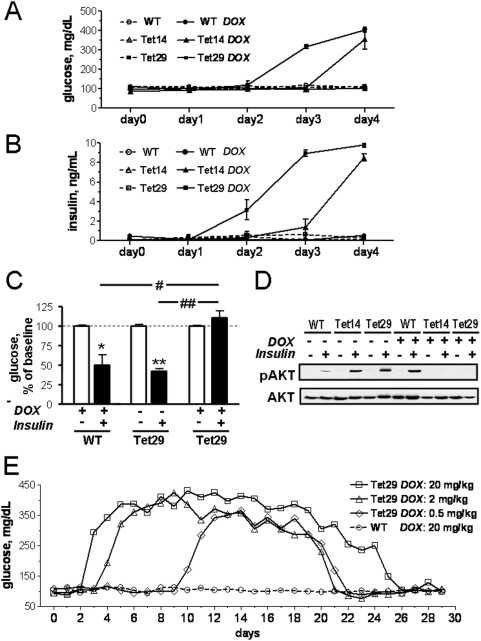
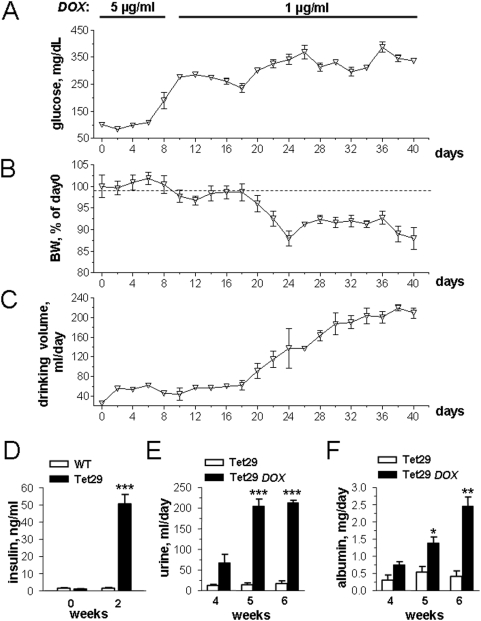
The rat is an important animal model in biomedical research, but gene targeting technology is not established for this species. Therefore, we aimed to produce transgenic knockdown rats using shRNA technology and pronuclear microinjection. To this purpose, we employed a tetracycline-inducible shRNA expression system targeting the insulin receptor (IR). Doxycycline (DOX) treatment of the resulting transgenic rats led to a dose-dependent and reversible increase in blood glucose caused by ubiquitous inhibition of IR expression and signalling. We could neither detect an interferon response nor disturbances in microRNA processing after DOX treatment excluding toxic effects of shRNA expression. Low dose DOX treatment induced a chronic state of diabetes mellitus. In conclusion, we have developed a technology which allows the specific, inducible, and reversible suppression of any gene of interest in the rat. Our first transgenic rat line generated with this method represents an inducible model for diabetes mellitus.
大鼠是生物医学研究中的一种重要动物模型,但该物种尚未建立基因靶向技术。因此,我们旨在利用短发夹RNA(shRNA)技术和原核显微注射来制备转基因敲低大鼠。为此,我们采用了一种靶向胰岛素受体(IR)的四环素诱导型shRNA表达系统。对所得转基因大鼠进行强力霉素(DOX)处理后,由于IR表达和信号传导的普遍抑制,导致血糖呈剂量依赖性且可逆性升高。DOX处理后,我们既未检测到干扰素反应,也未发现微小RNA加工过程受到干扰,排除了shRNA表达的毒性作用。低剂量DOX处理可诱导慢性糖尿病状态。总之,我们开发了一种技术,该技术能够在大鼠中特异性、诱导性和可逆性地抑制任何感兴趣的基因。用这种方法产生的我们的首个转基因大鼠品系代表了一种糖尿病的诱导模型。