Department of Epidemiology and Preventive Medicine, University of Maryland School of Medicine, Baltimore, USA.
Evid Based Complement Alternat Med. 2011;2011:383245. doi: 10.1093/ecam/nep022. Epub 2011 Jun 23.
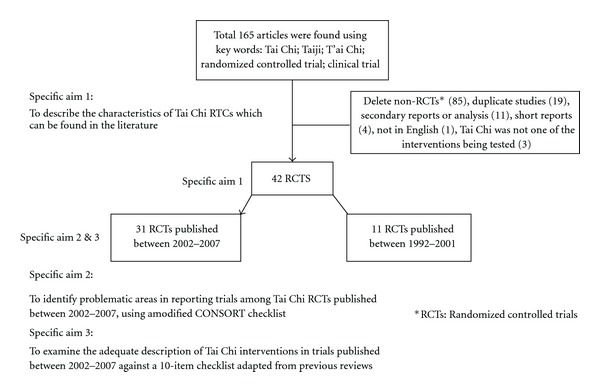
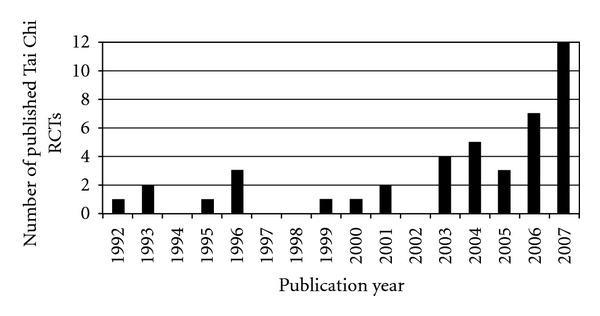
Objectives. To evaluate the reporting quality of published randomized clinical trials (RCTs) in the Tai Chi literature following the publication of the CONSORT guidelines in 2001. Data Sources. The OVID MEDLINE and PUBMED databases. Review Methods. To survey the general characteristics of Tai Chi RCTs in the literature, we included any report if (i) it was an original report of the trial; (ii) its design was RCT; (iii) one of the treatments being tested was Tai Chi; and (iv) it was in English. In addition, we assessed the reporting quality of RCTs that were published between 2002 and 2007, using a modified CONSORT checklist of 40 items. The adequate description of Tai Chi interventions in these trials was examined against a 10-item checklist adapted from previous reviews. Results. The search yielded 31 Tai Chi RCTs published from 2002 to 2007 and only 11 for 1992-2001. Among trials published during 2002-2007, the most adequately reported criteria were related to background, participant eligibility and interpretation of the study results. Nonetheless, the most poorly reported items were associated with randomization allocation concealment, implementation of randomization and the definitions of period of recruitment and follow-up. In addition, only 23% of RCTs provided adequate details of Tai Chi intervention used in the trials. Conclusion. The findings in this review indicated that the reporting quality of Tai Chi intervention trials is sub-optimal. Substantial improvement is required to meet the CONSORT guidelines and allow assessment of the quality of evidence. We believe that not only investigators, but also journal editors, reviewers and funding agencies need to follow the CONSORT guidelines to improve the standards of research and strengthen the evidence base for Tai Chi and for complementary and alternative medicine.
目的。评估 2001 年 CONSORT 指南发布后,太极拳文献中已发表的随机临床试验(RCT)的报告质量。
数据来源。OVID MEDLINE 和 PUBMED 数据库。
审查方法。为了调查文献中太极拳 RCT 的一般特征,我们纳入了任何符合以下标准的报告:(i)为试验的原始报告;(ii)设计为 RCT;(iii)正在测试的治疗方法之一为太极拳;(iv)为英文。此外,我们还使用改良的 CONSORT 40 项清单评估了 2002 年至 2007 年发表的 RCT 的报告质量。这些试验中太极拳干预措施的充分描述,根据先前综述改编的 10 项清单进行了检查。
结果。搜索结果为 2002 年至 2007 年发表的 31 项太极拳 RCT,而 1992 年至 2001 年仅发表了 11 项。在 2002-2007 年发表的试验中,报告最充分的标准与背景、参与者资格和研究结果解释有关。尽管如此,报告最差的项目与随机分组隐藏、随机分组实施以及招募和随访期间的定义有关。此外,只有 23%的 RCT 提供了试验中使用的太极拳干预措施的充分细节。
结论。本综述的结果表明,太极拳干预试验的报告质量不尽如人意。为了满足 CONSORT 指南并评估证据质量,需要进行实质性改进。我们认为,不仅研究人员,而且期刊编辑、评审人员和资助机构都需要遵循 CONSORT 指南,以提高研究标准,并为太极拳和补充替代医学提供更有力的证据基础。