Hu Yao Fei, Caron Marc G, Sieber-Blum Maya
Department of Cell Biology, Neurobiology and Anatomy, Medical College of Wisconsin, Milwaukee, WI 53226, USA.
BMC Genomics. 2009 Apr 8;10:151. doi: 10.1186/1471-2164-10-151.
We have identified a differential gene expression profile in neural crest stem cells that is due to deletion of the norepinephrine transporter (NET) gene. NET is the target of psychotropic substances, such as tricyclic antidepressants and the drug of abuse, cocaine. NET mutations have been implicated in depression, anxiety, orthostatic intolerance and attention deficit hyperactivity disorder (ADHD). NET function in adult noradrenergic neurons of the peripheral and central nervous systems is to internalize norepinephrine from the synaptic cleft. By contrast, during embryogenesis norepinephrine (NE) transport promotes differentiation of neural crest stem cells and locus ceruleus progenitors into noradrenergic neurons, whereas NET inhibitors block noradrenergic differentiation. While the structure of NET und the regulation of NET function are well described, little is known about downstream target genes of norepinephrine (NE) transport.
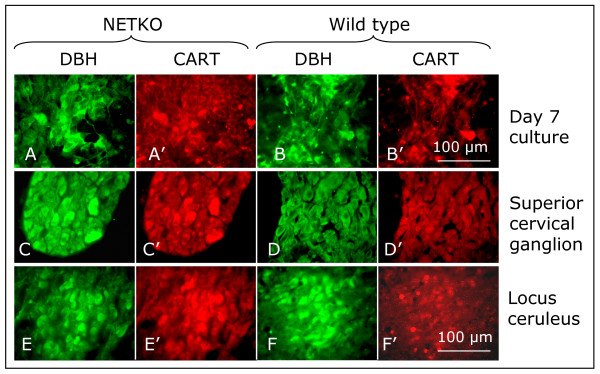
We have prepared gene expression profiles of in vitro differentiating wild type and norepinephrine transporter-deficient (NETKO) mouse neural crest cells using long serial analysis of gene expression (LongSAGE). Comparison analyses have identified a number of important differentially expressed genes, including genes relevant to neural crest formation, noradrenergic neuron differentiation and the phenotype of NETKO mice. Examples of differentially expressed genes that affect noradrenergic cell differentiation include genes in the bone morphogenetic protein (BMP) signaling pathway, the Phox2b binding partner Tlx2, the ubiquitin ligase Praja2, and the inhibitor of Notch signaling, Numbl. Differentially expressed genes that are likely to contribute to the NETKO phenotype include dopamine-beta-hydroxylase (Dbh), tyrosine hydroxylase (Th), the peptide transmitter 'cocaine and amphetamine regulated transcript' (Cart), and the serotonin receptor subunit Htr3a. Real-time PCR confirmed differential expression of key genes not only in neural crest cells, but also in the adult superior cervical ganglion and locus ceruleus. In addition to known genes we have identified novel differentially expressed genes and thus provide a valuable database for future studies.
Loss of NET function during embryonic development in the mouse deregulates signaling pathways that are critically involved in neural crest formation and noradrenergic cell differentiation. The data further suggest deregulation of signaling pathways in the development and/or function of the NET-deficient peripheral, central and enteric nervous systems.
我们已经确定了神经嵴干细胞中的一种差异基因表达谱,这是由于去甲肾上腺素转运体(NET)基因缺失所致。NET是精神活性物质的靶点,如三环类抗抑郁药和滥用药物可卡因。NET突变与抑郁症、焦虑症、体位性不耐受和注意力缺陷多动障碍(ADHD)有关。NET在周围和中枢神经系统的成年去甲肾上腺素能神经元中的功能是将突触间隙中的去甲肾上腺素内化。相比之下,在胚胎发生过程中,去甲肾上腺素(NE)转运促进神经嵴干细胞和蓝斑祖细胞分化为去甲肾上腺素能神经元,而NET抑制剂则阻断去甲肾上腺素能分化。虽然NET的结构和NET功能的调节已得到充分描述,但对去甲肾上腺素(NE)转运的下游靶基因了解甚少。
我们使用基因表达的长序列分析(LongSAGE)制备了体外分化的野生型和去甲肾上腺素转运体缺陷(NETKO)小鼠神经嵴细胞的基因表达谱。比较分析确定了许多重要的差异表达基因,包括与神经嵴形成、去甲肾上腺素能神经元分化和NETKO小鼠表型相关的基因。影响去甲肾上腺素能细胞分化的差异表达基因的例子包括骨形态发生蛋白(BMP)信号通路中的基因、Phox2b结合伴侣Tlx2、泛素连接酶Praja2和Notch信号抑制剂Numbl。可能导致NETKO表型的差异表达基因包括多巴胺-β-羟化酶(Dbh)、酪氨酸羟化酶(Th)、肽递质“可卡因和苯丙胺调节转录物”(Cart)和5-羟色胺受体亚基Htr3a。实时PCR证实关键基因不仅在神经嵴细胞中差异表达,而且在成年颈上神经节和蓝斑中也差异表达。除了已知基因外,我们还鉴定了新的差异表达基因,从而为未来的研究提供了一个有价值的数据库。
小鼠胚胎发育过程中NET功能的丧失会使参与神经嵴形成和去甲肾上腺素能细胞分化的信号通路失调。数据进一步表明,NET缺陷的周围、中枢和肠神经系统的发育和/或功能中的信号通路失调。