Traub Michael L, Van Arsdale Anne, Pal Lubna, Jindal Sangita, Santoro Nanette
Department of Obstetrics & Gynecology and Women's Health, Albert Einstein College of Medicine and Montefiore Medical Center, Bronx, NY 10461, USA.
Reprod Biol Endocrinol. 2009 Apr 22;7:33. doi: 10.1186/1477-7827-7-33.
In-vitro fertilization (IVF) with blastocyst as opposed to cleavage stage embryos has been advocated to improve success rates. Limited information exists on which to predict which patients undergoing blastocyst embryo transfer (BET) will achieve pregnancy. This study's objective was to evaluate the predictive value of patient and cycle characteristics for clinical pregnancy following fresh BET.
This was a retrospective cohort study from 2003-2007 at an academic assisted reproductive program. 114 women with infertility underwent fresh IVF with embryo transfer. We studied patients undergoing transfer of embryos at the blastocyst stage of development. Our main outcome of interest was clinical pregnancy. Clinical pregnancy and its associations with patient characteristics (age, body mass index, FSH, ethnicity) and cycle parameters (thickness of endometrial stripe, number eggs, available cleaving embryos, number blastocysts available, transferred, and cryopreserved, and embryo quality) were examined using Student's T test and Mann-Whitney-U tests as appropriate. Multivariable logistic regression models were created to determine independent predictors of CP following BET. Receiver Operating Characteristic analyses were used to determine the optimal thickness of endometrial stripe for predicting clinical pregnancy.
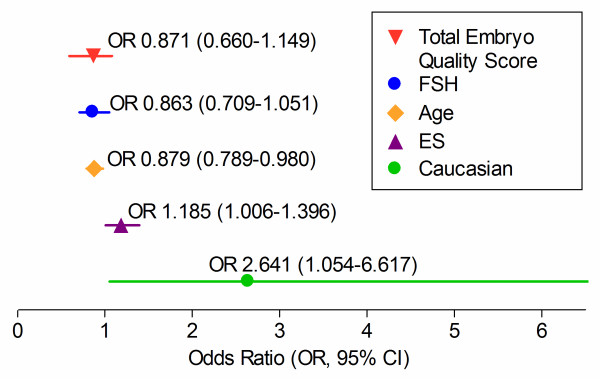
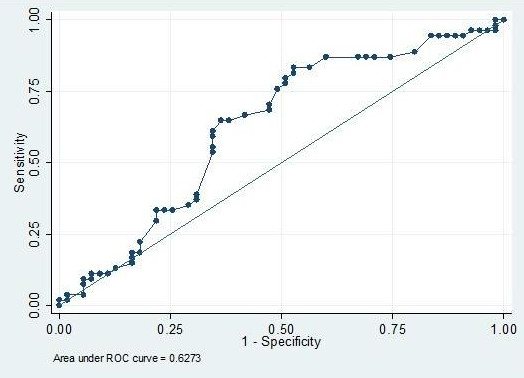
Patients achieving clinical pregnancy demonstrated a thicker endometrial stripe and were younger preceding embryo transfer. On multivariable logistic regression analyses, Caucasian ethnicity (OR 2.641, 95% CI 1.054-6.617), thickness of endometrial stripe, (OR 1.185, 95% CI 1.006-1.396) and age (OR 0.879, 95% CI 0.789-0.980) predicted clinical pregnancy. By receiver operating characteristic analysis, endometrial stripe >or= 9.4 mm demonstrated a sensitivity of 83% for predicting clinical pregnancy following BET.
In a cohort of patients undergoing fresh BET, thicker endometrial stripe, Caucasian ethnicity, and younger age are positive predictors of clinical pregnancy after fresh BET. These findings may be useful in clinical management of infertile patients undergoing fresh BET cycles.
与卵裂期胚胎相比,采用囊胚进行体外受精(IVF)被认为可提高成功率。关于预测哪些接受囊胚胚胎移植(BET)的患者会怀孕的信息有限。本研究的目的是评估患者及周期特征对新鲜BET后临床妊娠的预测价值。
这是一项2003年至2007年在一个学术性辅助生殖项目中进行的回顾性队列研究。114名不孕女性接受了新鲜IVF并进行胚胎移植。我们研究了处于囊胚发育阶段进行胚胎移植的患者。我们感兴趣的主要结局是临床妊娠。采用学生t检验和曼-惠特尼-U检验,酌情检查临床妊娠及其与患者特征(年龄、体重指数、促卵泡激素、种族)和周期参数(子宫内膜厚度、卵子数量、可分裂胚胎数量、可用囊胚数量、移植和冷冻保存的囊胚数量以及胚胎质量)之间的关联。建立多变量逻辑回归模型以确定BET后临床妊娠的独立预测因素。采用受试者工作特征分析来确定预测临床妊娠的最佳子宫内膜厚度。
实现临床妊娠的患者在胚胎移植前子宫内膜较厚且年龄较小。在多变量逻辑回归分析中,白种人种族(比值比2.641,95%置信区间1.054 - 6.617)、子宫内膜厚度(比值比1.185,95%置信区间1.006 - 1.396)和年龄(比值比0.879,95%置信区间0.789 - 0.980)可预测临床妊娠。通过受试者工作特征分析,子宫内膜厚度≥9.4 mm对预测BET后的临床妊娠显示出83%的敏感性。
在一组接受新鲜BET的患者中,较厚的子宫内膜厚度、白种人种族和较年轻的年龄是新鲜BET后临床妊娠的阳性预测因素。这些发现可能对接受新鲜BET周期的不孕患者的临床管理有用。