Asmundson Anna L, Taber Alexandria M, van der Walde Adella, Lin Danielle H, Olson John S, Anthony-Cahill Spencer J
Department of Chemistry, Western Washington University, Bellingham, Washington 98225-9150, USA.
Biochemistry. 2009 Jun 16;48(23):5456-65. doi: 10.1021/bi900216p.
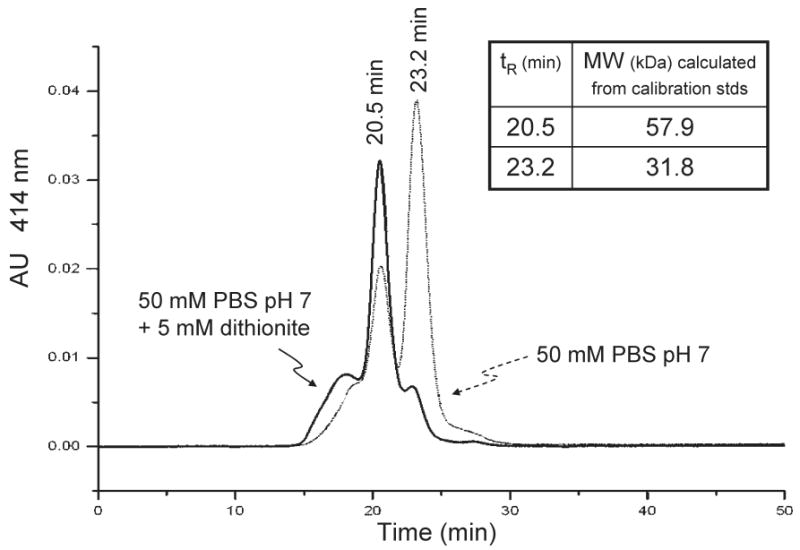
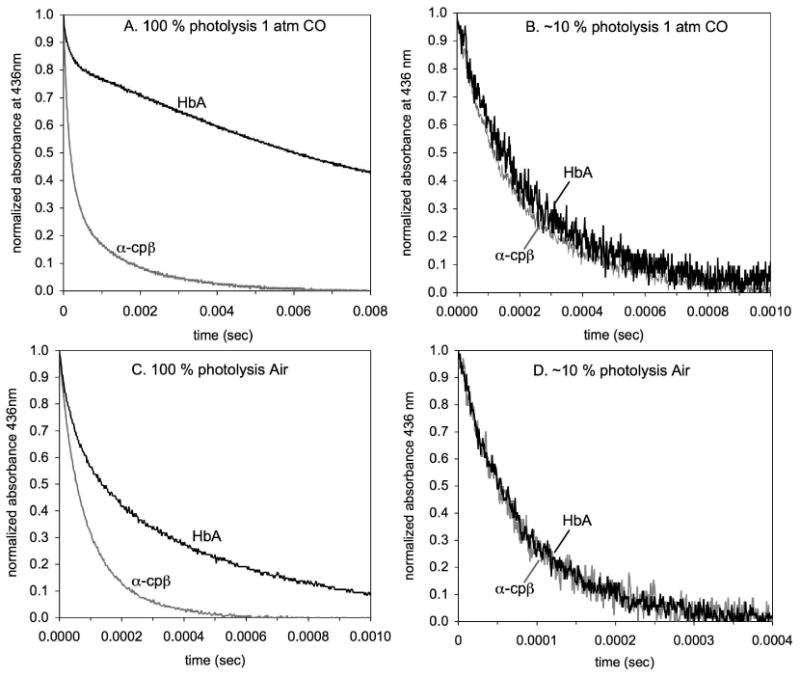
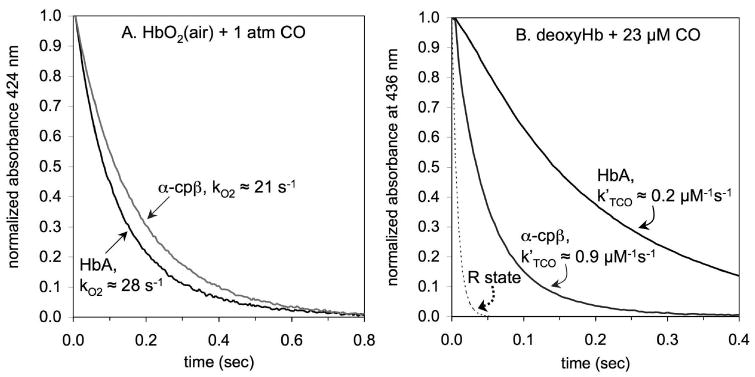
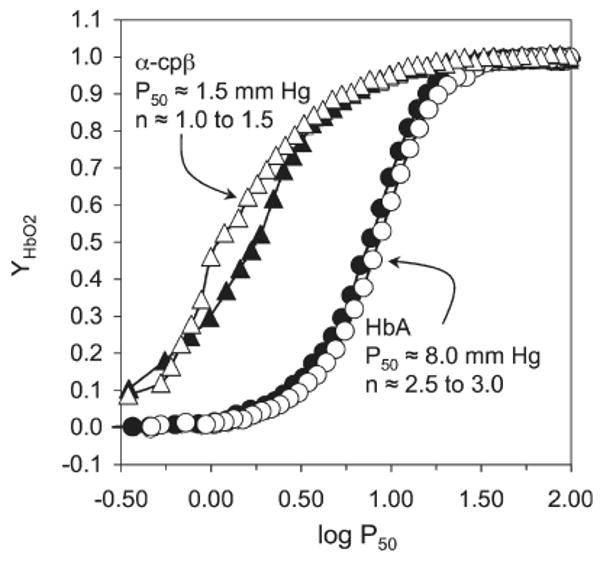
For the first time, a circularly permuted human beta-globin (cpbeta) has been coexpressed with human alpha-globin in bacterial cells and shown to associate to form alpha-cpbeta hemoglobin in solution. Flash photolysis studies of alpha-cpbeta show markedly biphasic CO and O(2) kinetics with the amplitudes for the fast association phases being dominant due the presence of large amounts of high-affinity liganded hemoglobin dimers. Extensive dimerization of liganded but not deoxygenated alpha-cpbeta was observed by gel chromatography. The rate constants for O(2) and CO binding to the R state forms of alpha-cpbeta are almost identical to those of native HbA (k'(R(CO)) approximately 5.0 microM(-1) s(-1); k'(R(O(2))) approximately 50 microM(-1) s(-1)), and the rate of O(2) dissociation from fully oxygenated alpha-cpbeta is also very similar to that observed for HbA (k(R(O(2))) approximately 21-28 s(-1)). When the equilibrium deoxyHb form of alpha-cpbeta is reacted with CO in rapid mixing experiments, the observed time courses are monophasic and the observed bimolecular association rate constant is approximately 1.0 microM(-1) s(-1), which is intermediate between the R state rate measured in partial photolysis experiments (approximately 5 microM(-1) s(-1)) and that observed for T state deoxyHbA (k'(T(CO)) approximately 0.1 to 0.2 microM(-1) s(-1)). Thus the deoxygenated permutated beta subunits generate an intermediate, higher affinity, deoxyHb quaternary state. This conclusion is supported by equilibrium oxygen binding measurements in which alpha-cpbeta exhibits a P(50) of approximately 1.5 mmHg and a low n-value (approximately 1.3) at pH 7, 20 degrees C, compared to 8.5 mmHg and n approximately 2.8 for native HbA under identical, dilute conditions.
首次在细菌细胞中,将环状排列的人β-珠蛋白(cpβ)与人α-珠蛋白共表达,并显示其在溶液中缔合形成α-cpβ血红蛋白。对α-cpβ的闪光光解研究表明,CO和O₂动力学具有明显的双相性,由于存在大量高亲和力的配体血红蛋白二聚体,快速缔合阶段的振幅占主导。通过凝胶色谱法观察到配体化而非脱氧的α-cpβ发生广泛二聚化。O₂和CO与α-cpβ的R态形式结合的速率常数与天然HbA几乎相同(k'(R(CO))约为5.0 μM⁻¹ s⁻¹;k'(R(O₂))约为50 μM⁻¹ s⁻¹),并且完全氧合的α-cpβ中O₂解离速率也与HbA非常相似(k(R(O₂))约为21 - 28 s⁻¹)。在快速混合实验中,当α-cpβ的平衡脱氧血红蛋白形式与CO反应时,观察到的时间进程是单相的,观察到的双分子缔合速率常数约为1.0 μM⁻¹ s⁻¹,这介于部分光解实验中测量的R态速率(约5 μM⁻¹ s⁻¹)和T态脱氧HbA观察到的速率(k'(T(CO))约为0.1至0.2 μM⁻¹ s⁻¹)之间。因此,脱氧的置换β亚基产生了一种中间的、更高亲和力的脱氧血红蛋白四级状态。这一结论得到了平衡氧结合测量的支持,在pH 7、20℃条件下,α-cpβ的P(50)约为1.5 mmHg,n值较低(约1.3),而在相同的稀释条件下,天然HbA的P(50)为8.5 mmHg,n约为2.8。