University Hospital of Geneva, Switzerland.
Ann Rheum Dis. 2010 Feb;69(2):387-93. doi: 10.1136/ard.2008.105064. Epub 2009 May 4.
Patients with rheumatoid arthritis (RA) with an inadequate response to TNF antagonists (aTNFs) may switch to an alternative aTNF or start treatment from a different class of drugs, such as rituximab (RTX). It remains unclear in which clinical settings these therapeutic strategies offer most benefit.
To analyse the effectiveness of RTX versus alternative aTNFs on RA disease activity in different subgroups of patients.
A prospective cohort study of patients with RA who discontinued at least one aTNF and subsequently received either RTX or an alternative aTNF, nested within the Swiss RA registry (SCQM-RA) was carried out. The primary outcome, longitudinal improvement in 28-joint count Disease Activity Score (DAS28), was analysed using multivariate regression models for longitudinal data and adjusted for potential confounders.
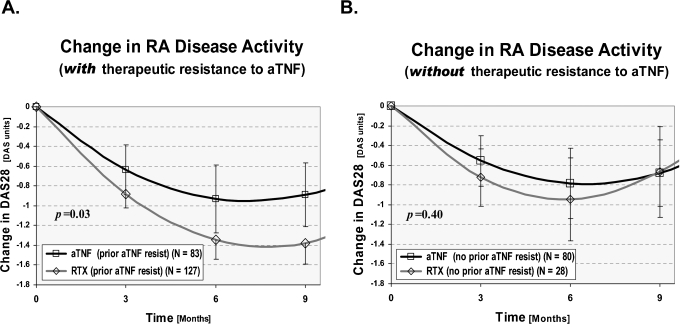
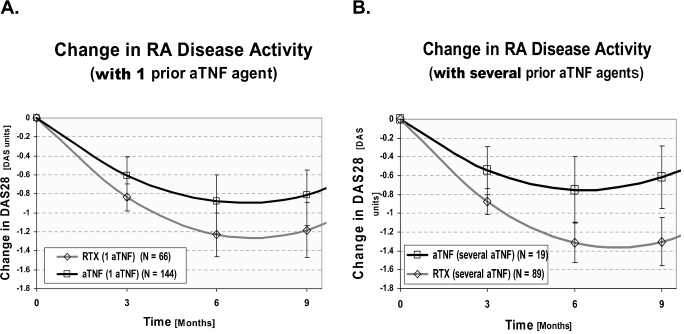
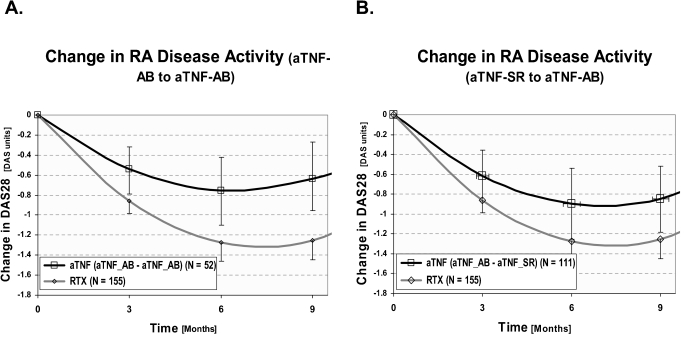
Of the 318 patients with RA included; 155 received RTX and 163 received an alternative aTNF. The relative benefit of RTX varied with the type of prior aTNF failure: when the motive for switching was ineffectiveness to previous aTNFs, the longitudinal improvement in DAS28 was significantly better with RTX than with an alternative aTNF (p = 0.03; at 6 months, -1.34 (95% CI -1.54 to -1.15) vs -0.93 (95% CI -1.28 to -0.59), respectively). When the motive for switching was other causes, the longitudinal improvement in DAS28 was similar for RTX and alternative aTNFs (p = 0.40). These results were not significantly modified by the number of previous aTNF failures, the type of aTNF switches, or the presence of co-treatment with a disease-modifying antirheumatic drug.
This observational study suggests that in patients with RA who have stopped a previous aTNF treatment because of ineffectiveness changing to RTX is more effective than switching to an alternative aTNF.
对于肿瘤坏死因子拮抗剂(aTNF)治疗应答不足的类风湿关节炎(RA)患者,可能会转而使用另一种 aTNF 或开始使用不同类别的药物(如利妥昔单抗[RTX])治疗。在哪些临床环境下这些治疗策略最能获益尚不清楚。
分析 RTX 与另一种 aTNF 治疗 RA 患者不同亚组疾病活动的疗效。
一项前瞻性队列研究纳入了瑞士 RA 登记处(SCQM-RA)中至少停用一种 aTNF 后接受 RTX 或另一种 aTNF 的 RA 患者。采用纵向数据的多变量回归模型分析主要结局指标(28 关节疾病活动评分[DAS28])的纵向改善情况,并对潜在混杂因素进行调整。
共纳入 318 例 RA 患者,其中 155 例接受 RTX 治疗,163 例接受另一种 aTNF 治疗。RTX 的相对获益随先前 aTNF 失败类型而变化:当换用的原因为先前 aTNF 治疗无效时,RTX 治疗的 DAS28 纵向改善明显优于另一种 aTNF(p=0.03;在 6 个月时,-1.34(95%CI-1.54 至-1.15)vs.-0.93(95%CI-1.28 至-0.59))。当换用的原因为其他原因时,RTX 和另一种 aTNF 的 DAS28 纵向改善相似(p=0.40)。这些结果不受先前 aTNF 失败次数、aTNF 换用类型或是否同时使用改善病情抗风湿药物的影响。
这项观察性研究表明,对于先前 aTNF 治疗因无效而停药的 RA 患者,改用 RTX 比换用另一种 aTNF 更有效。