Ilmonen Petteri, Stundner Gloria, Thoss Michaela, Penn Dustin J
Konrad Lorenz Institute for Ethology, Austrian Academy of Sciences, Vienna, Austria.
BMC Evol Biol. 2009 May 16;9:104. doi: 10.1186/1471-2148-9-104.
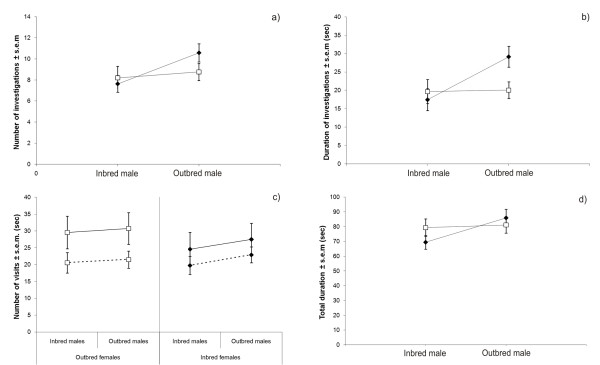
There is increasing interest to determine the relative importance of non-additive genetic benefits as opposed to additive ones for the evolution of mating preferences and maintenance of genetic variation in sexual ornaments. The 'good-genes-as-heterozygosity' hypothesis predicts that females should prefer to mate with more heterozygous males to gain more heterozygous (and less inbred) offspring. Heterozygosity increases males' sexual ornamentation, mating success and reproduction success, yet few experiments have tested whether females are preferentially attracted to heterozygous males, and none have tested whether females' own heterozygosity influences their preferences. Outbred females might have the luxury of being more choosey, but on the other hand, inbred females might have more to gain by mating with heterozygous males. We manipulated heterozygosity in wild-derived house mice (Mus musculus musculus) through inbreeding and tested whether the females are more attracted to the scent of outbred versus inbred males, and whether females' own inbreeding status affects their preferences. We also tested whether infecting both inbred and outbred males with Salmonella would magnify females' preferences for outbred males.
Females showed a significant preference for outbred males, and this preference was more pronounced among inbred females. We found no evidence that Salmonella infection increased the relative attractiveness of outbred versus inbred males; however, we found no evidence that inbreeding affected males' disease resistance in this study.
Our findings support the idea that females are more attracted to outbred males, and they suggest that such preferences may be stronger among inbred than outbred females, which is consistent with the 'good-genes-as-heterozygosity' hypothesis. It is unclear whether this odour preference reflects females' actual mating preferences, though it suggests that future studies should consider females' as well as males' heterozygosity. Our study has implications for efforts to understand how mate choice can provide genetic benefits without eroding genetic diversity (lek paradox), and also conservation efforts to determine the fitness consequences of inbreeding and the maintenance of genetic diversity in small, inbred populations.
相较于加性遗传益处,确定非加性遗传益处在交配偏好进化和维持性饰基因遗传变异中的相对重要性,引发了越来越多的关注。“杂合性即优质基因”假说预测,雌性应更倾向于与杂合性更高的雄性交配,以获得更多杂合(且近亲繁殖程度更低)的后代。杂合性会增加雄性的性饰特征、交配成功率和繁殖成功率,但很少有实验测试雌性是否会优先被杂合雄性所吸引,也没有实验测试雌性自身的杂合性是否会影响她们的偏好。远交雌性可能有更挑剔的资本,但另一方面,近交雌性与杂合雄性交配可能会获得更多益处。我们通过近亲繁殖操纵野生小家鼠(小家鼠指名亚种)的杂合性,并测试雌性是否会被远交雄性而非近交雄性的气味所吸引,以及雌性自身的近亲繁殖状态是否会影响她们的偏好。我们还测试了用沙门氏菌感染近交和远交雄性是否会增强雌性对远交雄性的偏好。
雌性对远交雄性表现出显著偏好,且这种偏好在近交雌性中更为明显。我们没有发现证据表明沙门氏菌感染会增加远交雄性相对于近交雄性的相对吸引力;然而,在本研究中我们也没有发现证据表明近亲繁殖会影响雄性的抗病能力。
我们的研究结果支持了雌性更被远交雄性吸引的观点,并且表明这种偏好在近交雌性中可能比远交雌性更强,这与“杂合性即优质基因”假说一致。目前尚不清楚这种气味偏好是否反映了雌性实际的交配偏好,不过这表明未来的研究应考虑雌性以及雄性的杂合性。我们的研究对于理解配偶选择如何在不侵蚀遗传多样性的情况下提供遗传益处(lek悖论),以及对于确定近亲繁殖的适合度后果和在小型近交种群中维持遗传多样性的保护工作都具有启示意义。