Sosenko Jay M, Palmer Jerry P, Rafkin-Mervis Lisa, Krischer Jeffrey P, Cuthbertson David, Mahon Jeffery, Greenbaum Carla J, Cowie Catherine C, Skyler Jay S
Division of Endocrinology, University of Miami, Miami, Florida, USA.
Diabetes Care. 2009 Sep;32(9):1603-7. doi: 10.2337/dc08-2140. Epub 2009 Jun 1.
We studied the incidence of dysglycemia and its prediction of the development of type 1 diabetes in islet cell autoantibody (ICA)-positive individuals. In addition, we assessed whether dysglycemia was sustained.
Participants (n = 515) in the Diabetes Prevention Trial-Type 1 (DPT-1) with normal glucose tolerance who underwent periodic oral glucose tolerance tests (OGTTs) were followed for incident dysglycemia (impaired fasting glucose, impaired glucose tolerance, and/or high glucose levels at intermediate time points of OGTTs). Incident dysglycemia at the 6-month visit was assessed for type 1 diabetes prediction.
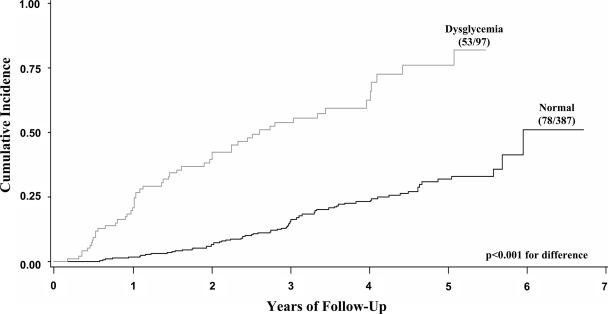
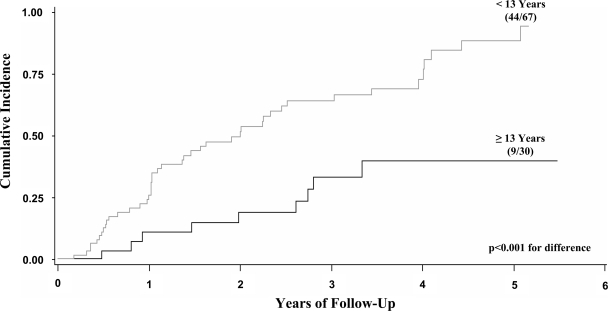
Of 515 participants with a normal baseline OGTT, 310 (60%) had at least one episode of dysglycemia over a maximum follow-up of 7 years. Dysglycemia at the 6-month visit was highly predictive of the development of type 1 diabetes, both in those aged <13 years (P < 0.001) and those aged > or =13 years (P < 0.01). Those aged <13 years with dysglycemia at the 6-month visit had a high cumulative incidence (94% estimate by 5 years). Among those who developed type 1 diabetes after a dysglycemic OGTT and who had at least two OGTTs after the dysglycemic OGTT, 33 of 64 (52%) reverted back to a normal OGTT. However, 26 (79%) of the 33 then had another dysglycemic OGTT before diagnosis.
ICA-positive individuals with normal glucose tolerance had a high incidence of dysglycemia. Incident dysglycemia in those who are ICA positive is strongly predictive of type 1 diabetes. Children with incident dysglycemia have an especially high risk. Fluctuations in and out of the dysglycemic state are not uncommon before the onset of type 1 diabetes.
我们研究了胰岛细胞自身抗体(ICA)阳性个体中血糖异常的发生率及其对1型糖尿病发生的预测作用。此外,我们评估了血糖异常是否持续存在。
对糖尿病预防试验1型(DPT-1)中515名糖耐量正常且接受定期口服葡萄糖耐量试验(OGTT)的参与者进行随访,观察血糖异常(空腹血糖受损、糖耐量受损和/或OGTT中间时间点血糖水平升高)的发生情况。评估6个月随访时的血糖异常情况对1型糖尿病的预测作用。
在515名基线OGTT正常的参与者中,310名(60%)在最长7年的随访中至少有一次血糖异常发作。6个月随访时的血糖异常对1型糖尿病的发生具有高度预测性,在年龄<13岁的人群中(P<0.001)以及年龄≥13岁的人群中(P<0.01)均如此。6个月随访时血糖异常的<13岁人群累积发病率较高(5年估计为94%)。在血糖异常OGTT后发生1型糖尿病且在血糖异常OGTT后至少进行了两次OGTT的人群中,64名中有