Chechlinska Magdalena, Siwicki Jan Konrad, Gos Monika, Oczko-Wojciechowska Malgorzata, Jarzab Michal, Pfeifer Aleksandra, Jarzab Barbara, Steffen Jan
Department of Immunology, Maria Sklodowska-Curie Memorial Cancer Centre and Institute of Oncology, Warsaw, Poland.
BMC Genomics. 2009 Jun 8;10:261. doi: 10.1186/1471-2164-10-261.
The molecular mechanisms of cell cycle exit are poorly understood. Studies on lymphocytes at cell cycle exit after growth factor deprivation have predominantly focused on the initiation of apoptosis. We aimed to study gene expression profile of primary and immortalised IL-2-dependent human T cells forced to exit the cell cycle by growth factor withdrawal, before apoptosis could be evidenced.
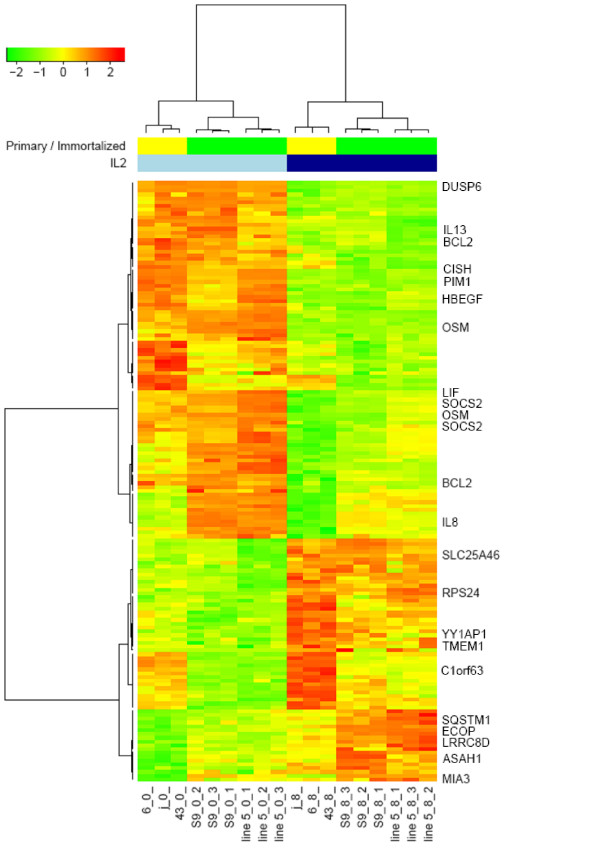
By the Affymetrix microarrays HG-U133 2.0 Plus, 53 genes were distinguished as differentially expressed before and soon after IL-2 deprivation. Among those, PIM1, BCL2, IL-8, HBEGF, DUSP6, OSM, CISH, SOCS2, SOCS3, LIF and IL13 were down-regulated and RPS24, SQSTM1, TMEM1, LRRC8D, ECOP, YY1AP1, C1orf63, ASAH1, SLC25A46 and MIA3 were up-regulated. Genes linked to transcription, cell cycle, cell growth, proliferation and differentiation, cell adhesion, and immune functions were found to be overrepresented within the set of the differentially expressed genes.
Cell cycle exit of the growth factor-deprived T lymphocytes is characterised by a signature of differentially expressed genes. A coordinate repression of a set of genes known to be induced during T cell activation is observed. However, growth arrest following exit from the cell cycle is actively controlled by several up-regulated genes that enforce the non-dividing state. The identification of genes involved in cell cycle exit and quiescence provides new hints for further studies on the molecular mechanisms regulating the non-dividing state of a cell, the mechanisms closely related to cancer development and to many biological processes.
细胞周期退出的分子机制尚不清楚。对生长因子剥夺后处于细胞周期退出阶段的淋巴细胞的研究主要集中在细胞凋亡的起始阶段。我们旨在研究在凋亡得以证实之前,因生长因子撤除而被迫退出细胞周期的原代和永生化白细胞介素-2依赖型人T细胞的基因表达谱。
通过Affymetrix HG-U133 2.0 Plus微阵列,53个基因被鉴定为在白细胞介素-2剥夺前后及之后不久差异表达。其中,PIM1、BCL2、IL-8、HBEGF、DUSP6、OSM、CISH、SOCS2、SOCS3、LIF和IL13表达下调,而RPS24、SQSTM1、TMEM1、LRRC8D、ECOP、YY1AP1、C1orf63、ASAH1、SLC25A46和MIA3表达上调。在差异表达基因集中发现与转录、细胞周期、细胞生长、增殖和分化、细胞黏附及免疫功能相关的基因占比过高。
生长因子剥夺的T淋巴细胞的细胞周期退出以差异表达基因的特征为标志。观察到一组已知在T细胞激活过程中被诱导的基因受到协同抑制。然而,退出细胞周期后的生长停滞由几个上调基因积极控制,这些基因维持非分裂状态。对参与细胞周期退出和静止的基因的鉴定为进一步研究调节细胞非分裂状态的分子机制提供了新线索,这些机制与癌症发展及许多生物学过程密切相关。