Laboratory of Human Genetics, Department of Molecular, Cellular and Animal Biology, University of Camerino, Camerino, Italy.
Curr Genomics. 2008 Nov;9(7):475-87. doi: 10.2174/138920208786241243.
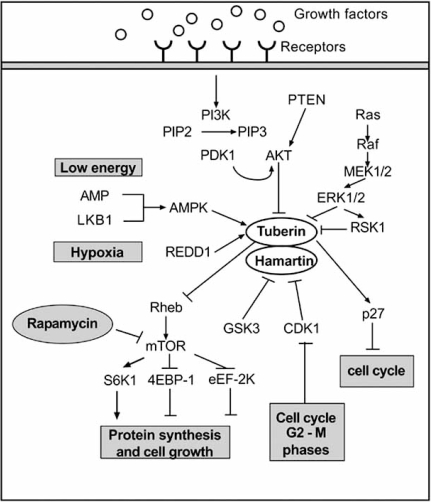
Tuberous Sclerosis Complex is a multisystem disorder exhibiting a wide range of manifestations characterized by tumour-like lesions called hamartomas in the brain, skin, eyes, heart, lungs and kidneys. Tuberous Sclerosis Complex is genetically determined with an autosomal dominant inheritance and is caused by inactivating mutations in either the TSC1 or TSC2 genes. TSC1/2 genes play a fundamental role in the regulation of phosphoinositide 3-kinase (PI3K) signalling pathway, inhibiting the mammalian target of rapamycin (mTOR) through activation of the GTPase activity of Rheb. Mutations in TSC1/2 genes impair the inhibitory function of the hamartin/tuberin complex, leading to phosphorylation of the downstream effectors of mTOR, p70 S6 kinase (S6K), ribosomal protein S6 and the elongation factor binding protein 4E-BP1, resulting in uncontrolled cell growth and tumourigenesis.Despite recent promising genetic, diagnostic, and therapeutic advances in Tuberous Sclerosis Complex, continuing research in all aspects of this complex disease will be pivotal to decrease its associated morbidity and mortality. In this review we will discuss and analyse all the important findings in the molecular pathogenesis of Tuberous Sclerosis Complex, focusing on genetics and the molecular mechanisms that define this multisystemic disorder.
结节性硬化症是一种多系统疾病,表现出广泛的表现,其特征是脑、皮肤、眼睛、心脏、肺和肾脏中的肿瘤样病变称为错构瘤。结节性硬化症具有常染色体显性遗传的遗传决定,是由 TSC1 或 TSC2 基因的失活突变引起的。TSC1/2 基因在调节磷酸肌醇 3-激酶 (PI3K) 信号通路中发挥着基础性作用,通过 Rheb 的 GTPase 活性激活来抑制雷帕霉素靶蛋白 (mTOR)。TSC1/2 基因突变损害了 hamartin/tuberin 复合物的抑制功能,导致 mTOR 的下游效应物 p70 S6 激酶 (S6K)、核糖体蛋白 S6 和延伸因子结合蛋白 4E-BP1 的磷酸化,导致失控的细胞生长和肿瘤发生。尽管结节性硬化症在遗传、诊断和治疗方面取得了最近的令人鼓舞的进展,但在该复杂疾病的所有方面进行持续研究对于降低其相关发病率和死亡率至关重要。在这篇综述中,我们将讨论和分析结节性硬化症分子发病机制的所有重要发现,重点关注遗传学和定义这种多系统疾病的分子机制。