
持续输注胰高血糖素样肽-1与结构化胰岛素输注方案在非禁食2型糖尿病患者中实现血糖正常化的疗效比较:一项临床试验试点研究
Efficacy of a continuous GLP-1 infusion compared with a structured insulin infusion protocol to reach normoglycemia in nonfasted type 2 diabetic patients: a clinical pilot trial.
作者信息
Sourij Harald, Schmölzer Isabella, Kettler-Schmut Eva, Eder Michaela, Pressl Helga, Decampo Antonella, Wascher Thomas C
机构信息
Division of Endocrinology and Nuclear Medicine, Department of Internal Medicine, Medical University of Graz, Graz, Austria.
出版信息
Diabetes Care. 2009 Sep;32(9):1669-71. doi: 10.2337/dc09-0475. Epub 2009 Jun 15.
OBJECTIVE
Continuously administered insulin is limited by the need for frequent blood glucose measurements, dose adjustments, and risk of hypoglycemia. Regimens based on glucagon-like peptide 1 (GLP-1) could represent a less complicated treatment alternative. This alternative might be advantageous in hyperglycemic patients hospitalized for acute critical illnesses, who benefit from near normoglycemic control.
RESEARCH DESIGN AND METHODS
In a prospective open randomized crossover trial, we investigated eight clinically stable type 2 diabetic patients during intravenous insulin or GLP-1 regimens to normalize blood glucose after a standardized breakfast.
RESULTS
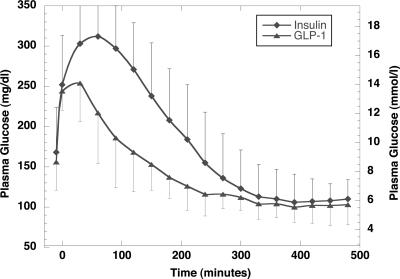
The time to reach a plasma glucose below 115 mg/dl was significantly shorter during GLP-1 administration (252 +/- 51 vs. 321 +/- 43 min, P < 0.01). Maximum glycemia (312 +/- 51 vs. 254 +/- 48 mg/dl, P < 0.01) and glycemia after 2 h (271 +/- 51 vs. 168 +/- 48 mg/dl, P = 0.012) and after 4 h (155 +/- 51 vs. 116 +/- 27 mg/dl, P = 0.02) were significantly lower during GLP-1 administration.
CONCLUSIONS
GLP-1 infusion is superior to an established insulin infusion regimen with regard to effectiveness and practicability.
目的
持续注射胰岛素存在诸多局限,如需要频繁测量血糖、调整剂量以及存在低血糖风险。基于胰高血糖素样肽1(GLP-1)的治疗方案可能是一种更为简便的替代方法。对于因急性危重症住院的高血糖患者而言,这种替代方法可能具有优势,这些患者可从接近正常血糖水平的控制中获益。
研究设计与方法
在一项前瞻性开放随机交叉试验中,我们对8例临床稳定的2型糖尿病患者进行了研究,观察他们在静脉注射胰岛素或GLP-1方案下,标准化早餐后血糖恢复正常的情况。
结果
在给予GLP-1期间,血糖降至115 mg/dl以下的时间显著缩短(252±51分钟对321±43分钟,P<0.01)。在给予GLP-1期间,最大血糖值(312±51对254±48 mg/dl,P<0.01)、2小时后血糖值(271±51对168±48 mg/dl,P = 0.012)以及4小时后血糖值(155±51对116±27 mg/dl,P = 0.02)均显著更低。
结论
在有效性和实用性方面,GLP-1输注优于既定的胰岛素输注方案。
 Zotero 插件