Dakin Steven C, Omigie Diana
UCL Institute of Ophthalmology, University College London, EC1V 9EL London, UK.
Vision Res. 2009 Sep;49(18):2285-96. doi: 10.1016/j.visres.2009.06.016. Epub 2009 Jun 23.
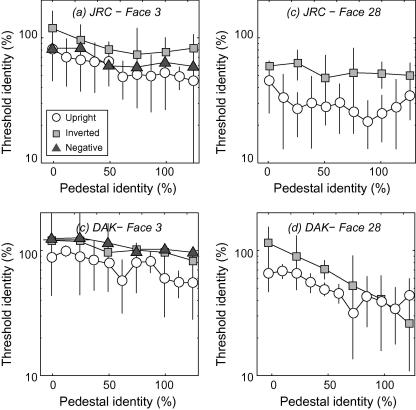
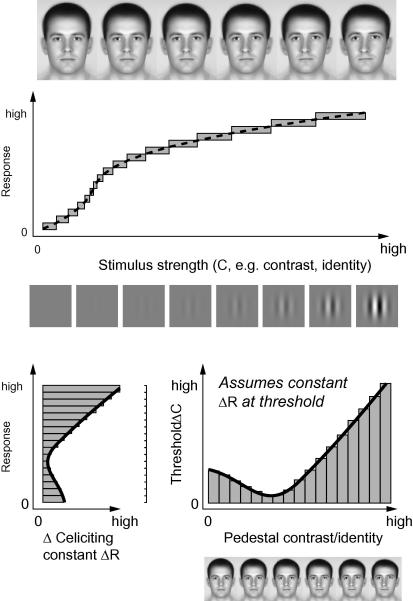
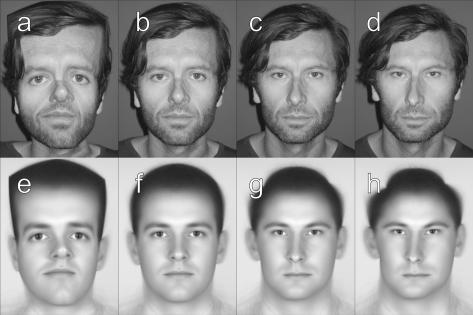
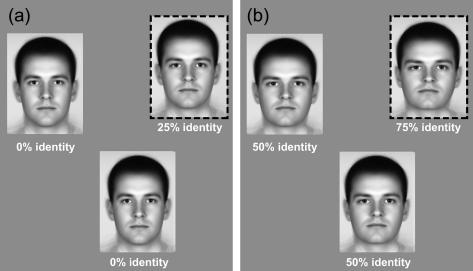
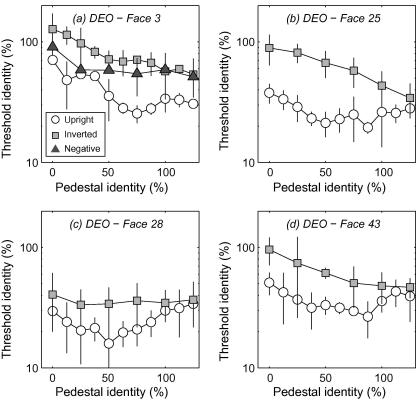
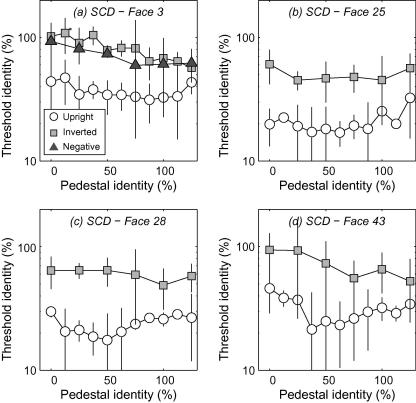
It has been proposed that faces are represented in the visual brain as points within a multi-dimensional "face space", with the average at its origin. We adapted a psychophysical procedure that measures non-linearities in contrast transduction (by measuring discrimination around different reference/pedestal levels of contrast) to examine the encoding of facial-identity within such a notional space. Specifically we had subjects perform identity discrimination at various pedestal levels of identity (varying from average/0% to caricature/125% identity) to derive "identity dipper functions". Results indicate that subjects are generally best at spotting identity change in neither average nor full-identity faces, but rather in faces containing an intermediate level of identity (which varies from face-to-face). The overall pattern of results is consistent with the neural encoding of faces involving a single modest non-linear transformation of identity that is consistent across faces and subjects, but that it scaled according to the distinctiveness of the face.
有人提出,在视觉大脑中,面孔是以多维“面孔空间”内的点来表示的,其原点为平均值。我们采用了一种心理物理学程序,该程序通过测量围绕不同对比度参考/背景水平的辨别力来测量对比度转换中的非线性,以检验在这样一个概念空间中面部身份的编码。具体而言,我们让受试者在各种身份背景水平(从平均/0%到漫画/125%身份)下进行身份辨别,以得出“身份勺状函数”。结果表明,受试者通常最不擅长在平均身份或完全身份的面孔中发现身份变化,而是在包含中等身份水平的面孔中(该水平因面孔而异)。结果的总体模式与面孔的神经编码一致,即涉及身份的单一适度非线性转换,这种转换在面孔和受试者之间是一致的,但会根据面孔的独特性进行缩放。