Department of Community and Preventive Medicine, Mount Sinai School of Medicine, New York, NY, USA.
Acad Pediatr. 2009 Sep-Oct;9(5):339-43. doi: 10.1016/j.acap.2009.05.003. Epub 2009 Jun 27.
Prior studies have shown an association between fast-food restaurants and adolescent body size. Less is known about the influence of neighborhood food stores on a child's body size. We hypothesized that in the inner-city, minority community of East Harlem, New York, the presence of convenience stores and fast-food restaurants near a child's home is associated with increased risk for childhood obesity as measured by body mass index (BMI).
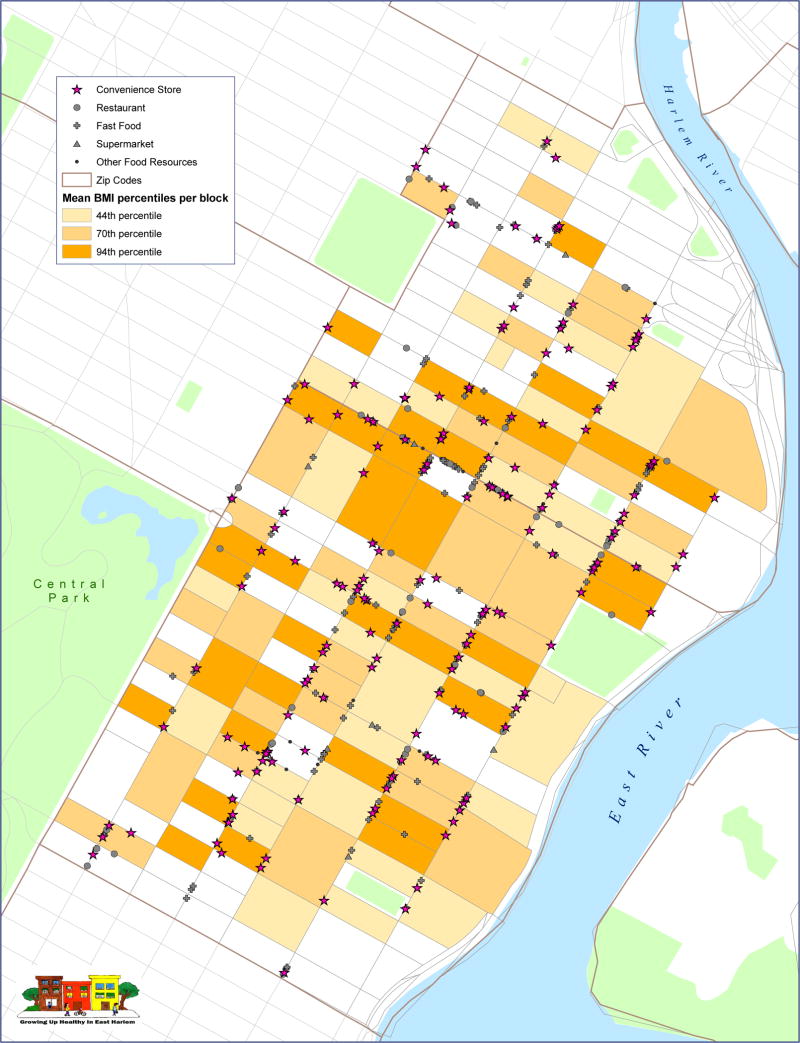
Baseline data of 6- to 8-year-old East Harlem boys and girls (N=323) were used. Anthropometry (height and weight) was conducted with a standardized protocol. Food-store data were collected via a walking survey. Stores located within the same census block as the child's home address were identified by using ArcGIS 8.3. We computed age- and sex-specific BMI percentiles by using national norms of the Centers for Disease Control and Prevention. Using odds ratios, we estimated risk of a child's BMI percentile being in the top tertile based on number and types of food stores on their census blocks.
Convenience stores were present in 55% of the surveyed blocks in which a study particpant lived and fast-food restaurants were present in 41%. Children (n=177) living on a block with 1 or more convenience stores (range, 1-6) were more likely to have a BMI percentile in the top tertile (odds ratio 1.90, 95% confidence interval, 1.15-3.15) compared with children having no convenience stores (n=146).
The presence of convenience stores near a child's residence was associated with a higher BMI percentile. This has potential implications for both child- and neighborhood-level childhood obesity interventions.
先前的研究表明,快餐店与青少年的体型有关。关于社区食品店对儿童体型的影响知之甚少。我们假设,在纽约东哈莱姆的这个城市中心、少数民族社区,儿童住所附近的便利店和快餐店的存在与儿童肥胖风险增加有关,肥胖风险通过体重指数(BMI)来衡量。
利用东哈莱姆 6 至 8 岁男孩和女孩的基线数据(N=323)。采用标准化协议进行人体测量学(身高和体重)。通过步行调查收集食品店数据。使用 ArcGIS 8.3 确定位于儿童家庭住址同一普查块内的商店。我们根据疾病控制与预防中心的国家规范计算了年龄和性别特异性 BMI 百分位数。使用比值比,我们根据其普查块上的食品店数量和类型,估算儿童 BMI 百分位数处于最高三分位数的风险。
在所调查的街区中,有 55%的街区有便利店,41%的街区有快餐店。居住在有 1 家或更多便利店的街区(范围为 1-6 家)的儿童(n=177),其 BMI 百分位数处于最高三分位数的可能性更高(比值比 1.90,95%置信区间,1.15-3.15),而没有便利店的儿童(n=146)则不然。
儿童住所附近便利店的存在与较高的 BMI 百分位数有关。这对儿童和社区层面的儿童肥胖干预都有潜在的影响。