Snehalatha Chamukuttan, Mary Simon, Selvam Sundaram, Sathish Kumar Cholaiyil Kizhakathil, Shetty Samith Babu Ananth, Nanditha Arun, Ramachandran Ambady
India Diabetes Research Foundation and Dr. A. Ramachandran's Diabetes Hospitals, Chennai, India.
Diabetes Care. 2009 Oct;32(10):1796-801. doi: 10.2337/dc09-0676. Epub 2009 Jul 8.
The Indian Diabetes Prevention Programme-1 (IDPP-1) showed that lifestyle modification (LSM) and metformin were effective for primary prevention of diabetes in subjects with impaired glucose tolerance (IGT). Among subjects followed up for 3 years (n = 502), risk reductions versus those for the control group were 28.5, 26.4, and 28.2% in LSM, metformin (MET), and LSM plus MET groups, respectively. In this analysis, the roles of changes in secretion and action of insulin in improving the outcome were studied.
For this analysis, 437 subjects (93 subjects with normoglycemia [NGT], 150 subjects with IGT, and 194 subjects with diabetes) were included. Measurements of anthropometry, plasma glucose, and plasma insulin at baseline and at follow-up were available for all of them. Indexes of insulin resistance (homeostasis model assessment of insulin resistance) and beta-cell function (insulinogenic index [DeltaI/G]: 30-min fasting insulin divided by 30-min glucose) were also analyzed in relation to the outcome.
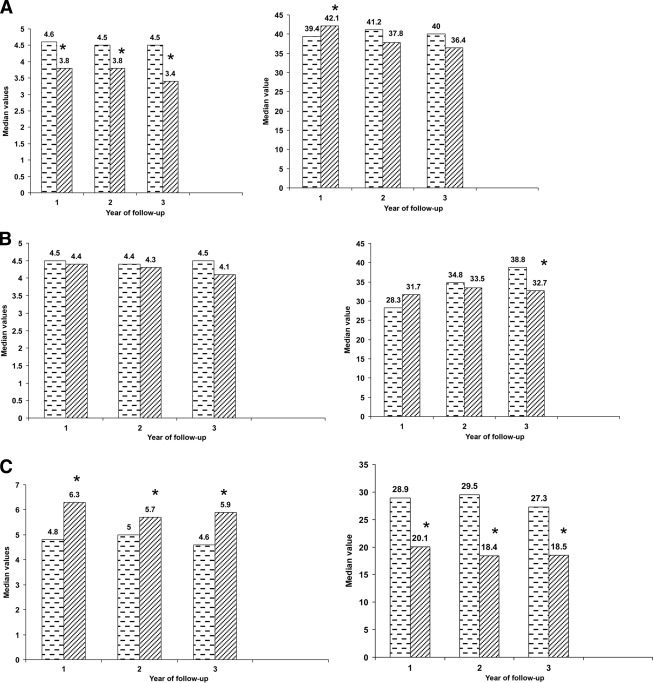
Subjects with IGT showed a deterioration in beta-cell function with time. Individuals with higher insulin resistance and/or low beta-cell function at baseline had poor outcome on follow-up. In relation to no abnormalities, the highest incidence of diabetes occurred when both abnormalities coexisted (54.9 vs. 33.7%, chi(2) = 7.53, P = 0.006). Individuals having abnormal insulin resistance (41.1%) or abnormal DeltaI/G (51.2%, chi(2) = 4.87, P = 0.027 vs. no abnormalities) had lower incidence. Normal beta-cell function with improved insulin sensitivity facilitated reversal to NGT, whereas deterioration in both resulted in diabetes. The beneficial changes were better with intervention than in the control group. Intervention groups had higher rates of NGT and lower rates of diabetes.
In the IDPP-1 subjects, beneficial outcomes occurred because of improved insulin action and sensitivity caused by the intervention strategies.
印度糖尿病预防计划-1(IDPP-1)表明,生活方式改变(LSM)和二甲双胍对糖耐量受损(IGT)受试者的糖尿病一级预防有效。在随访3年的受试者(n = 502)中,LSM组、二甲双胍(MET)组和LSM加MET组与对照组相比,风险降低分别为28.5%、26.4%和28.2%。在本分析中,研究了胰岛素分泌和作用的变化在改善结局中的作用。
纳入437名受试者(93名血糖正常[NGT]受试者、150名IGT受试者和194名糖尿病受试者)进行本分析。所有受试者均有基线和随访时的人体测量、血浆葡萄糖和血浆胰岛素测量数据。还分析了胰岛素抵抗指数(胰岛素抵抗稳态模型评估)和β细胞功能指数(胰岛素生成指数[DeltaI/G]:空腹30分钟胰岛素除以30分钟血糖)与结局的关系。
IGT受试者的β细胞功能随时间恶化。基线时胰岛素抵抗较高和/或β细胞功能较低的个体随访结局较差。与无异常情况相比,两种异常情况同时存在时糖尿病发病率最高(54.9%对33.7%,χ² = 7.53,P = 0.006)。胰岛素抵抗异常(41.1%)或DeltaI/G异常(51.2%,χ² = 4.87,P = 0.027,与无异常情况相比)的个体发病率较低。β细胞功能正常且胰岛素敏感性改善有助于逆转为NGT,而两者均恶化则导致糖尿病。干预组的有益变化比对照组更好。干预组NGT发生率较高,糖尿病发生率较低。
在IDPP-1受试者中,有益结局的出现是由于干预策略导致胰岛素作用和敏感性得到改善。