Muzumdar Jagannath M, Cline Richard R
Social and Administrative Pharmacy, College of Pharmacy, University of Minnesota, Minneapolis 55455, USA..
J Am Pharm Assoc (2003). 2009 Jul-Aug;49(4):e87-99. doi: 10.1331/JAPhA.2009.09007.
To provide an overview of supply and demand issues in the vaccine industry and the policy options that have been implemented to resolve these issues.
Medline, Policy File, and International Pharmaceutical Abstracts were searched to locate academic journal articles. Other sources reviewed included texts on the topics of vaccine history and policy, government agency reports, and reports from independent think tanks. Keywords included vaccines, immunizations, supply, demand, and policy.
Search criteria were limited to English language and human studies. Articles pertaining to vaccine demand, supply, and public policy were selected and reviewed for inclusion.
By the authors.
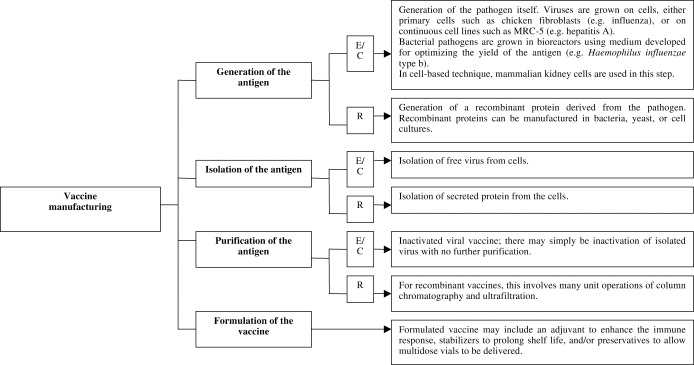
Vaccines are biologic medications, therefore making their development and production more difficult and costly compared with "small-molecule" drugs. Research and development costs for vaccines can exceed $800 million, and development may require 10 years or more. Strict manufacturing regulations and facility upgrades add to these costs. Policy options to increase and stabilize the supply of vaccines include those aimed at increasing supply, such as government subsidies for basic vaccine research, liability protection for manufacturers, and fast-track approval for new vaccines. Options to increase vaccine demand include advance purchase commitments, government stockpiles, and government financing for select populations.
High development costs and multiple barriers to entry have led to a decline in the number of vaccine manufacturers. Although a number of vaccine policies have met with mixed success in increasing the supply of and demand for vaccines, a variety of concerns remain, including developing vaccines for complex pathogens and increasing immunization rates with available vaccines. New policy innovations such as advance market commitments and Medicare Part D vaccine coverage have been implemented and may aid in resolving some of the problems in the vaccine industry.
概述疫苗行业的供需问题以及为解决这些问题而实施的政策选择。
检索了Medline、政策文件和国际药学文摘以查找学术期刊文章。审查的其他来源包括关于疫苗历史和政策的文本、政府机构报告以及独立智库的报告。关键词包括疫苗、免疫接种、供应、需求和政策。
检索标准限于英语语言和人体研究。选择并审查了与疫苗需求、供应和公共政策相关的文章以纳入研究。
由作者完成。
疫苗是生物药物,因此与“小分子”药物相比,其研发和生产更加困难且成本更高。疫苗的研发成本可能超过8亿美元,研发可能需要10年或更长时间。严格的生产法规和设施升级增加了这些成本。增加和稳定疫苗供应的政策选择包括旨在增加供应的措施,如政府对基础疫苗研究的补贴、对制造商的责任保护以及对新疫苗的快速审批。增加疫苗需求的选择包括预先采购承诺、政府储备以及对特定人群的政府资助。
高昂的研发成本和多重进入壁垒导致疫苗制造商数量减少。尽管一些疫苗政策在增加疫苗供应和需求方面取得了喜忧参半的成效,但仍存在各种问题,包括针对复杂病原体研发疫苗以及提高现有疫苗的免疫接种率。诸如预先市场承诺和医疗保险D部分疫苗覆盖等新的政策创新已经实施,可能有助于解决疫苗行业的一些问题。